Folklore & Legends
Will-o’-the-Wisp: Marsh Lights Between Chemistry and Folklore
Will-o’-the-wisp is a folklore category attached to real and misperceived lights, not one proven mechanism. New chemistry offers a plausible methane-ignition route while direct modern field measurements remain limited.
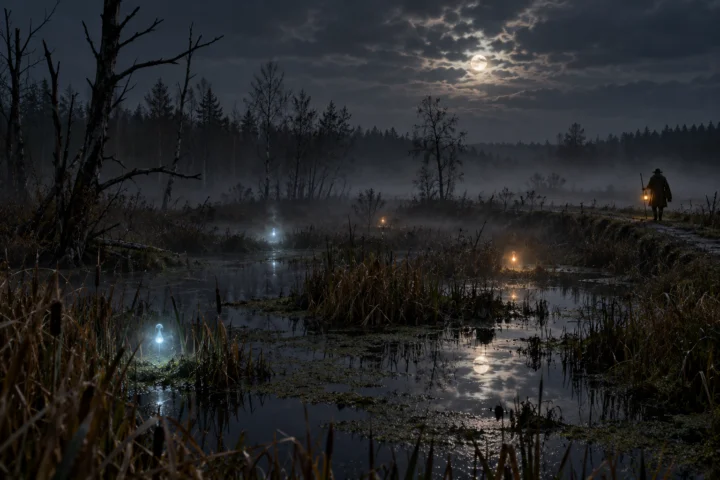
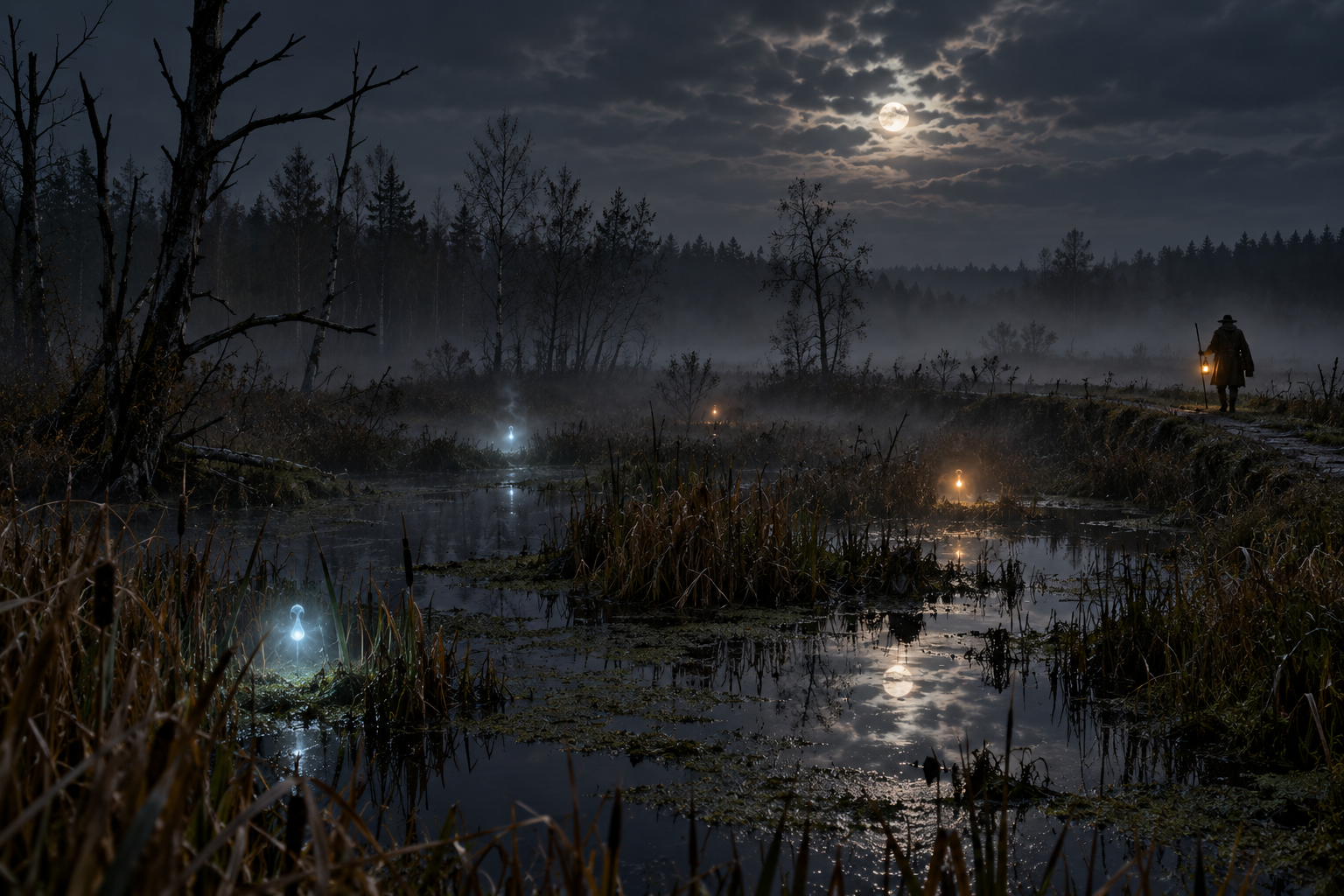
Across European wetlands, travellers described small lights that hovered, retreated or appeared to lead a walker from a safe path. English names include will-o’-the-wisp and jack-o’-lantern; Latin writers used ignis fatuus, “foolish fire.” Other cultures developed distinct names and moral interpretations.
Folklore made the light a deceptive spirit, wandering soul or lantern-bearing figure. Those stories encode a practical danger: following a light into marshland at night can end in drowning. A narrative role does not require every report to share one physical source.
Wetland decay produces methane, carbon dioxide and traces of phosphorus compounds. Methane does not ordinarily ignite by itself at ambient temperature, leaving the ignition step unresolved in many popular explanations. Laboratory work has now shown that microscopic charge differences among bubbles can create tiny electrical discharges and drive methane oxidation.
That mechanism is plausible, not a filmed identification of every historic wisp. Bioluminescent fungi, insects, distant lanterns, electrical phenomena, retinal effects and memory may account for other descriptions. Reports of a cold glow and a hot flame may not belong to one category.
The wisp connects natural observation in ball lightning, travelling legend in the vanishing hitchhiker, and variant analysis in folklore archives.
Claim, Context and Cautions
A category shaped by danger
Names and stories often portray agency because the light seems to respond when a traveller approaches. Relative motion, darkness and lack of distance cues can make a stationary source appear to retreat. Wind and changing gas release can move a flame, while a far human light may disappear behind vegetation.
The warning function is culturally real even when the lantern-bearer is not: stay on known paths through dangerous ground.
The marsh-gas problem
Anaerobic microbes generate methane in wet sediments. A conventional flame still needs oxygen and ignition, and pure phosphine is not automatically a complete answer under field conditions. Historical demonstrations and chemical hypotheses have not reproduced every reported colour, duration or motion.
A good explanation must specify gas concentration, mixing, energy source and why light remains visible without simply asserting “swamp gas.”
Microlightning and alternatives
Recent experiments found that colliding or separating microbubbles can exchange charge and produce very small sparks. In methane-and-air systems, those discharges initiated chemical reactions, supplying a potential natural ignition step. Scaling a laboratory result to a quiet marsh requires direct field measurements.
Cold chemiluminescence or bioluminescent organisms may produce dimmer glows. Owls, fireflies and human lights can enter the same narrative category despite different behaviour.
Why uncertainty should remain plural
Historical accounts were collected across centuries without standard measurements of spectrum, temperature, gas, range or weather. Some describe flames capable of ignition; others describe pale globes that vanish when approached. Combining them and demanding one explanation creates a problem nature may never have presented.
The justified conclusion is layered. Wetlands generate gases and multiple natural light sources; laboratory chemistry now demonstrates a credible microdischarge pathway; perception and folklore shape later reports. Direct instrumented observation of a classic marsh light remains scarce. Will-o’-the-wisp is therefore neither a single proven ghost nor a completely closed chemical event, but a durable meeting point between hazardous landscape, rare luminosity and storytelling.
Contextual glossary
Terms used in this entry
Definitions are offered as reading aids, not as conclusions about the case.
- Will-o’-the-wisp
- A wandering light reported over marshes and other dark landscapes and interpreted in many traditions as a spirit, omen or misleading guide. The name groups stories and observations that may not share one cause.
- Ball lightning
- A rare report of a luminous, usually short-lived sphere associated with storm conditions. The label is sometimes applied too broadly to any unexplained light near the ground.
- Bioluminescence
- Light produced by living organisms through a chemical reaction. Marine organisms can create glowing water, wakes or patches that look unfamiliar when their biological source is not visible.
- Uncertainty
- The stated limit on what a measurement, reconstruction or body of evidence can establish. Describing uncertainty is not indecision; it prevents a result from appearing more precise than the evidence allows.
- Oxidation
- A chemical process involving loss of electrons, commonly seen when iron-bearing material reacts to form rust-coloured compounds. It can change the colour of water, rock, metal and biological deposits.
Reference trail
Sources
- Royal Society of Chemistry, The Ignis Fatuus or Will o’ the Wisp (opens in a new tab)Scientific synthesis of historical observations and competing combustion, chemiluminescent and biological mechanisms.
- Philosophical Transactions A via PubMed, Will-o’-the-Wisp review (opens in a new tab)Peer-reviewed review stressing the lack of modern field analysis and limits of proposed explanations.
- Stanford Chemistry, microlightning and methane oxidation (opens in a new tab)University summary of experiments showing microbubble electrical discharge and a possible ignition pathway.
Case Book
Photographs, Maps and Supporting Images
Supporting images provide documentary, geographic or visual context. Read each caption for its date, source and evidential limits.

Continue researching
Follow the evidence, context and comparisons
Curated connections
Selected editorially for this entry.
Ball lightning is a label for rare luminous events reported near thunderstorms. Instrumental observations constrain some cases, while varied testimony and competing physical models leave its full scope unresolved.
Curated connection · Case fileThe Vanishing Hitchhiker: Anatomy of a Travelling LegendVanishing-hitchhiker stories are documented folklore rather than one verified recurring event. Their changing details, local authentication and older supernatural motifs reveal how a modern legend acquires credibility.
Curated connection · ArticleFrom Tale to Archive: How Folklorists Track a StoryFolklore archives preserve voices and contexts as well as plots. Responsible comparison follows provenance, language, collector influence and variation before proposing historical relationships.
More through shared context
Additional routes based only on existing topics, themes and metadata.
The Lake Nyos disaster was caused by a limnic eruption: deep water saturated with volcanic carbon dioxide overturned and released a dense, suffocating cloud.
Shared theme: Atmosphere & optics · Case fileThe Battle of Los Angeles: Searchlights, Shells and Wartime NervesIn February 1942, Los Angeles saw searchlights, anti-aircraft fire and rumours of enemy aircraft in a case where fear, weather and uncertainty lit up the sky.