Folklore & Legends
From Tale to Archive: How Folklorists Track a Story
Folklore archives preserve voices and contexts as well as plots. Responsible comparison follows provenance, language, collector influence and variation before proposing historical relationships.
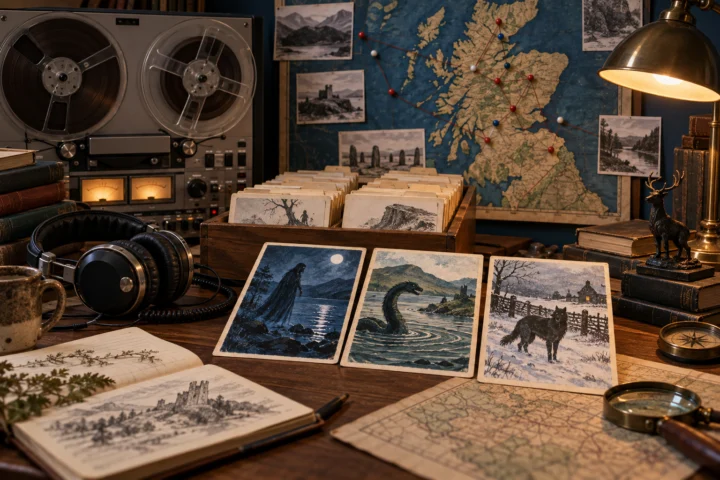
A folktale does not enter an archive as a weightless plot. Someone performs it at a particular time, in a language and place, for a collector using particular equipment and questions. The recording captures a relationship as well as a story.
Archivists preserve the audio, catalogue its speaker, collector, date and location, and sometimes add a transcript or translation. Missing context matters. A polished typescript copied from an earlier book is not equivalent to a field recording in which pauses, dialect and audience response remain audible.
Folklorists compare variants: related performances that share motifs or structure while changing characters, places and outcomes. Tale-type and motif indexes make large collections searchable, but their categories are tools rather than natural laws. An index can conceal local meaning if its international label becomes the conclusion.
Digital access allows communities and researchers to hear source recordings once confined to a reading room. It also raises rights, consent and cultural-sensitivity questions. Public availability does not erase a performer’s authorship or a community’s authority over restricted knowledge.
The method clarifies changing traditions such as the vanishing hitchhiker, mapped place-lore in fairy geography, and the print circulation examined in newspapers spreading strange tales.
Claim, Context and Cautions
Preserve provenance before plot
Useful metadata records who spoke, who recorded, where, when, in which language, and whether the item was learned orally, read, or prompted. A title supplied later by a cataloguer should not be mistaken for the performer's own name. Original audio lets later listeners test a transcript and hear tone or interruption.
Without provenance, two identical texts may look like independent tradition when both came from the same printed collection.
What a variant can show
Repeated unusual details can support a relationship among performances, while common motifs may arise widely. Dates set limits: an archived version proves circulation no later than its recording, not the age claimed within the tale. Geographic clusters may reflect transmission, collector coverage or catalogue language.
A family tree is therefore a hypothesis. Oral stories can borrow across branches, return from print to speech and merge with local events.
Indexes help and distort
The Aarne–Thompson–Uther tale-type system and motif indexes enable comparison across thousands of items. They foreground recurring narrative units, but a performance may fit several types or none. Classification created around European collections can poorly describe another tradition.
Researchers should cite both the index term and the underlying item. Counting classifications without listening to the stories can mistake cataloguing practice for cultural frequency.
Archives are living relationships
Digitisation reduces distance but not responsibility. Names, sacred material, grief and family allegations may require permission or restriction. Translation should retain the original language and identify choices instead of presenting one English rendering as the story itself.
The strongest historical conclusion often traces documented change: which version was recorded, what it shares, and what the performer made new. Folklore persists because people reshape it. Variation is not corruption to be stripped away in search of a perfect original; it is central evidence of how a community remembers, entertains and argues. Repositories should preserve withdrawn access decisions and catalogue revisions so future users can see how stewardship itself changed.
Contextual glossary
Terms used in this entry
Definitions are offered as reading aids, not as conclusions about the case.
- Provenance
- The documented history of an object’s origin, ownership, location and handling. A dramatic claim with weak provenance cannot reliably establish where or when an object came from.
- Tale type
- A classification for a complete traditional story built from a recognisable sequence of motifs. Different performances can belong to one type without having identical wording or details.
- Oral tradition
- Knowledge and narrative transmitted mainly through speech and performance across people or generations. Variation is part of the tradition and should not automatically be treated as corruption.
- Metadata
- Information stored about a record, such as its creation time, device, location, format or editing history. Metadata can support provenance but may be missing, altered or copied incorrectly.
- Variant
- A particular version of a story, belief or custom recorded from one teller, place or occasion. Differences between variants show how tradition is adapted and transmitted.
Reference trail
Sources
- Oral Tradition, Dipping into the Well: Scottish Oral Tradition Online (opens in a new tab)Peer-reviewed account of archive digitisation, metadata, access and interpretation.
- University of Edinburgh Library, School of Scottish Studies Sound Archives (opens in a new tab)Institutional discussion of recorded folklore collections and research routes.
- Scottish Records Association, School of Scottish Studies Archives (opens in a new tab)Archive history, scale and stewardship context for recordings, photographs and field notes.
Case Book
Photographs, Maps and Supporting Images
Supporting images provide documentary, geographic or visual context. Read each caption for its date, source and evidential limits.

Continue researching
Follow the evidence, context and comparisons
Curated connections
Selected editorially for this entry.
Vanishing-hitchhiker stories are documented folklore rather than one verified recurring event. Their changing details, local authentication and older supernatural motifs reveal how a modern legend acquires credibility.
Curated connection · ArticleFairy Lore as Local GeographyHills, rings, paths and boundaries often matter more than wings or glitter in older fairy traditions.
Curated connection · ArticleThe Role of Newspapers in Spreading Strange TalesOld newspapers preserved remarkable local reports, but they also shaped them for appetite, humour and alarm.