Scientific Anomalies & Natural Phenomena
Lake Nyos: The Night a Lake Released a Silent Cloud
The Lake Nyos disaster was caused by a limnic eruption: deep water saturated with volcanic carbon dioxide overturned and released a dense, suffocating cloud.
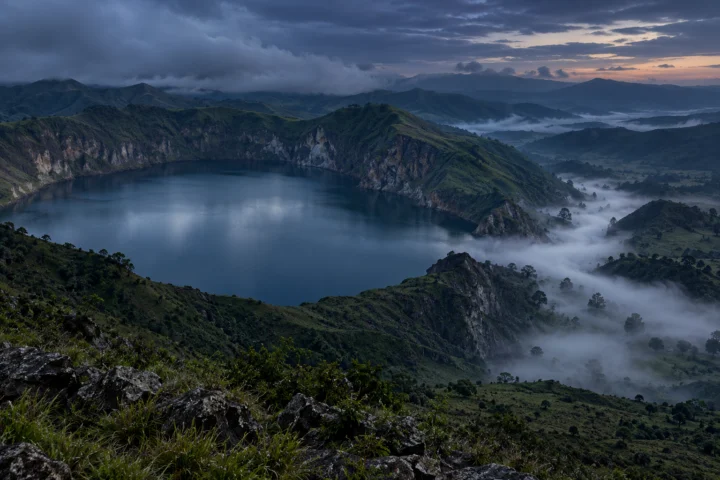
On the evening of 21 August 1986, people and animals in valleys below Lake Nyos in Cameroon collapsed without warning. More than 1,700 people died. Buildings were largely intact and there was no lava flow or explosive blast to explain the pattern.
Investigators found that the deep crater lake held large quantities of dissolved carbon dioxide supplied through the volcanic system beneath it. When the water column overturned, gas came out of solution rapidly. The dense cloud spilled over the lake rim and travelled downhill, displacing breathable air in low ground.
This process is called a limnic eruption. It is rare because it requires a deep, stratified lake, a continuing gas source and conditions that allow dissolved gas to accumulate. The precise trigger for the 1986 overturn—landslide, cooling, wind or internal instability—remains less certain than the cause of death.
Lake Nyos can be compared with the atmospheric consequences of Tunguska, the measurement lessons of Hessdalen, and the archive’s separation of observation from interpretation.
Claim, Context and Cautions
A disaster without visible destruction
Victims were found across villages and grazing land while many structures remained standing. Survivors described loss of consciousness, breathing difficulty and an unusual quiet. The topographic pattern followed low valleys rather than a blast radius.
Those observations directed investigators towards a dense asphyxiating gas rather than conventional eruption, warfare or epidemic.
Carbon dioxide stored at depth
Rain and groundwater enter the lake while volcanic carbon dioxide seeps upward. At depth, pressure allows large amounts of gas to dissolve, much as pressure keeps gas in a sealed bottle. Stable layering prevents frequent mixing with the surface.
Over time, the lower water can approach saturation. That stored chemical condition was measured after the disaster.
Runaway release
If gas-rich deep water rises, pressure falls and bubbles form. The bubbles make the water more buoyant, lifting it faster and releasing still more gas. This feedback can overturn a large part of the lake in a short period.
Carbon dioxide is colourless and denser than air. A concentrated cloud can therefore hug the ground and collect in valleys while leaving little visible trace after dispersal.
Trigger versus mechanism
Proposed triggers include a landslide, strong wind, cooling rain or spontaneous instability in the water column. Evidence for the initiating event is incomplete. The dissolved-gas mechanism, by contrast, is supported by lake chemistry, physical modelling and the distribution of casualties.
Uncertainty about the first disturbance does not make the entire disaster unexplained.
Engineering a safer lake
Degassing pipes were installed to bring deep water upward in controlled flows, allowing carbon dioxide to escape gradually. Monitoring also considers the natural dam and continuing gas supply.
Lake Nyos matters because a seemingly impossible event became a measurable environmental hazard. The lesson is not that the lake was supernatural, but that rare processes can be lethal before they are recognised.
Contextual glossary
Terms used in this entry
Definitions are offered as reading aids, not as conclusions about the case.
- Limnic eruption
- A rare, sudden release of dissolved gas from deep lake water. Carbon dioxide can flow downslope as an invisible, oxygen-displacing cloud, as occurred at Lake Nyos in 1986.
- Uncertainty
- The stated limit on what a measurement, reconstruction or body of evidence can establish. Describing uncertainty is not indecision; it prevents a result from appearing more precise than the evidence allows.
Reference trail
Sources
- U.S. Geological Survey, Lake Nyos disaster report (opens in a new tab)Near-contemporary scientific investigation of the lake, gas release, casualty pattern and competing triggers.
- Smithsonian Global Volcanism Program, Lake Nyos (opens in a new tab)Authoritative geological context and eruption/event record for the volcanic lake.
- PubMed, medical report on the Lake Nyos disaster (opens in a new tab)Peer-reviewed medical record of survivor effects and the asphyxiating gas explanation.
- CDC MMWR archive, Lake Nyos disaster (opens in a new tab)Public-health account used for casualty and clinical context.
Case Book
Photographs, Maps and Supporting Images
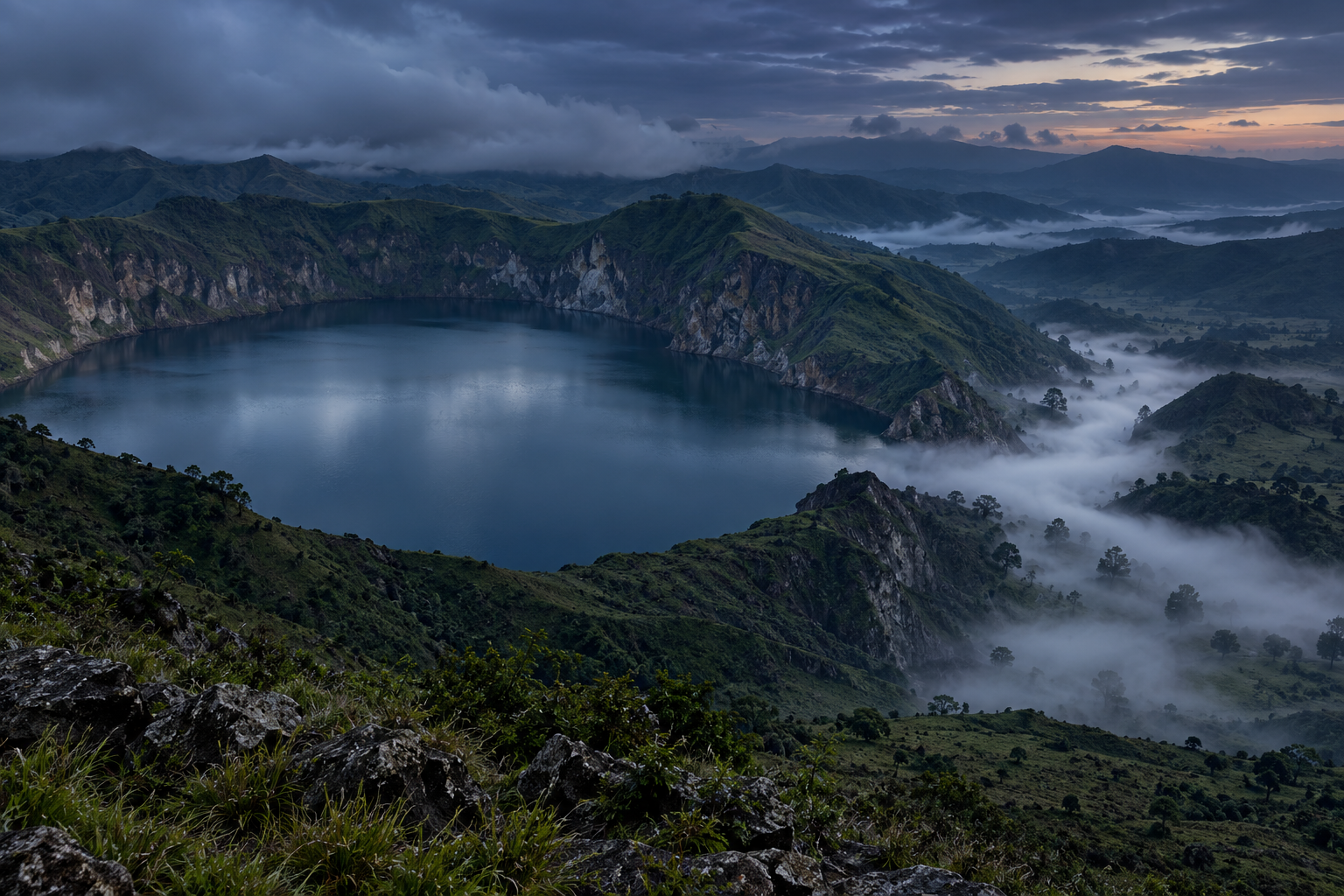
Supporting images provide documentary, geographic or visual context. Read each caption for its date, source and evidential limits.

Continue researching
Follow the evidence, context and comparisons
Curated connections
Selected editorially for this entry.
A 1908 blast over Siberia flattened forest without leaving a classic impact crater, making Tunguska a cornerstone case in anomaly, science and myth.
Curated connection · Case fileThe Hessdalen Lights: A Valley Under ObservationHessdalen’s recurring lights prompted field campaigns and automatic monitoring after a wave in the early 1980s. The label covers mixed observations, not one proven phenomenon.
Curated connection · ArticleThe Difference Between Evidence, Testimony and LegendA field guide to three words that often get tangled in mystery research.
More through shared context
Additional routes based only on existing topics, themes and metadata.
Ball lightning is a label for rare luminous events reported near thunderstorms. Instrumental observations constrain some cases, while varied testimony and competing physical models leave its full scope unresolved.
Same primary topic · Shared theme: Atmosphere & optics · Case fileThe Marfa Lights: Distance, Headlights and a Desert HorizonThe Marfa Lights combine a modern roadside observation problem with older local folklore. Headlights and atmospheric effects explain much of the repeatable display without resolving every anecdote.