Scientific Anomalies & Natural Phenomena
The Marfa Lights: Distance, Headlights and a Desert Horizon
The Marfa Lights combine a modern roadside observation problem with older local folklore. Headlights and atmospheric effects explain much of the repeatable display without resolving every anecdote.
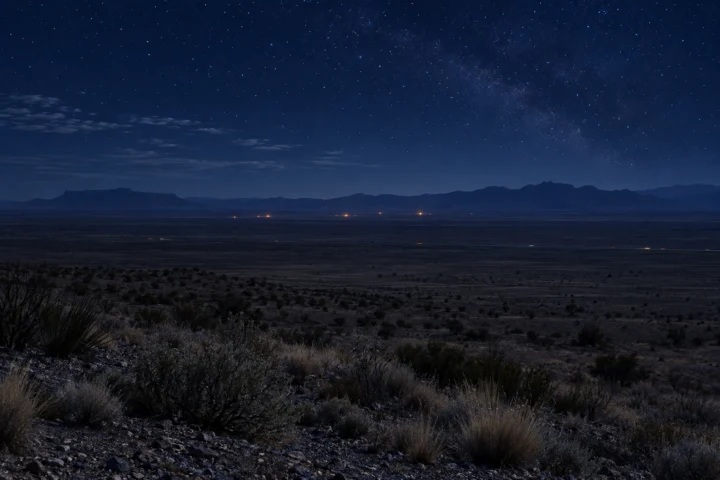
East of Marfa, Texas, observers look south-west across Mitchell Flat for lights said to hover, move, separate or disappear. The public viewing area faces a landscape with long sightlines, uneven terrain and distant roads. At night, those features make range and height unusually hard to judge.
A local tradition places sightings in the nineteenth century, often through a later recollection attributed to rancher Robert Reed Ellison. The historical claim matters as folklore, but it was not recorded with the precision of a modern observing log. Today’s repeatable lights frequently coincide with vehicle routes, particularly traffic on US 67.
Headlights seen through layers of warm and cool air can brighten, distort and appear displaced. Terrain can hide the vehicle while leaving its light visible. That explanation accounts for a large share of what visitors photograph; it need not explain every personal report made across different locations and decades.
Marfa offers a useful comparison with the instrumented Hessdalen Lights, the sound-localisation problem of the Taos Hum, and the archive’s guide to ordinary lights in extraordinary reports.
Claim, Context and Cautions
A landscape built for uncertain distance
Mitchell Flat offers few illuminated objects whose known size can anchor a night-time estimate. A light may seem to float because its road, vehicle and surrounding ground are invisible. Small changes in brightness can then look like approach, retreat or division.
The viewing geometry is evidence, not dismissal. It predicts when and where ordinary traffic should become difficult to recognise.
The Ellison tradition
Accounts commonly say that Robert Reed Ellison saw unexplained lights in 1883 while crossing Paisano Pass. The story is important to Marfa's identity, but the surviving public versions are retrospective and vary in detail.
It cannot be treated as a timed nineteenth-century instrument observation. It shows that the tradition has depth, while leaving its earliest wording uncertain.
Traffic and atmospheric refraction
Field observers have matched many lights with vehicles on distant highways. Headlights may be visible before the car itself emerges, and refraction in temperature gradients can shift or stretch an image near the horizon. Multiple cars create apparent splitting and recombination.
This model is testable through bearings, schedules and simultaneous observation near the road—features absent from many dramatic anecdotes.
Reports outside the traffic model
Residents describe lights in locations or periods they believe do not align with modern roads. Some may involve ranch lights, trains, aircraft, stars, fires or memories whose original viewing position is no longer recoverable.
A residual story is not automatically a residual physical phenomenon. Each observation needs its own geometry and time.
Why Marfa remains worth watching
The site allows repeated, comparative observation rather than reliance on one vanished event. That makes it valuable for studying perception, atmospheric optics and the way expectations shape a night watch.
The evidence supports a strong ordinary explanation for many modern displays and a broader folklore that cannot be reduced to one dataset. It does not establish an unknown energy or craft.
Contextual glossary
Terms used in this entry
Definitions are offered as reading aids, not as conclusions about the case.
- Atmospheric refraction
- The bending of light as it passes through air layers of different density. It can shift, stretch or distort the apparent position and shape of distant lights, stars and landscape features.
Reference trail
Sources
- Texas State Historical Association, “Marfa Lights” (opens in a new tab)State historical reference for the tradition, geography and development of public interest.
- Texas Highways, “The Mysterious Marfa Lights” (opens in a new tab)Regional reporting on observation conditions, local testimony and the public viewing site.
- Visit Big Bend, Marfa Lights viewing information (opens in a new tab)Regional visitor information used for the viewing geometry and road-facing location; not treated as scientific proof.
Case Book
Photographs, Maps and Supporting Images
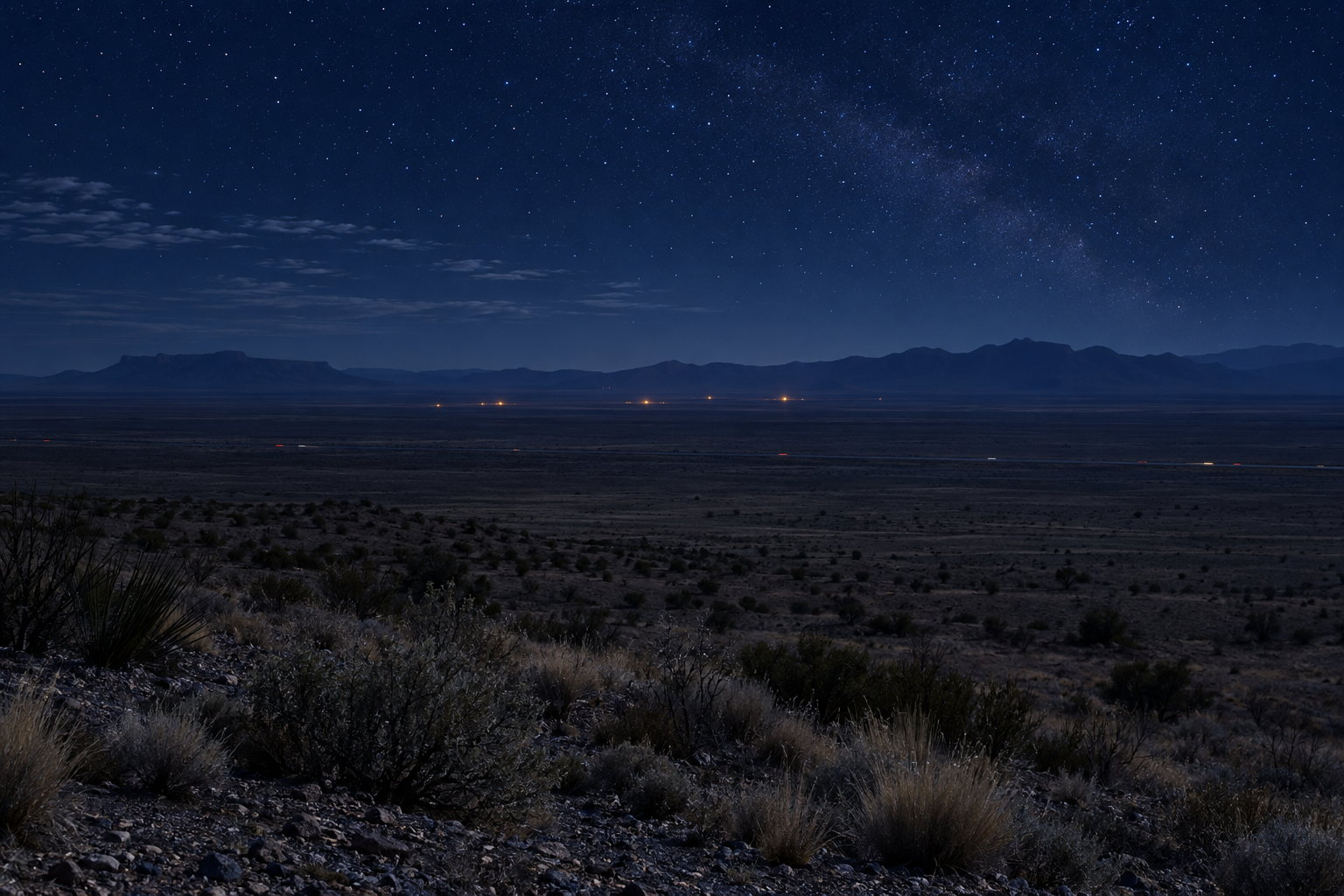
Supporting images provide documentary, geographic or visual context. Read each caption for its date, source and evidential limits.

Continue researching
Follow the evidence, context and comparisons
Curated connections
Selected editorially for this entry.
Hessdalen’s recurring lights prompted field campaigns and automatic monitoring after a wave in the early 1980s. The label covers mixed observations, not one proven phenomenon.
Curated connection · Case fileThe Taos Hum: A Sound the Instruments Could Not ShareThe Taos Hum became a public problem in the early 1990s when residents described a distant-engine sound. Researchers documented sincere reports but found no common external source.
Curated connection · ArticleHow Ordinary Lights Become Extraordinary UFO ReportsAircraft, satellites, planets, drones and atmospheric effects can become strange when context is missing.
More through shared context
Additional routes based only on existing topics, themes and metadata.
Ball lightning is a label for rare luminous events reported near thunderstorms. Instrumental observations constrain some cases, while varied testimony and competing physical models leave its full scope unresolved.
Same primary topic · Shared theme: Atmosphere & optics · Case fileLake Nyos: The Night a Lake Released a Silent CloudThe Lake Nyos disaster was caused by a limnic eruption: deep water saturated with volcanic carbon dioxide overturned and released a dense, suffocating cloud.