UFOs & Aerial Phenomena
The Hessdalen Lights: A Valley Under Observation
Hessdalen’s recurring lights prompted field campaigns and automatic monitoring after a wave in the early 1980s. The label covers mixed observations, not one proven phenomenon.
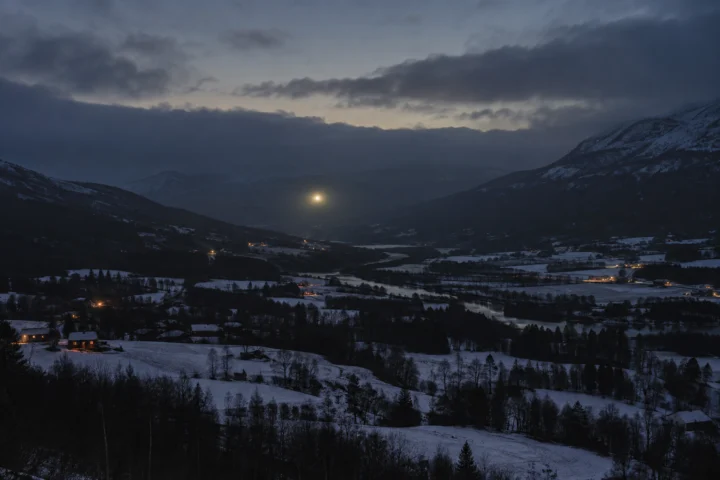
Hessdalen is a Norwegian valley where residents and researchers have reported luminous phenomena for decades. Interest intensified between 1981 and 1985, when sightings became frequent enough to prompt an organised field campaign. The name now covers brief flashes, moving lights, long-lived glows and observations later attributable to ordinary sources.
Project Hessdalen’s 1984 campaign and the automatic station installed in 1998 turned part of the story into a monitoring problem. Photographs and instrument readings are more useful than memory alone, but they do not show that every light has the same cause. Some records are incomplete, and claims involving radar or spectra depend on the quality and calibration of particular observations.
Plasma, charged dust and geochemical or electrical processes have been proposed. These are research hypotheses, not an agreed explanation. Vehicle headlights, aircraft, stars and camera artefacts also account for part of the catalogue.
Useful comparisons include the archive’s guide to ordinary lights in extraordinary reports, perception and expertise, and the distinction between evidence, testimony and legend.
Claim, Context and Cautions
A wave becomes a research project
Although local histories place unusual lights earlier, the surge beginning in 1981 created the modern case. Residents sometimes reported several sightings in a week. In January and February 1984, volunteers conducted an 18-day field campaign using cameras, radar and other instruments. The project's published tally classified 53 observations as the target phenomenon.
A count made by a project is not a count of unknown physical objects. It records events that met its working criteria. The campaign nevertheless established repeat observation, location and instrumentation as goals rather than relying only on retrospective anecdotes.
What “the Hessdalen phenomenon” contains
Descriptions include white or yellow lights, coloured flashes and luminous forms that appear stationary or move through the valley. Durations and apparent behaviours vary. This diversity may reflect several mechanisms, different viewing conditions and mistaken identifications gathered under one convenient name.
Treating the label as a single object creates false consistency. A headlight seen along a distant road and an unusual luminous transient can both enter an early report set, but resolving one says nothing automatic about the other.
Measurements and their limits
Long-term work has used photography, video, radar, magnetometers, optical instruments and automatic cameras. Some studies report correlated or spectroscopic observations worthy of follow-up. Instrumentation reduces certain ambiguities, yet isolated readings remain sensitive to calibration, geometry, contamination and the lack of simultaneous independent sensors.
The automatic Blue Box, installed in 1998, is important because it permits continuing records. It has not produced a single diagnostic signature that resolves every class of sighting.
Mundane lights belong in the dataset
Field investigators have reproduced some apparent phenomena with vehicle headlights on distant roads. Aircraft, planets, stars, satellites and camera effects are also necessary controls. Removing such cases is not an embarrassment; it is how a broad sighting catalogue becomes a useful residual problem.
Witness confidence cannot supply distance to a point of light. Without distance, speed and size estimates can change dramatically. Terrain, winter atmosphere and unfamiliar viewing angles make precise triangulation especially valuable.
Natural hypotheses under test
Researchers have discussed ionised gas, dusty plasma and electrical effects involving the valley's geology and atmosphere. A 2010 paper presented a dusty-plasma model while acknowledging that no existing model explained all contradictory observations. A 2024 geophysical survey tested subsurface–atmosphere ideas but did not capture a luminous event during the measurements.
These studies make the case scientifically interesting. They should not be promoted from possible mechanisms to confirmed causes. A hypothesis earns preference only when it predicts repeatable observations better than its alternatives.
Why unanswered does not mean extraterrestrial
No verified evidence requires spacecraft, intelligent control or a single exotic object. The most defensible description is a mixed catalogue: identifiable conventional lights, reports too weak to classify, and a smaller set of luminous observations for which natural mechanisms remain under investigation.
Hessdalen matters because observation continued after the headlines. Its value lies in better cameras, longer baselines and explicit uncertainty. The valley is not proof that mystery defeats measurement; it is an example of how measurement can make a mystery narrower and more precise.
Contextual glossary
Terms used in this entry
Definitions are offered as reading aids, not as conclusions about the case.
- Contamination
- The introduction of outside material or information into evidence. It may affect DNA, objects, recordings or witness accounts and must be considered before treating a match as independent.
- Triangulation
- Locating a point from measurements made at known positions, often using directions or distances. Informal estimates from witnesses are not equivalent to surveyed angles with synchronised timing.
- Uncertainty
- The stated limit on what a measurement, reconstruction or body of evidence can establish. Describing uncertainty is not indecision; it prevents a result from appearing more precise than the evidence allows.
Reference trail
Sources
- Project Hessdalen: official project history and observations (opens in a new tab)Project-run archive describing the early-1980s wave, 1984 field campaign and continuing automatic monitoring.
- Project Hessdalen, “Project Hessdalen 1984—Final Technical Report” (opens in a new tab)Project report for the 18-day 1984 campaign, its methods and classified observations.
- Gerson Paiva and Carlton Taft, “Hessdalen lights: a possible dusty plasma phenomenon” (JASTP, 2010) (opens in a new tab)Peer-reviewed physical hypothesis that explicitly does not explain every reported observation.
- Bjørn Gitle Hauge, “Investigation and analysis of transient luminous phenomena in the low atmosphere of Hessdalen valley” (Acta Astronautica, 2010) (opens in a new tab)Peer-reviewed analysis of long-term instrumental observations and transient luminous reports.
- Journal of Applied Geophysics, VLF survey of Hessdalen (2024) (opens in a new tab)Recent geophysical survey testing subsurface–atmosphere interaction; no light event was captured during the survey.
Case Book
Photographs, Maps and Supporting Images
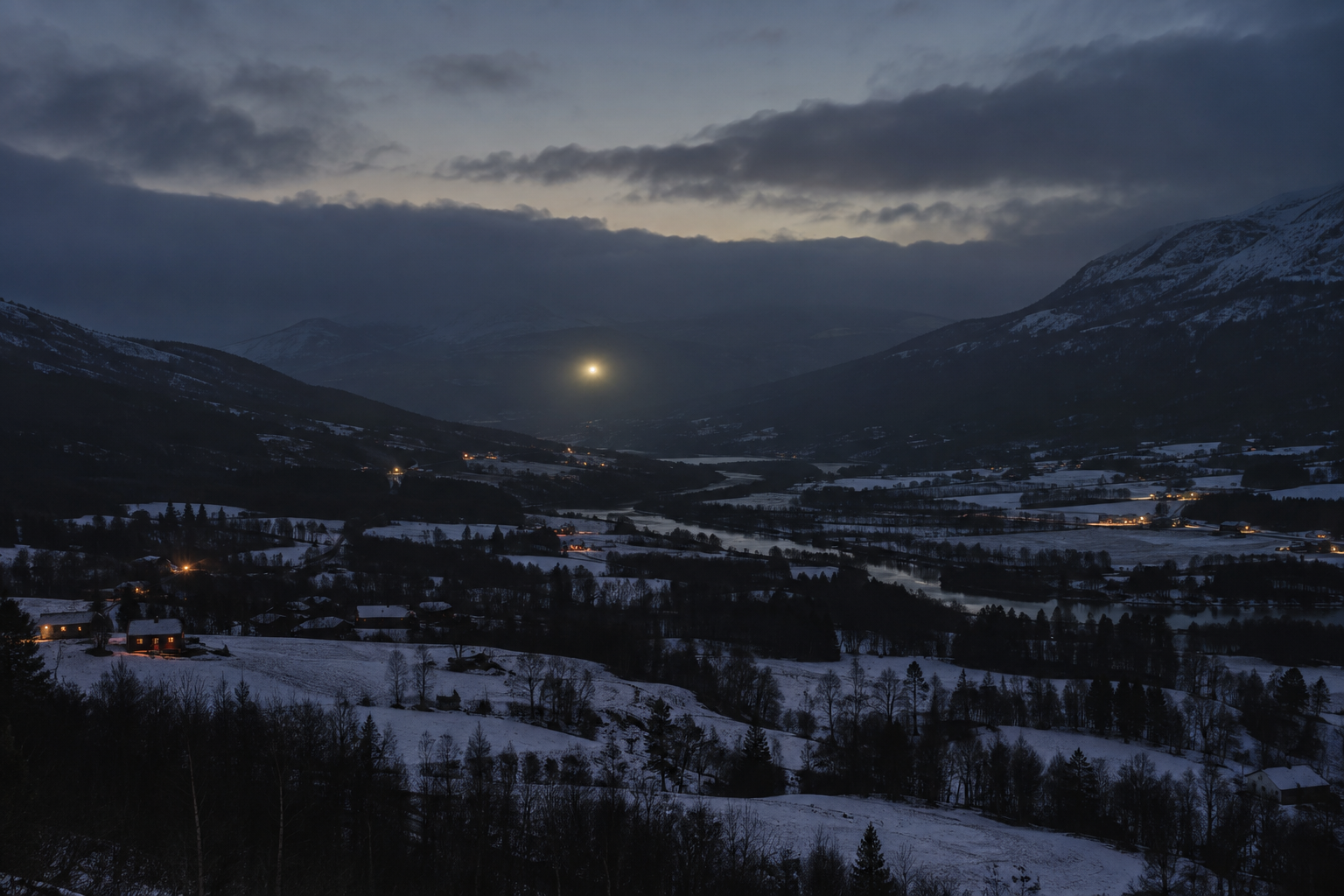
Supporting images provide documentary, geographic or visual context. Read each caption for its date, source and evidential limits.

Continue researching
Follow the evidence, context and comparisons
Curated connections
Selected editorially for this entry.
Aircraft, satellites, planets, drones and atmospheric effects can become strange when context is missing.
Curated connection · ArticlePilot Reports and the Problem of Expert PerceptionTrained observers matter, but expertise does not remove ambiguity from distance, speed, glare and surprise.
Curated connection · ArticleThe Difference Between Evidence, Testimony and LegendA field guide to three words that often get tangled in mystery research.
More through shared context
Additional routes based only on existing topics, themes and metadata.
In February 1942, Los Angeles saw searchlights, anti-aircraft fire and rumours of enemy aircraft in a case where fear, weather and uncertainty lit up the sky.
Shared theme: Atmosphere & optics · Case fileLake Nyos: The Night a Lake Released a Silent CloudThe Lake Nyos disaster was caused by a limnic eruption: deep water saturated with volcanic carbon dioxide overturned and released a dense, suffocating cloud.