UFOs & Aerial Phenomena
The Battle of Los Angeles: Searchlights, Shells and Wartime Nerves
In February 1942, Los Angeles saw searchlights, anti-aircraft fire and rumours of enemy aircraft in a case where fear, weather and uncertainty lit up the sky.
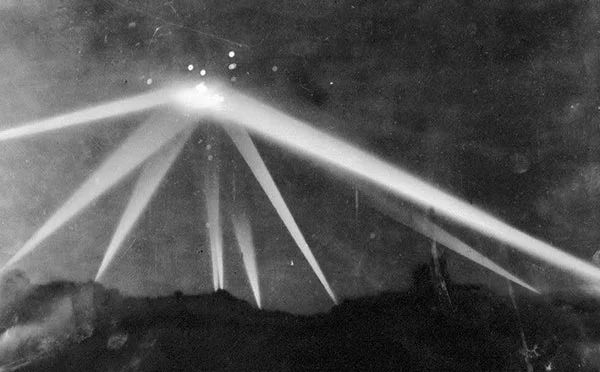
Before dawn on 25 February 1942, Los Angeles blacked out and anti-aircraft batteries fired into a sky crowded with searchlight beams, smoke and bursting shells. The spectacle was real. The attacking formation was not. What triggered the barrage remains less tidy than the famous photograph suggests.
A coast expecting attack
The United States had entered the Second World War less than three months earlier. Pearl Harbor remained an immediate shock, and the West Coast expected that the next attack might arrive from the sea or air. On 23 February, Japanese submarine I-17 shelled the Ellwood oil field near Santa Barbara, causing limited physical damage but intensifying the sense that California was exposed.
An alert on the night of 24 February was lifted without an attack. Hours later, radar and visual reports again suggested an object approaching the coast. The region entered blackout conditions. Searchlights began probing a sky in which every uncertain report carried wartime consequences.
The barrage
At about 3:00 a.m., batteries opened fire and continued, with interruptions, for more than an hour. Roughly 1,400 rounds were fired. Observers reported balloons, aircraft formations, single objects and nothing definite at all. Searchlights converging on smoke and shell bursts created bright shapes that could be mistaken for a target and then used to direct further fire.
No enemy aircraft was brought down, and no Japanese raid was later established. Falling fragments damaged buildings and vehicles. Civilian deaths were associated with the event through traffic accidents and heart attacks, although accounts differ in how they total casualties. The certainty visible in the gunfire was not matched by certainty in the reports.
Official disagreement
Secretary of the Navy Frank Knox described the episode as a false alarm. Secretary of War Henry Stimson allowed that as many as fifteen aircraft might have been present, possibly commercial aircraft operated for psychological effect. Later Army history treated the event as wartime nerves, likely initiated by a meteorological balloon and sustained by stray flares, shell bursts and mutually reinforcing observations.
That disagreement is central. “Official” was not one voice reaching a settled conclusion. Different services received incomplete reports while the event was still politically sensitive. The archive contains reaction, interpretation and retrospective reconstruction rather than a recovered target.
The photograph
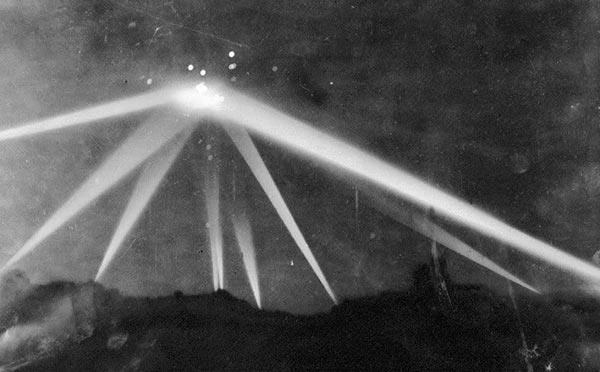
The best-known newspaper image shows beams apparently converging on a bright object. It records searchlights, smoke and anti-aircraft fire, but it cannot by itself establish what occupied the point of convergence. Newspaper reproduction increased contrast and made a chaotic night legible as one target under attack.
Later UFO interpretations often read the image outside its 1942 setting. The common flying-saucer vocabulary did not become widespread until years later. The wartime witnesses were primarily looking for enemy aircraft; later audiences supplied a different expected object.
Why the case remains useful
The event shows that trained organisations can produce a large, sincere response from uncertain inputs. Radar alerts, visual expectation, independent batteries, smoke and the actions of neighbouring crews created a feedback system. Once guns were firing, every burst made the sky harder to interpret.
This does not make the observers foolish. Their task was to defend a city under conditions in which failing to respond could be catastrophic. It does show why the status of a witness cannot replace geometry and preserved records, and why ordinary lights and atmospheric effects must be tested before an extraordinary craft is proposed.
Claim, Context and Cautions
Claim
Los Angeles air defences engaged one or more unidentified targets during the early hours of 25 February 1942; later retellings sometimes describe an extraordinary craft in the searchlights.
What is solid?
A blackout occurred, anti-aircraft batteries fired roughly 1,400 rounds, searchlights and shell bursts filled the sky, debris caused damage, and no enemy aircraft was recovered or confirmed.
What remains disputed?
The initiating radar or visual target was never securely identified. Contemporary Navy and Army interpretations differed, and later accounts disagree over the role of a weather balloon, flares and observer feedback.
Possible explanations
The strongest historical explanation combines invasion anxiety, an uncertain initial target, balloon or visual reports, smoke, flares, shell bursts and batteries reacting to one another.
Sceptical view
The famous photograph proves a dramatic barrage, not a solid craft. Searchlight convergence and contrast cannot supply the missing target, range or recovered material.
Why it still matters
The episode is a rare large-scale record of uncertainty becoming action under genuine pressure, and of a wartime scare later being reinterpreted through UFO culture.
Contextual glossary
Terms used in this entry
Definitions are offered as reading aids, not as conclusions about the case.
- Flying saucer
- A popular term for a disc-like reported aerial object, widely adopted after press coverage in 1947. The phrase became broader than the shapes in the reports that helped popularise it.
- Uncertainty
- The stated limit on what a measurement, reconstruction or body of evidence can establish. Describing uncertainty is not indecision; it prevents a result from appearing more precise than the evidence allows.
- Reconstruction
- A later model, image or account made to represent an event from surviving information. It can clarify a hypothesis but should remain visibly separate from contemporary evidence.
- UFO
- Unidentified flying object, historically used for an aerial observation that remains unidentified at the time of reporting. In popular culture it often implies a spacecraft, which is a separate claim.
Reference trail
Sources
- US Army Center of Military History: The Western Hemisphere (opens in a new tab)Official wartime history covering the February 1942 Los Angeles alert and barrage.
- California State Military Museum: The Impact of the Second World War on Los Angeles (opens in a new tab)Historical study placing the barrage within the city's civil-defence preparations and wartime anxiety.
- Wikimedia Commons: Battle of Los Angeles photograph (opens in a new tab)Public-domain image record and reuse information.
Case Book
Photographs, Maps and Supporting Images
Supporting images provide documentary, geographic or visual context. Read each caption for its date, source and evidential limits.
Continue researching
Follow the evidence, context and comparisons
Curated connections
Selected editorially for this entry.
Aircraft, satellites, planets, drones and atmospheric effects can become strange when context is missing.
Curated connection · ArticlePilot Reports and the Problem of Expert PerceptionTrained observers matter, but expertise does not remove ambiguity from distance, speed, glare and surprise.
Curated connection · Case fileRendlesham Forest: Lights, Logs and the British UFO ArchiveRendlesham remains one of the most famous UFO cases in Britain because it produced sightings, notes and later arguments in the shadow of a military base.
More through shared context
Additional routes based only on existing topics, themes and metadata.
Kenneth Arnold’s 1947 report helped launch the modern flying-saucer era. His observation was sincere and carefully timed, but distance and object identity were never independently secured.
Same primary topic · Shared theme: Aviation, Witness & memory · Case fileJapan Air Lines 1628: Lights, Radar and Scale Over AlaskaThe crew’s visual report was real and professionally documented. Radar returns were intermittent and disputed, while darkness, cloud and uncertain distance made size estimates especially fragile.