UFOs & Aerial Phenomena
Japan Air Lines 1628: Lights, Radar and Scale Over Alaska
The crew’s visual report was real and professionally documented. Radar returns were intermittent and disputed, while darkness, cloud and uncertain distance made size estimates especially fragile.
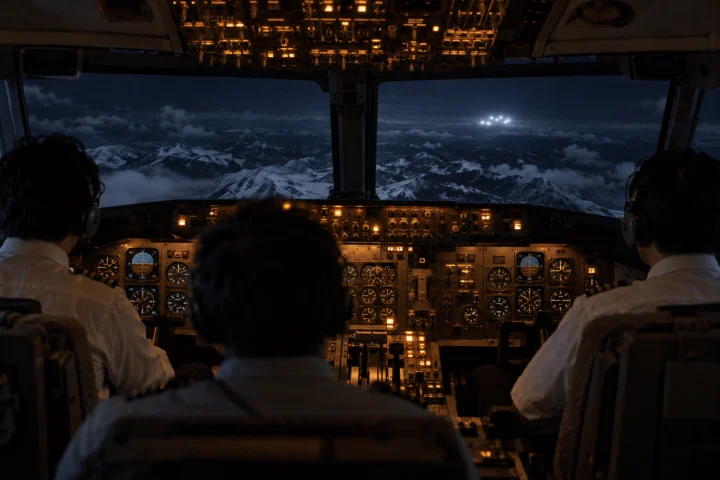
On 17 November 1986, Japan Air Lines cargo flight 1628 crossed Alaska at night. Captain Kenju Terauchi reported lights near the Boeing 747, initially as two objects and later as an enormous dark form accompanied by lights. The other two crew members saw lights but did not endorse every scale description.
Anchorage controllers found no known traffic matching the report. FAA radar sometimes showed an additional return near the aircraft, while military radar confirmation was inconsistent and controllers also described clutter or split returns. The plane changed altitude and direction with permission; the crew continued to Anchorage safely.
The evidential strength is documentation, not automatic corroboration. Recorded radio calls prove that a professional crew reported something in real time. A radar return near a transponder track can be weather, processing artefact or a target; it must be stable enough to correlate with the sightline before it proves the same object.
Terauchi compared the later object to an aircraft carrier. In darkness, a cluster of lights without a known range supplies no reliable physical scale. Jupiter and Mars were in the relevant sky and ice-crystal effects have been proposed, though neither explanation reproduces every stage with certainty.
JAL 1628 sits beside the Tehran intercept, Washington’s radar alerts, and the problem of expert perception.
Claim, Context and Cautions
Three crew members, different detail
All three were trained aviation observers, but the captain supplied the richest and most extraordinary narrative. Later summaries sometimes merge his descriptions with the crew's more limited visual confirmation. Keeping each witness separate prevents agreement about lights from becoming agreement about a gigantic structured object.
Expertise supports accurate reporting of instruments and aircraft behaviour; it cannot create distance cues that the scene did not contain.
What the FAA record establishes
The archive contains incident forms, interviews, air-traffic communications, radar printouts and internal discussion. Those records establish an official review and concern about public interpretation. They do not contain a finding that an extraterrestrial or solid giant craft was tracked.
The strongest radar claims require alignment in time, position and movement. Intermittent secondary returns beside a strong aircraft echo do not supply that clean chain.
Astronomy, atmosphere and geometry
Bright planets can appear to follow an aircraft as it turns, while ice crystals can create reflections or luminous patches. Cloud layers and cockpit glass add further surfaces. Critics use these mechanisms to explain portions of the sequence; proponents point to motion and changing appearance that they consider inconsistent.
No reconstruction has access to the exact crystals, viewing adaptation and attention of the crew. That prevents both a perfect natural replay and confident extraordinary identification.
A documented unknown, narrowly stated
The case deserves more than dismissal because testimony and institutional records survive. It deserves less than the popular claim of confirmed radar pursuit by a mothership. Visual reports, controller observations and electronic data are different evidence streams with partial rather than complete correspondence.
The cautious conclusion is that the crew observed unexplained lights and the captain inferred a much larger object. Available records do not securely determine their distance, structure or cause. Preserving those limits makes JAL 1628 a useful aviation-perception case rather than a slogan. Later headlines should always be checked against the timed controller record.
Contextual glossary
Terms used in this entry
Definitions are offered as reading aids, not as conclusions about the case.
- Radar return
- Energy received by radar after a transmitted pulse interacts with a target or the environment. A plotted return requires interpretation and can represent an aircraft, weather, terrain, interference or anomalous propagation.
- Reconstruction
- A later model, image or account made to represent an event from surviving information. It can clarify a hypothesis but should remain visibly separate from contemporary evidence.
- Corroboration
- Independent information that supports part of an account, such as a record, trace or separately obtained observation. Repetition from a shared source is not independent corroboration.
- Transponder
- Equipment that automatically replies to an interrogation signal, commonly providing aircraft identity or altitude to secondary radar. A missing reply is not the same as proof that no aircraft was present.
- Artefact
- An object made, modified or used by people. Its material, manufacture, wear and archaeological context are evidence; an unusual appearance alone does not establish an unusual age or origin.
Reference trail
Sources
- UAP Records Archive, FAA Japan Airlines 1628 records (opens in a new tab)Indexed set of digitised FAA and National Archives case records.
- Anomaly Watch, FAA continuous radar printout (opens in a new tab)Document viewer for the FAA-released radar chronology and controller annotations.
- Washington Post, UFO Sighting Confirmed by FAA, Air Force Radar (opens in a new tab)Contemporary report useful for the public chronology and official statements, not proof of identification.
Case Book
Photographs, Maps and Supporting Images
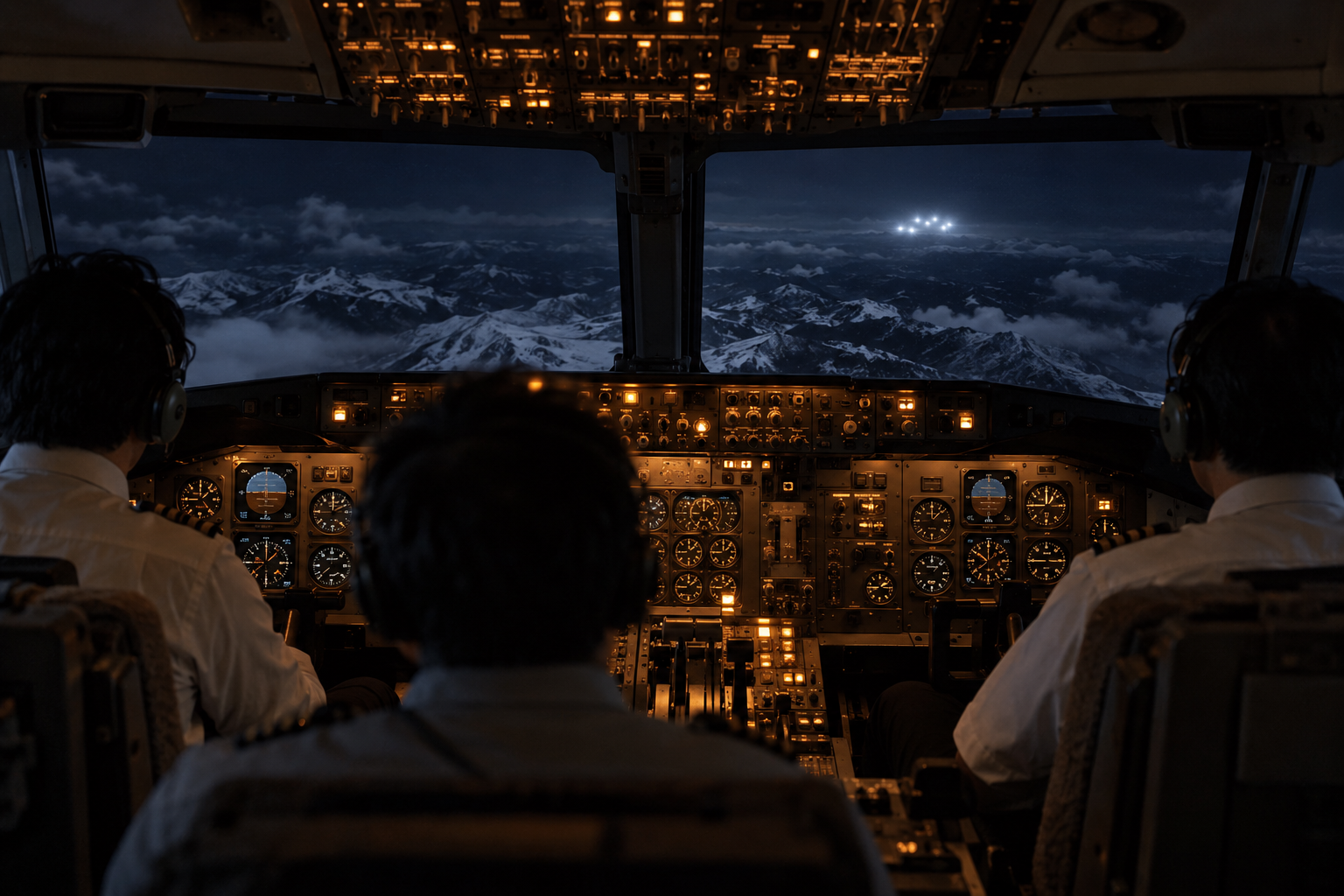
Supporting images provide documentary, geographic or visual context. Read each caption for its date, source and evidential limits.

Continue researching
Follow the evidence, context and comparisons
Curated connections
Selected editorially for this entry.
The Tehran incident rests on a contemporaneous military message reporting civilian observations, two intercepts and aircraft anomalies. The document is strong evidence that the episode was reported, but incomplete for reconstructing the lights or failures.
Curated connection · Case fileWashington 1952: Radar Returns Over the CapitalThe Washington sightings combined radar returns, visual reports and official alarm. Temperature inversions offer a plausible mechanism for some returns, but the heterogeneous evidence does not support one neat solution.
Curated connection · ArticlePilot Reports and the Problem of Expert PerceptionTrained observers matter, but expertise does not remove ambiguity from distance, speed, glare and surprise.
More through shared context
Additional routes based only on existing topics, themes and metadata.
The Socorro incident rests on a prompt police report and documented ground traces, yet neither the marks nor later theories securely identify what Lonnie Zamora saw.
Same primary topic · Shared theme: Aviation, Witness & memory · Case fileThe Allagash Abductions: Memory After the LightA shared light sighting on an Allagash lake preceded later hypnotic abduction accounts. The original observation is testimony; hypnosis does not validate the later memories.