UFOs & Aerial Phenomena
Socorro: Lonnie Zamora and the Object in the Arroyo
The Socorro incident rests on a prompt police report and documented ground traces, yet neither the marks nor later theories securely identify what Lonnie Zamora saw.
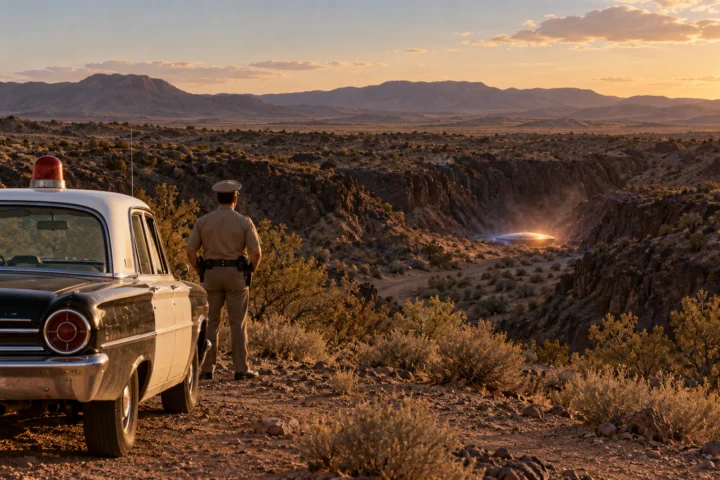
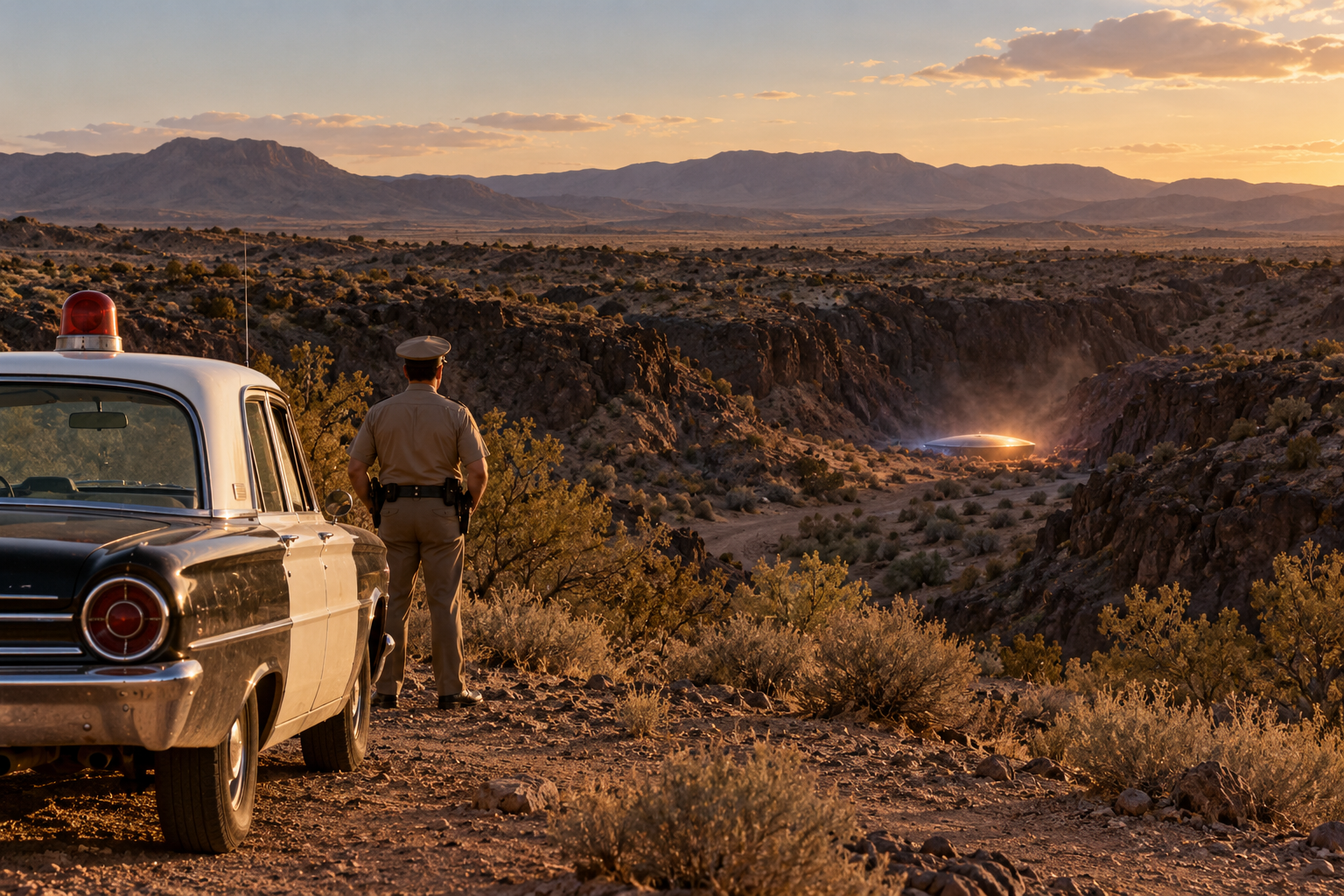
At about 5.45 p.m. on 24 April 1964, Socorro police officer Lonnie Zamora broke off a traffic pursuit after hearing a roar and seeing a flame south-west of town. Driving over rough ground, he first thought a pale object in an arroyo might be an overturned car. He reported two small figures nearby, then approached until the object rose with a loud roar and blue-orange flame before departing across the landscape.
Zamora radioed promptly. Sergeant Sam Chavez and other officials reached the area soon afterwards. They recorded four depressions, scorched or smoking vegetation and a rough arrangement of marks. The FBI’s contemporary communication described Zamora as sober and dependable, but the Bureau left the technical inquiry to the Air Force and Army.
Project Blue Book did not find a conventional vehicle that satisfied the whole account and listed the case as unidentified. That classification means the available data did not support an explanation; it is not an official conclusion that the object was extraterrestrial.
Socorro belongs beside the archive’s guide to ordinary lights and extraordinary reports, the official records in Rendlesham Forest, and the disputed close encounter at Kelly-Hopkinsville.
Claim, Context and Cautions
A report made in real time
The short interval between observation, radio traffic and inspection is the case's strongest feature. Zamora did not first publish a memoir years later. His route, initial impression of an accident, fear during the departure and description of an oval object were documented while the scene was still fresh.
Even prompt testimony remains perception from one principal observer. Estimates of distance, size and speed were made under surprise and stress, and later summaries sometimes merge details from separate official notes.
What the ground traces establish
Investigators photographed depressions and burned plants and tested samples. The marks demonstrate that the site contained disturbed soil and local scorching. Their geometry appeared compatible with supports, but no recovered fragment or residue uniquely linked them to a machine.
A trace can corroborate part of a narrative without identifying its cause. Visitors, vehicles and later handling also complicate a scene that was not sealed like a modern forensic site.
Proposed explanations
Suggestions have included a lunar-survey test vehicle, helicopter activity, a student prank and a conventional aircraft seen under unusual conditions. Each can explain selected features, but no proposal has produced a documented vehicle, participants and sequence that match the surviving record. Claims that named students later confessed are retrospective and lack a secure primary confession.
The extraordinary alternative has the same problem in larger form: an unidentified object and unexplained traces do not supply evidence of origin beyond Earth.
Why Socorro remains useful
Socorro is stronger than a story built only from late recollection, yet weaker than a sensor-rich incident with recoverable material. It shows how a credible witness and prompt investigation can preserve uncertainty rather than abolish it.
Air Force interest is sometimes treated as proof that investigators secretly knew more than they published. The surviving files instead show agencies exchanging information, testing possibilities and failing to reach a satisfactory identification. Institutional attention establishes that the report was taken seriously; it does not turn an unresolved file into confirmation of a preferred theory.
The responsible conclusion is narrow: Zamora made a serious, promptly documented report, physical changes were observed, and the available archive does not securely identify the object or manufacture an origin for it.
Contextual glossary
Terms used in this entry
Definitions are offered as reading aids, not as conclusions about the case.
- Witness statement
- A recorded account attributed to a particular witness at a particular time. The original wording, questions asked and edits are part of the evidence and should be preserved.
- Close encounter
- A classification used for reported nearby encounters with an unusual aerial object or its alleged effects. It organises testimony; it does not certify that the reported object had an extraordinary origin.
- Uncertainty
- The stated limit on what a measurement, reconstruction or body of evidence can establish. Describing uncertainty is not indecision; it prevents a result from appearing more precise than the evidence allows.
Reference trail
Sources
- FBI, UFO Near Socorro records (FOIA release) (opens in a new tab)Scans of FBI communications recording Zamora’s prompt account, the responding officers and the observed site marks.
- National Archives, Project BLUE BOOK records (opens in a new tab)Official archival guide to the declassified Air Force investigation series and its evidential limits.
- Project Blue Book Archive, Socorro case materials (opens in a new tab)Document index providing the FBI release, Air Force case file and official photographs together; used as an access aid, not as an official conclusion.
Case Book
Photographs, Maps and Supporting Images
Supporting images provide documentary, geographic or visual context. Read each caption for its date, source and evidential limits.

Continue researching
Follow the evidence, context and comparisons
Curated connections
Selected editorially for this entry.
Aircraft, satellites, planets, drones and atmospheric effects can become strange when context is missing.
Curated connection · Case fileRendlesham Forest: Lights, Logs and the British UFO ArchiveRendlesham remains one of the most famous UFO cases in Britain because it produced sightings, notes and later arguments in the shadow of a military base.
Curated connection · Case fileThe Kelly-Hopkinsville Encounter: A Farmhouse Under SiegeThe Sutton and Lankford households reported a night-long confrontation near Kelly, Kentucky. Police found frightened witnesses and gunfire evidence, but no creature or trace that identified what they saw.
More through shared context
Additional routes based only on existing topics, themes and metadata.
The crew’s visual report was real and professionally documented. Radar returns were intermittent and disputed, while darkness, cloud and uncertain distance made size estimates especially fragile.
Same primary topic · Shared theme: Aviation, Witness & memory · Case fileThe Allagash Abductions: Memory After the LightA shared light sighting on an Allagash lake preceded later hypnotic abduction accounts. The original observation is testimony; hypnosis does not validate the later memories.