UFOs & Aerial Phenomena
Washington 1952: Radar Returns Over the Capital
The Washington sightings combined radar returns, visual reports and official alarm. Temperature inversions offer a plausible mechanism for some returns, but the heterogeneous evidence does not support one neat solution.
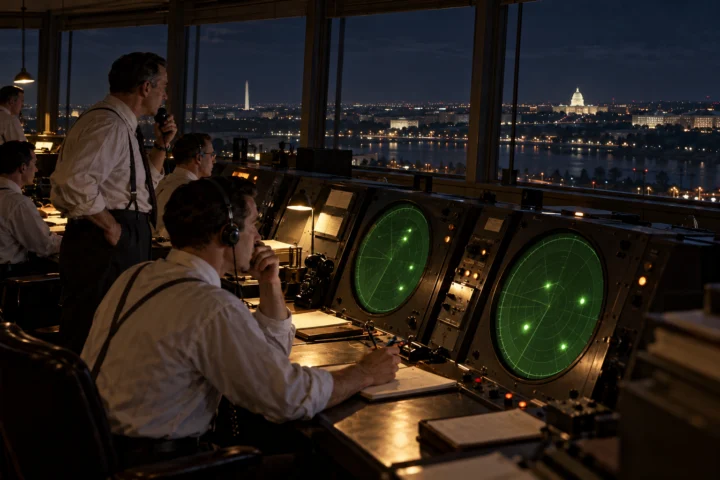
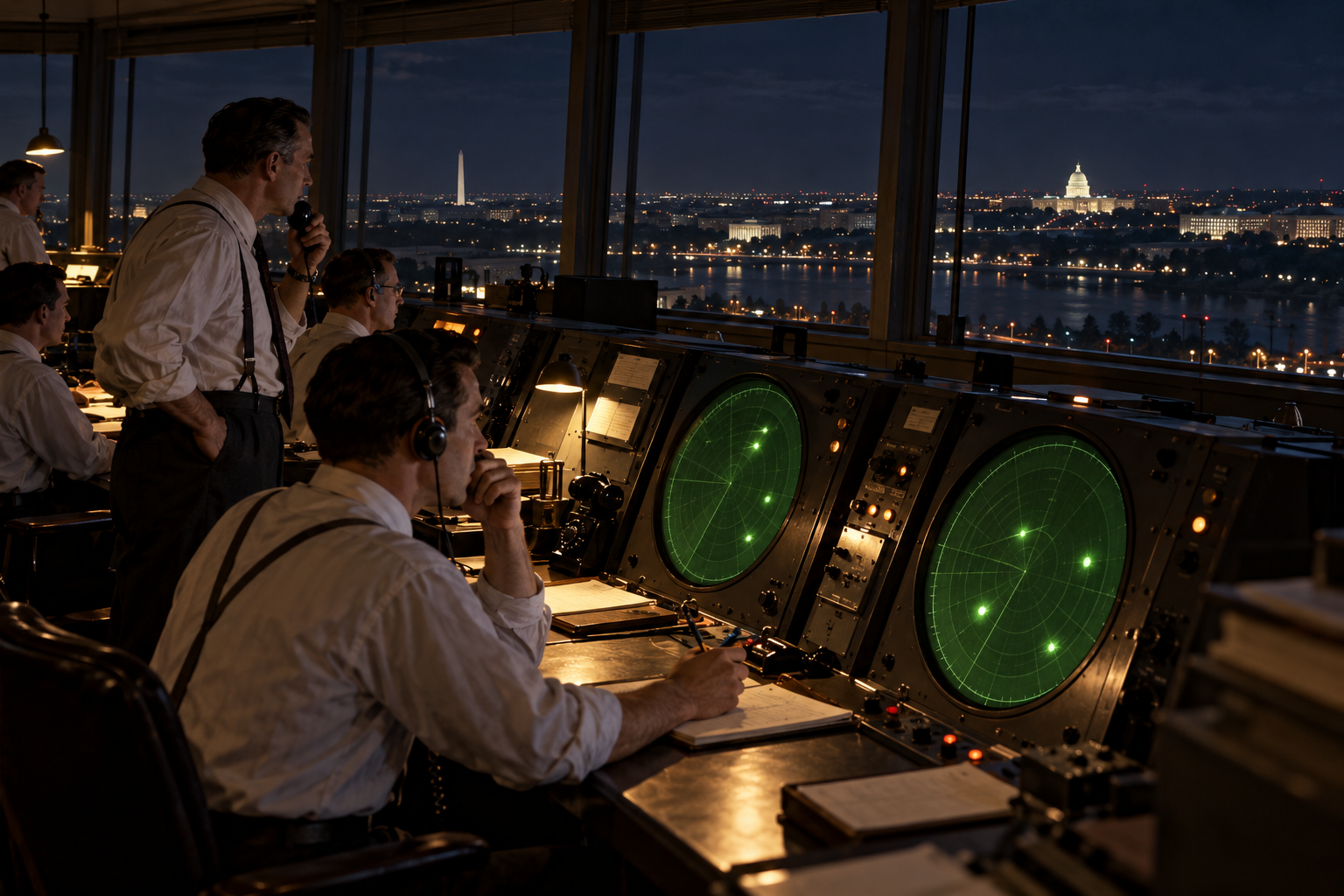
Shortly before midnight on 19 July 1952, controllers at Washington National Airport observed several unusual returns on radar. Operators at nearby Andrews Air Force Base reported related targets, while pilots and people on the ground described lights. Targets appeared again the following weekend, prompting Air Force interceptor launches and national headlines.
The episode occurred during a wider surge of UFO reports. Radar made Washington seem unusually objective, yet the surviving evidence is not one synchronized recording. It is a collection of recollections, logs, press accounts and later summaries from different instruments. Some visual lights may have been stars, meteors or aircraft; some radar returns may have had other causes.
The Air Force publicly emphasized temperature inversions, which can bend radar energy and create anomalous propagation. Critics noted that experienced controllers described movement unlike stationary ground echoes and that visual reports sometimes accompanied the returns. Neither point establishes a spacecraft: correlation was often approximate, and interceptors made no documented recovery or close identification.
The case sits between the archive’s account of ordinary lights and extraordinary UFO reports, the wartime alarm of the Battle of Los Angeles, and the formative Kenneth Arnold sighting.
Claim, Context and Cautions
Two weekends of reports
Controllers described groups of returns appearing in restricted or sensitive airspace, sometimes moving slowly and sometimes seeming to accelerate. Airline crews were asked to look, and several reported lights. On the second weekend, jets were placed over the region, but targets faded or shifted before a sustained interception.
The chronology matters because popular retellings often compress both nights into a continuous battle between aircraft and objects. Reports varied in time, position and quality, and not every light was matched to a radar plot.
What radar can and cannot identify
Radar records reflected energy. Operators infer a target from its position, motion and consistency across sweeps, but weather, birds, ground objects and propagation can also produce returns. In 1952, displays were watched in real time and the full modern digital data stream did not exist for later reanalysis.
Agreement between separated radars would strengthen a track, yet claims of exact agreement must be supported by shared timing and coordinates. The archive offers less precision than later narratives imply.
The inversion explanation
A temperature inversion places warmer air above cooler air and can refract radar energy toward the ground, allowing distant structures to generate moving or intermittent echoes. Weather officials reported inversion conditions during the Washington events. The mechanism is physically credible, although it may not account for every reported target or visual observation.
Project Blue Book's public explanation also served an institutional need to calm concern. That motive does not make the physics false, just as an unresolved report does not make an extraterrestrial answer true.
A heterogeneous case, not one object
The strongest conclusion is that controllers encountered unusual radar indications during two busy nights and that several people reported lights. The evidence does not demonstrate that every observation shared a cause. Stars, aircraft and anomalous propagation can coexist with genuinely unresolved returns.
The Air Force investigation and press conference are historical facts, not proof of concealment or proof that the case was completely solved. Because raw synchronized plots are unavailable, later analysts cannot reconstruct every track. Washington remains important as a study of air-defence uncertainty, media pressure and the temptation to force many reports into one dramatic vehicle.
Contextual glossary
Terms used in this entry
Definitions are offered as reading aids, not as conclusions about the case.
- Anomalous propagation
- Unusual bending of radar or radio waves through layers of air with changing temperature or moisture. It can produce returns from beyond the normal horizon or place a return at a misleading apparent position.
- Temperature inversion
- An atmospheric layer in which temperature increases with height instead of decreasing. Inversions can trap pollution and bend light or radio waves in ways relevant to distant lights and radar returns.
- Correlation
- A pattern in which two things vary together. Correlation can suggest a question to investigate, but it does not show that one caused the other.
- Uncertainty
- The stated limit on what a measurement, reconstruction or body of evidence can establish. Describing uncertainty is not indecision; it prevents a result from appearing more precise than the evidence allows.
- UFO
- Unidentified flying object, historically used for an aerial observation that remains unidentified at the time of reporting. In popular culture it often implies a spacecraft, which is a separate claim.
Reference trail
Sources
- National Archives, Project BLUE BOOK records (opens in a new tab)Official guide to the declassified Air Force record series and the limits of its classifications.
- National Archives, Saucers Over Washington (opens in a new tab)Archival history placing the July 1952 events within Project Blue Book and the contemporary reporting wave.
- National Archives, Project Blue Book’s 50th anniversary (opens in a new tab)Official overview of the Air Force files, investigation categories and continued public access to the records.
Case Book
Photographs, Maps and Supporting Images
Supporting images provide documentary, geographic or visual context. Read each caption for its date, source and evidential limits.

Continue researching
Follow the evidence, context and comparisons
Curated connections
Selected editorially for this entry.
Aircraft, satellites, planets, drones and atmospheric effects can become strange when context is missing.
Curated connection · Case fileThe Battle of Los Angeles: Searchlights, Shells and Wartime NervesIn February 1942, Los Angeles saw searchlights, anti-aircraft fire and rumours of enemy aircraft in a case where fear, weather and uncertainty lit up the sky.
Curated connection · Case fileKenneth Arnold: The Sighting That Named the Flying SaucerKenneth Arnold’s 1947 report helped launch the modern flying-saucer era. His observation was sincere and carefully timed, but distance and object identity were never independently secured.
More through shared context
Additional routes based only on existing topics, themes and metadata.
The crew’s visual report was real and professionally documented. Radar returns were intermittent and disputed, while darkness, cloud and uncertain distance made size estimates especially fragile.
Same primary topic · Shared theme: Aviation, Witness & memory · Case fileSocorro: Lonnie Zamora and the Object in the ArroyoThe Socorro incident rests on a prompt police report and documented ground traces, yet neither the marks nor later theories securely identify what Lonnie Zamora saw.