Scientific Anomalies & Natural Phenomena
Ball Lightning: Rare Observation, Unsettled Mechanism
Ball lightning is a label for rare luminous events reported near thunderstorms. Instrumental observations constrain some cases, while varied testimony and competing physical models leave its full scope unresolved.
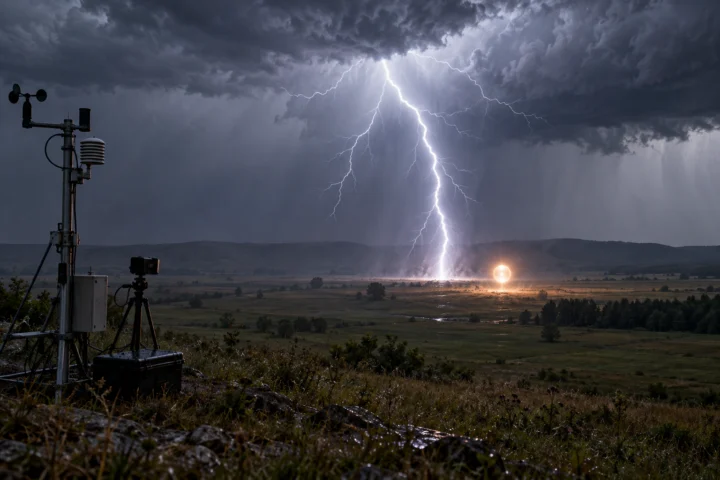
Witnesses have long described glowing balls during or after thunderstorms. The reported objects may float, descend, move horizontally or disappear explosively, and usually last longer than an ordinary lightning channel. Some accounts place them inside buildings or aircraft, making the phenomenon unusually difficult to reproduce with one mechanism.
Most evidence is testimonial. A bright, brief event can be confused with a power-line arc, burning material, a conventional lightning afterimage or distance-misjudged light. Reports collected after surprise also vary in size, colour and duration. Those limitations do not make every report false, but they widen the category.
In 2012, researchers observing ordinary lightning on the Qinghai Plateau recorded a luminous event with video and a slitless spectrograph. Its spectrum contained emission associated with silicon, iron and calcium, elements present in soil. The observation connected one event to a cloud-to-ground strike and supported models involving vaporised ground material.
One spectrum does not settle all cases. Proposed mechanisms include oxidising silicon nanoparticles, microwave-confined plasma, electrical discharge around airborne material and ordinary combustion. Laboratory effects can reproduce selected colours, lifetimes or motions without yet demonstrating that the same process produces every field report.
The case rewards the measurement strategy outlined in investigating anomalous signals and invites comparison with the recurring Hessdalen lights and distant lights at Mitchell Flat near Marfa.
Claim, Context and Cautions
A broad eyewitness category
Ball lightning is defined mostly by appearance rather than cause. Reports grouped under the name may include several physical phenomena: compact luminous plasma, burning aerosols, electrical equipment failures and visual effects. Extreme claims such as passage through closed windows require especially careful reconstruction of openings, reflections and observer position.
Reliable description should preserve what was seen before choosing a mechanism. Apparent diameter and distance are difficult to separate when a light has no familiar scale.
The Qinghai spectrum
The 2012 recording is important because instruments captured time, motion, colour and spectral composition rather than a recollection alone. The luminous event appeared after a nearby cloud-to-ground discharge and persisted for more than a second. Strong soil-element lines make material excavated or vaporised by the strike a credible component.
The observation was one event under particular conditions. It is evidence against treating the entire subject as pure legend, but it does not validate unrelated reports with different settings.
Competing physical models
In a silicon model, a strike reduces silica-bearing soil and creates particles that oxidise while glowing. Microwave models propose that lightning produces radiation capable of sustaining a plasma structure. Other approaches use charged aerosols, combustion or electrically driven vortices.
Each model faces constraints from energy, lifetime, motion, spectrum and formation rate. A successful laboratory glow establishes physical possibility under those conditions, not identity with an outdoor event unless matching measurements connect them.
What would resolve more cases
High-speed multi-angle cameras, calibrated spectra, electric-field sensors, weather radar and precise lightning locations can turn a striking sight into a testable event. Automated observation near active storm regions offers better evidence than asking witnesses to estimate seconds and metres after the fact.
The cautious conclusion is neither that every report is imaginary nor that one exotic object has been proved. Some luminous storm phenomena are instrumentally real. Their rarity, diversity and incomplete measurements allow multiple mechanisms, while the most dramatic historical descriptions remain testimony rather than established physical behaviour.
Contextual glossary
Terms used in this entry
Definitions are offered as reading aids, not as conclusions about the case.
- Ball lightning
- A rare report of a luminous, usually short-lived sphere associated with storm conditions. The label is sometimes applied too broadly to any unexplained light near the ground.
- Reconstruction
- A later model, image or account made to represent an event from surviving information. It can clarify a hypothesis but should remain visibly separate from contemporary evidence.
- Afterimage
- A visual impression that continues after the original stimulus has gone. Bright lights can leave shapes or motion in vision that are mistaken for something still present.
- Bearing
- A direction measured clockwise from north, usually in degrees. A bearing gives a line of direction rather than a distance; two or more reliable bearings may help locate a source.
Reference trail
Sources
- Cen, Yuan and Xue, Observation of the Optical and Spectral Characteristics of Ball Lightning (opens in a new tab)Peer-reviewed 2014 report of a naturally occurring luminous event recorded by video and spectrograph.
- MIT-hosted author copy of the ball-lightning spectrum paper (opens in a new tab)Accessible copy of the instrument methods, spectrum and relationship to a cloud-to-ground strike.
- Wu, Relativistic-microwave theory of ball lightning (opens in a new tab)Open theoretical paper representing a competing plasma and microwave explanation and its testable consequences.
Case Book
Photographs, Maps and Supporting Images
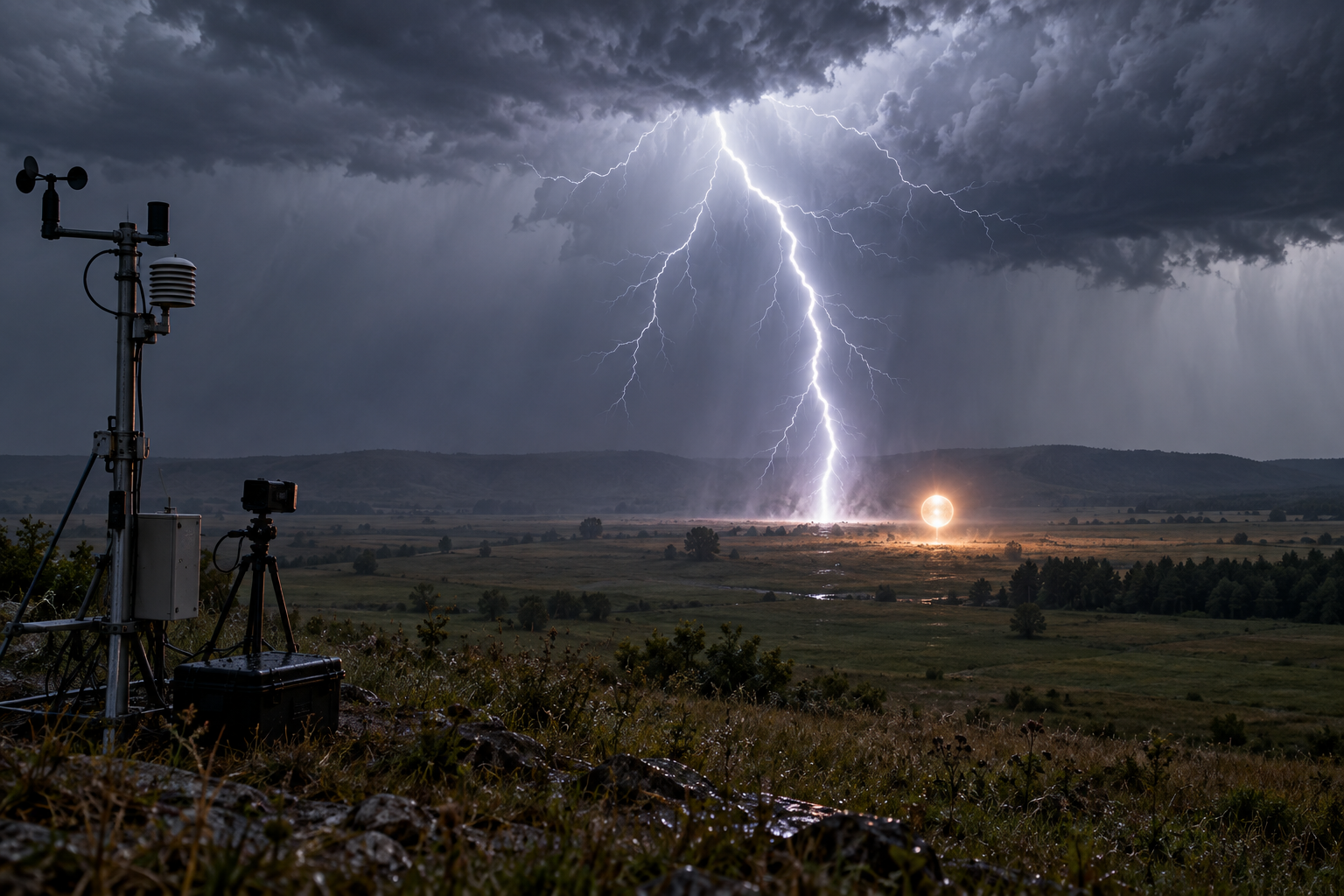
Supporting images provide documentary, geographic or visual context. Read each caption for its date, source and evidential limits.

Continue researching
Follow the evidence, context and comparisons
Curated connections
Selected editorially for this entry.
A source-led guide to anomalous signals, from underwater sounds to radio bursts: how calibration, reference libraries and independent repetition separate useful evidence from compelling noise.
Curated connection · Case fileThe Hessdalen Lights: A Valley Under ObservationHessdalen’s recurring lights prompted field campaigns and automatic monitoring after a wave in the early 1980s. The label covers mixed observations, not one proven phenomenon.
Curated connection · Case fileThe Marfa Lights: Distance, Headlights and a Desert HorizonThe Marfa Lights combine a modern roadside observation problem with older local folklore. Headlights and atmospheric effects explain much of the repeatable display without resolving every anecdote.
More through shared context
Additional routes based only on existing topics, themes and metadata.
The Lake Nyos disaster was caused by a limnic eruption: deep water saturated with volcanic carbon dioxide overturned and released a dense, suffocating cloud.
Same primary topic · Shared theme: Atmosphere & optics · Case fileTunguska: The Morning the Forest Fell FlatA 1908 blast over Siberia flattened forest without leaving a classic impact crater, making Tunguska a cornerstone case in anomaly, science and myth.