Folklore & Legends
Urban Legends Before the Internet
Chain letters, photocopies, local radio and schoolyard retellings show that viral folklore did not need a screen.
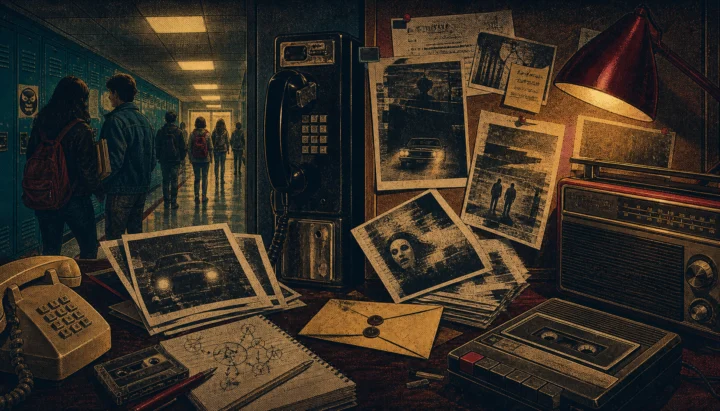
A story did not need a share button to go viral. It needed a good warning, a vivid image and a route through ordinary life. Before social media, alarming tales moved through school corridors, factory floors, pubs, church groups, local radio, newspaper columns, letters and photocopied notices. The network was slower, but it was already social.
Calling these stories “urban legends” does not mean they belong only to cities. The term describes plausible modern narratives told as if they happened to someone close enough to trust: a colleague’s cousin, a neighbour’s friend, a family known to the teller. Folklorists often abbreviate this distance as FOAF – friend of a friend.
The hand-to-hand network
Spoken stories travelled where people repeatedly met. A school legend could cross year groups and reappear with the abandoned house moved to the next town. A workplace warning might be retold during breaks until the company, product or victim changed. Pubs and clubs supplied both an audience and the social pressure to improve an ending.
Paper gave rumour a different authority. Chain letters combined a supernatural threat with instructions to make copies. Photocopied warnings appeared on noticeboards without an identifiable author. A typed page looked documented even when it preserved nothing more than a spoken claim. Local newspapers sometimes printed such material as curiosity, warning or filler, then provided a clipping that later tellers could cite as proof.
Radio, newspapers and repeated certainty
Broadcast media widened the circle while retaining an intimate voice. A caller to local radio could describe an experience in one town; listeners elsewhere could recognise it as something that had happened “near us.” Newspaper reprints worked similarly. The newspaper trail shows how one item could appear in many papers and acquire the false appearance of independent confirmation.
The War of the Worlds case demonstrates a second process. The original broadcast, immediate reactions and later claims about mass panic are different layers. The legend of the reaction eventually became more familiar than the uneven evidence for the reaction itself.
Why the same plot moves house
A durable legend is specific enough to picture and loose enough to relocate. The dangerous bend becomes the road outside the listener’s town. The threatening stranger uses a current model of car. The contaminated product changes brand. The story survives because it can absorb local details while preserving its moral shape.
This mutation is evidence about transmission. If five towns claim the same event with different street names, the archive should not count five confirmed incidents. It should compare the versions: which details remain stable, which respond to local fears, and which appeared only after newspaper or broadcast coverage.
From folklore to a named creature
The Jersey Devil became especially visible during the newspaper excitement of 1909. Existing regional traditions, fresh reports, illustrations and press competition converged into a recognisable public creature. The case is useful because the legend was not simply invented on one morning, yet the media surge changed its scale and form.
Similar processes shape supernatural warnings. A local black-dog account can start as a personal night-time encounter, pick up an omen motif and later return as a supposedly ancient tradition. Age is often claimed more confidently than it can be documented.
A research method for travelling stories
- Write down the version you actually heard. Record the teller, date, setting and exact claimed connection to the event.
- Search distinctive phrases. A peculiar sentence can reveal a photocopy source or newspaper reprint.
- Build a version table. Compare place, date, victim, threat, ending and claimed source across tellings.
- Find the earliest dated record. This establishes a documentary floor, not necessarily the story’s birth.
- Separate event evidence from circulation evidence. Many copies prove that a story travelled, not that its event occurred.
- Preserve disagreement. Corrections, jokes and sceptical responses are part of the legend’s history too.
What changed online
The internet increased speed, reach and visibility. It did not invent repetition, anonymous authority or local adaptation. Screenshots replaced photocopies; group chats replaced some noticeboards; recommendation systems can now repeat a story before any human editor sees it.
The pre-internet record is therefore more than nostalgia. It shows that viral folklore depends on people, trust and retelling before it depends on technology. The medium changes. The invitation remains the same: this did not happen to me, but it happened close enough that you should listen.
Contextual glossary
Terms used in this entry
Definitions are offered as reading aids, not as conclusions about the case.
- Black dog
- A spectral or uncanny dog associated in British and Irish traditions with roads, churchyards, boundaries, storms or death omens. Similar motifs do not make every local story the same tradition.
- Medium
- A person who claims to communicate with the dead or other non-ordinary agents. Historical study distinguishes mental mediumship from physical performances involving objects, sounds or material effects.
- Rumour
- Unverified information circulated between people because it appears relevant or urgent. Repetition can make a rumour familiar without adding an independent source.
Reference trail
Sources
- Library of Congress: Einstein's Folklore (opens in a new tab)A worked example of friend-of-a-friend transmission and the instability of attribution.
- Library of Congress: Legends and Belief Tales (opens in a new tab)Research guide to legend narratives, belief and oral storytelling collections.
- Library of Congress: Folk Culture in the Digital Age (opens in a new tab)Discussion of variation, performance, context and digital continuity in folklore.
- Library of Congress: Chronicling America (opens in a new tab)Collection context for tracing newspaper versions and reprints.
Case Book
Photographs, Maps and Supporting Images
Supporting images provide documentary, geographic or visual context. Read each caption for its date, source and evidential limits.
Continue researching
Follow the evidence, context and comparisons
Curated connections
Selected editorially for this entry.
Old newspapers preserved remarkable local reports, but they also shaped them for appetite, humour and alarm.
Curated connection · Case fileThe Jersey Devil: From Pine Barrens Legend to Newspaper PanicThe Jersey Devil shows how regional folklore, landscape and newspaper appetite can turn a local creature story into a durable public monster.
Curated connection · Case fileThe War of the Worlds Panic: Radio, Rumour and the Shape of FearA classic media panic case showing how a drama, late tuning and newspaper repetition turned a radio play into a durable legend.
More through shared context
Additional routes based only on existing topics, themes and metadata.
Ourang Medan is a maritime legend built through changing newspaper and magazine retellings. No verified ship registration, crew list, wreck or rescue record anchors the event.
Same primary topic · Shared theme: Media & rumour · Case fileThe Bridgewater Triangle: How a Folklore Region Took ShapeLoren Coleman popularised the Bridgewater Triangle as a regional paranormal zone. Its component stories vary greatly in age and evidence, and the boundary expanded through retelling.