Folklore & Legends
Ourang Medan: The Ghost Ship With No Secure Ship
Ourang Medan is a maritime legend built through changing newspaper and magazine retellings. No verified ship registration, crew list, wreck or rescue record anchors the event.
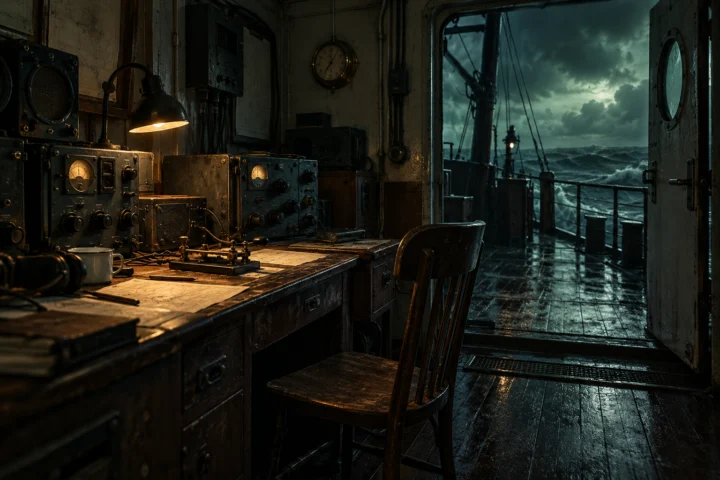
The familiar story begins with a distress signal from the Dutch freighter Ourang Medan: officers and captain dead, perhaps the whole crew dead, followed by the words “I die”. Rescuers supposedly found bodies staring in terror before fire forced them off and the ship exploded, destroying the evidence.
Versions place the disaster in 1947 or 1948 near the Strait of Malacca and name the Silver Star as rescue ship. Yet British newspapers printed a recognisable version in November 1940. Later Dutch, American and German retellings changed the date, route, message and survival details.
No secure registration for Ourang Medan, crew list, wreck position or contemporary rescue log has been located. The 1952 retelling in a United States Coast Guard publication was a magazine story, not the finding of a Coast Guard investigation. Its official-looking venue later became borrowed authority.
The paper trail resembles the merged sources of the Black Knight Satellite, the maritime gaps around Mary Celeste, and the mechanism described in urban legends before the internet.
Claim, Context and Cautions
The story people remember
The dead crew, impossible final message, hurried boarding party and convenient explosion create an efficient horror narrative. Proposed causes range from poison cargo to carbon monoxide and the supernatural. Each explanation begins by assuming the shipboard scene occurred.
Before explaining deaths, the archive must establish a vessel, date, crew and original report. Those foundations are missing.
A publication date before the disaster
Yorkshire newspapers carried the mystery SOS story in November 1940. Later accounts moved it to the post-war period and added named ships or locations. The source chain repeatedly points towards writer Silvio Scherli of Trieste rather than an identifiable maritime authority.
A story cannot be contemporary evidence for a 1947 event when substantially the same story was already in print seven years earlier.
Registers, logs and borrowed authority
Historic Lloyd’s Registers provide a large record of merchant shipping, but researchers have not found a matching vessel. Nor has a rescue log supplied the missing chain. Smuggling or wartime secrecy is sometimes offered to explain every absence, making the claim harder rather than easier to test.
The Coast Guard magazine’s later republication documents circulation. It does not retroactively create an investigation file.
A ghost made of citations
Each retelling could cite an earlier retelling while adding atmosphere. Once a government publication repeated the tale, later authors often cited the institution rather than asking what evidence the article itself supplied.
Ourang Medan is therefore valuable as documented folklore. The mystery is not how a verified crew died, but how a story without a secure ship acquired the appearance of a maritime case file.
Why chemical explanations do not rescue the record
Hazardous cargo, leaking carbon monoxide and wartime nerve agents are frequently proposed because they could kill a crew and make rescuers retreat. Theories then use the reported explosion to explain why no sample survived. This creates a closed loop: every missing record becomes evidence of secrecy, and destroyed evidence is invoked to support a cause that was never measured.
Real maritime disasters can involve undocumented cargo and confused radio traffic, but they still leave intersecting records—ports, owners, insurers, crew families, weather, wreck searches or named radio stations. The Ourang Medan story supplies none with a stable date. Even the rescue ship’s identity shifts across versions.
An ordinary mechanism cannot authenticate a fictional or composite event. Chemistry becomes relevant only after the historical vessel and incident are established. Until then, the most economical explanation is transmission and embellishment in print.
Reference trail
Sources
- British Newspaper Archive, Yorkshire Evening Post Ourang Medan result (opens in a new tab)Archive index confirming the 21 November 1940 newspaper appearance; access to the scan may require a subscription.
- U.S. Coast Guard, Proceedings of the Merchant Marine Council, May 1952 (opens in a new tab)Digitised volume containing the later “We Sail Together” retelling; it is a publication source, not an investigative finding.
- Lloyd’s Register Foundation, historic Registers online (opens in a new tab)Authoritative portal to digitised ship registers, used to describe the documentary record against which the alleged vessel has been searched.
- The Skittish Library, 1940 Ourang Medan newspaper trail (opens in a new tab)Source-led research reproducing and tracing the 1940 British reports; useful secondary analysis with clear archive references.
Case Book
Photographs, Maps and Supporting Images
Supporting images provide documentary, geographic or visual context. Read each caption for its date, source and evidential limits.

Continue researching
Follow the evidence, context and comparisons
Curated connections
Selected editorially for this entry.
The Black Knight is a composite legend assembled from unrelated radio experiments, Cold War tracking stories and STS-88 photographs of lost thermal insulation.
Curated connection · Case fileMary Celeste: The Empty Ship That Would Not Explain ItselfThe famous 1872 maritime mystery is less a ghost story than a stubborn problem of evidence, weather, cargo and missing people.
Curated connection · ArticleUrban Legends Before the InternetChain letters, photocopies, local radio and schoolyard retellings show that viral folklore did not need a screen.
More through shared context
Additional routes based only on existing topics, themes and metadata.
The Jersey Devil shows how regional folklore, landscape and newspaper appetite can turn a local creature story into a durable public monster.
Same primary topic · Shared theme: Media & rumour · Case fileThe Bridgewater Triangle: How a Folklore Region Took ShapeLoren Coleman popularised the Bridgewater Triangle as a regional paranormal zone. Its component stories vary greatly in age and evidence, and the boundary expanded through retelling.