Folklore & Legends
The Bridgewater Triangle: How a Folklore Region Took Shape
Loren Coleman popularised the Bridgewater Triangle as a regional paranormal zone. Its component stories vary greatly in age and evidence, and the boundary expanded through retelling.
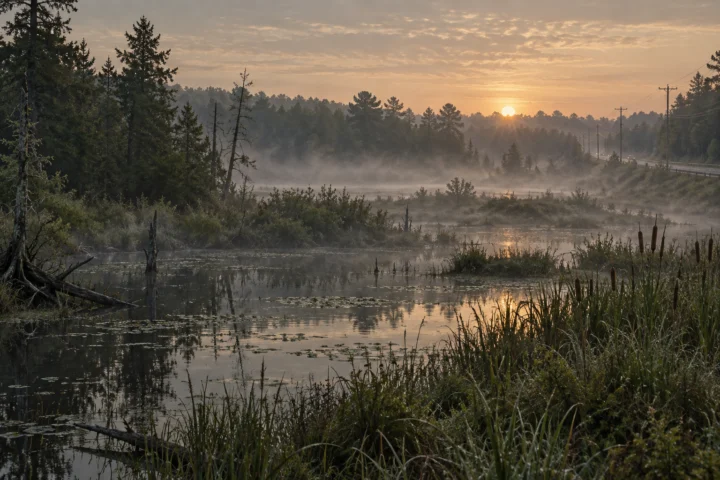
The Bridgewater Triangle is said to cover a broad part of southeastern Massachusetts, linking Hockomock Swamp with reports of lights, animals, apparitions, disappearances and ritual activity. It sounds like an ancient mapped anomaly. The organising label, however, was popularised by cryptozoologist Loren Coleman in the 1970s.
The earliest formulation focused on the towns of Abington, Bridgewater and Freetown. Later versions enlarged the boundary and gathered stories that arose in different periods, communities and documentary conditions. A report inside a drawn triangle does not become corroboration for another report miles and decades away.
Hockomock is a real and ecologically important wetland. Its difficult terrain, darkness, wildlife and deep Indigenous history deserve more than an ominous backdrop. Claims that the entire region carried one ancient supernatural meaning often flatten distinct Wampanoag histories into a modern paranormal brand.
This constructed geography can be compared with the Bennington Triangle, the evolution of modern urban legends, and the archive’s guide to working carefully with folklore.
Claim, Context and Cautions
A name coined after the stories
The triangle was not a pre-existing administrative, geological or Indigenous region. Coleman used a memorable geometric label to connect reports around the Bridgewaters and nearby country. Later maps vary, sometimes stretching towards Rehoboth and Freetown.
Because the border follows stories rather than a defined dataset, its apparent density cannot be compared meaningfully with an unselected control region.
Many genres, not one phenomenon
The collection mixes cryptid sightings, UFO reports, ghost stories, crime, historical tragedy and rumours of ritual. These categories require different evidence and do not automatically support each other.
A large anthology increases the chance that some item will feel striking. It does not demonstrate a common cause beneath unrelated events.
Hockomock beyond the ominous image
State sources describe Hockomock Swamp as a large, biologically rich wetland supporting water regulation, habitat and public conservation. Fog, difficult access and animal calls can create ambiguous experiences, but the landscape is not evidence of a curse.
Treating it solely as wilderness also obscures long human use and living Indigenous connections.
Archives reveal the construction process
The Bridgewater Public Library collection preserves clippings, correspondence and materials through which the regional idea circulated. Dates and variants make it possible to see boundaries expand and old incidents acquire a new label.
That provenance is more informative than repeating every story as if it were a contemporaneous report.
A folklore classification
Some component incidents may remain individually unresolved. The Bridgewater Triangle itself is best understood as a modern narrative framework: a way of selecting, mapping and interpreting disparate local material.
This does not make the folklore worthless. It changes the question from ‘what force occupies the triangle?’ to ‘how did this landscape become a container for strangeness?’
Contextual glossary
Terms used in this entry
Definitions are offered as reading aids, not as conclusions about the case.
- Corroboration
- Independent information that supports part of an account, such as a record, trace or separately obtained observation. Repetition from a shared source is not independent corroboration.
- Provenance
- The documented history of an object’s origin, ownership, location and handling. A dramatic claim with weak provenance cannot reliably establish where or when an object came from.
- Ritual
- A repeated, structured action carrying social, religious or symbolic meaning. Similar-looking actions can have very different meanings, so local and historical context is essential.
- Anomaly
- An observation or result that does not fit the current account. An anomaly identifies a question; it is not, by itself, evidence for any particular extraordinary explanation.
- Cryptid
- An animal or animal-like being reported in testimony or tradition but not established by accepted zoological evidence. The term covers very different claims and should not be treated as a biological category.
Reference trail
Sources
- Bridgewater Public Library, Bridgewater Triangle and Hockomock Swamp collection (opens in a new tab)Local special-collection guide documenting clippings, correspondence and the growth of the regional narrative.
- Bridgewater Public Library digitised Triangle collection PDF (opens in a new tab)Primary archive bundle used to check report dates, places and variants.
- Commonwealth of Massachusetts, “Into the Hockomock” (opens in a new tab)Official environmental and cultural context for the real wetland landscape.
- Cultural Analysis, study of Bridgewater Triangle legend-making (opens in a new tab)Peer-reviewed folklore analysis of how the region and its supernatural associations were constructed.
Case Book
Photographs, Maps and Supporting Images
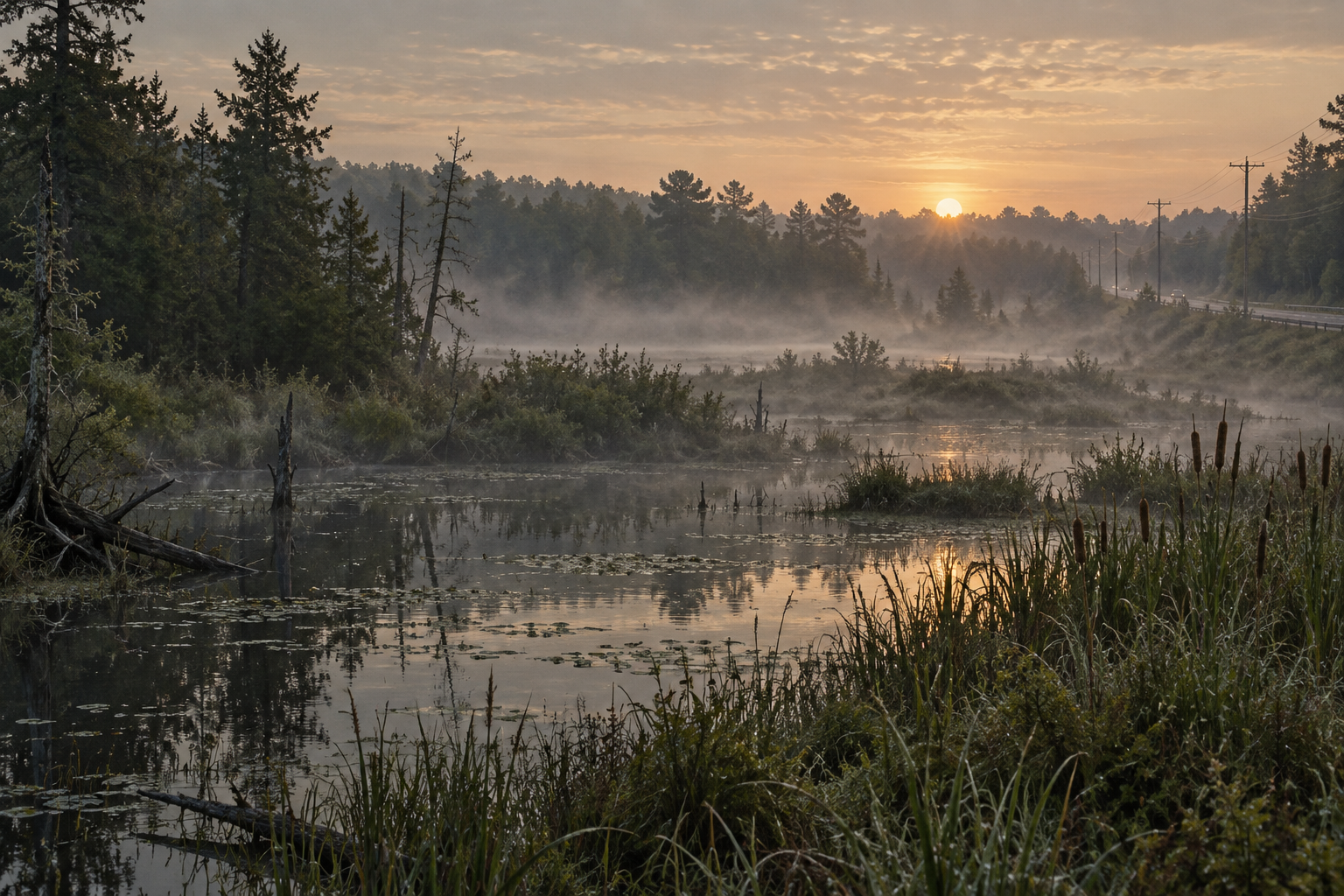
Supporting images provide documentary, geographic or visual context. Read each caption for its date, source and evidential limits.

Continue researching
Follow the evidence, context and comparisons
Curated connections
Selected editorially for this entry.
The Bennington Triangle is less a single event than a regional pattern built from disappearances, local lore and the human need to connect coincidences.
Curated connection · ArticleUrban Legends Before the InternetChain letters, photocopies, local radio and schoolyard retellings show that viral folklore did not need a screen.
Curated connection · ArticleFairy Lore as Local GeographyHills, rings, paths and boundaries often matter more than wings or glitter in older fairy traditions.
More through shared context
Additional routes based only on existing topics, themes and metadata.
The Jersey Devil shows how regional folklore, landscape and newspaper appetite can turn a local creature story into a durable public monster.
Same primary topic · Shared theme: Media & rumour · Case fileOurang Medan: The Ghost Ship With No Secure ShipOurang Medan is a maritime legend built through changing newspaper and magazine retellings. No verified ship registration, crew list, wreck or rescue record anchors the event.