Hoaxes, Misidentifications & Media
The Face on Mars: Pareidolia in a Planetary Archive
The Face on Mars became a classic anomaly because one low-resolution Viking image looked uncannily human until better imaging restored it to geology.
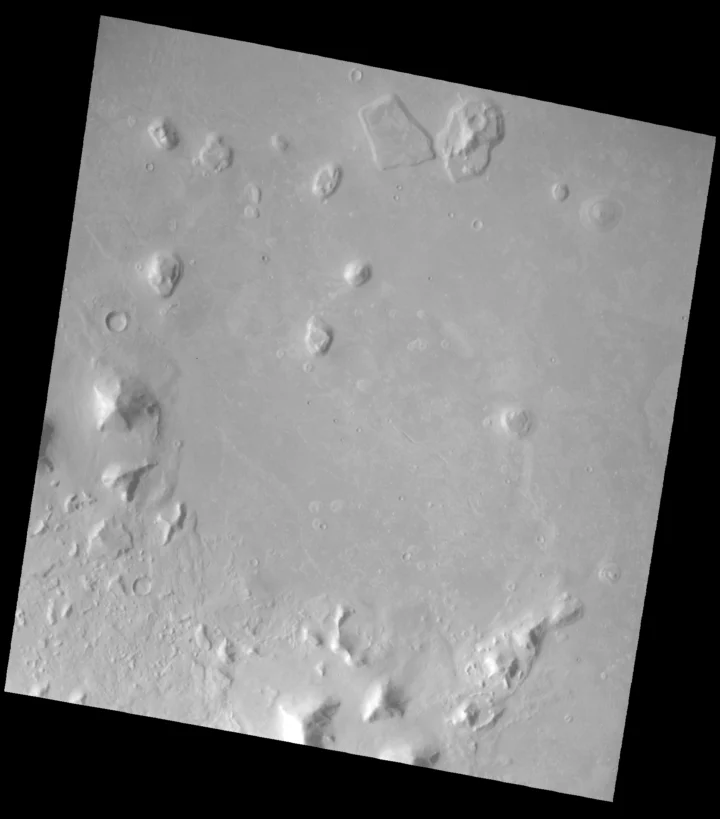
In one 1976 orbital frame, a Martian mesa had eyes, a nose and a mouth. In later, sharper frames it was one eroded hill among many. The landform did not change. The information did, making Cydonia an unusually clear test of whether a mystery is allowed to shrink when better evidence arrives.
The Viking frame
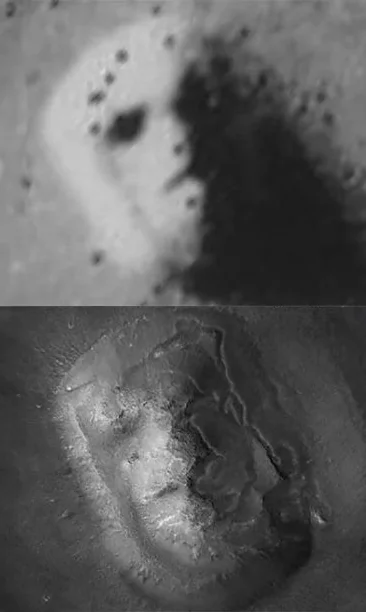
Viking Orbiter 1 photographed the Cydonia region on 25 July 1976 while NASA was surveying possible landing sites. Frame 35A72 showed a roughly two-kilometre-wide feature illuminated at a low angle. At the available resolution, bright slopes and deep shadows arranged themselves into a face-like pattern.
NASA’s contemporary caption described a rock formation resembling a human head and attributed the appearance to shadows. The image nevertheless entered books, lectures and television as possible evidence of artificial construction. Nearby hills were grouped into supposed pyramids and alignments, allowing one ambiguous frame to grow into an imagined complex.
Why the face was easy to keep seeing
Human vision is specialised for detecting faces quickly, including in incomplete information. This tendency, pareidolia, is useful in everyday life and prolific in clouds, stains and rock. Once the expected pattern has been named, attention locks onto features that support it. Compression, contrast adjustment and repeated cropping can strengthen the pattern further.
The first frame also lacked a familiar scale. Viewers saw a face-shaped object rather than a large mesa cut by ridges and gullies. The language of “the Face” then made the interpretation feel like the object’s name rather than one response to one lighting condition.
Returning with better cameras
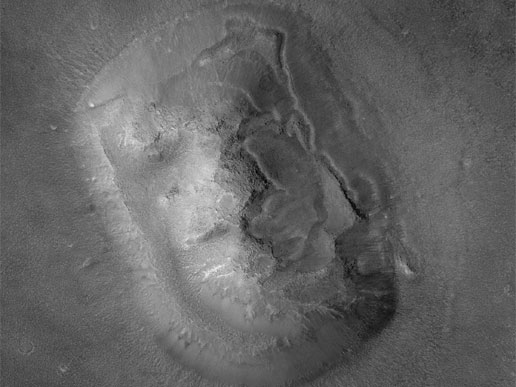
Mars Global Surveyor acquired a much higher-resolution image in April 1998. Further images followed under different illumination, and Mars Express later mapped Cydonia in stereo and colour. The supposed eyes, nose and mouth resolved into ordinary topography. Infrared views placed the hill among neighbouring mesas with comparable geology.
Some advocates argued that unfavourable lighting or processing concealed artificial features. That move reverses the normal evidential test: instead of allowing higher-quality observations to evaluate the first claim, it protects the claim from observations that weaken it. A hypothesis that accepts only the image it began with cannot improve.
What was actually discovered
The Viking photograph was real, the resemblance was striking and the later images are publicly available. There is no verified structure, construction material or associated artefact at the site. The resolved mystery is the identity of the formation, not the cultural life of the image.
Cydonia remains valuable because it shows the archive working as it should. The earliest record is retained, the better records are placed beside it, and the interpretation changes. Noticing a face was human. Insisting on a face after the terrain became visible would be the mistake.
Claim, Context and Cautions
Claim
A Viking Orbiter image was interpreted by some writers as an artificial human face and evidence of a lost Martian civilisation.
What is solid?
The 1976 frame shows a face-like pattern under low-angle illumination. NASA, ESA and later missions obtained substantially sharper images of the same natural mesa.
What changed?
Higher resolution and different lighting resolved the apparent facial features into ridges, slopes and shadows typical of the surrounding terrain.
Explanation
Pareidolia, low resolution, shadow and expectation explain why a natural landform was read as a designed face.
Sceptical view
A claim should be revised when better observations remove the feature that made it compelling. The first image cannot be privileged simply because it is more suggestive.
Why it still matters
Cydonia is a visual demonstration of how anomalies are created by limited data and how an honest archive lets improved evidence reduce mystery.
Contextual glossary
Terms used in this entry
Definitions are offered as reading aids, not as conclusions about the case.
- Pareidolia
- The perception of a meaningful form, especially a face or figure, in ambiguous patterns. It is a normal feature of perception and becomes stronger when an expected shape has already been suggested.
- Anomaly
- An observation or result that does not fit the current account. An anomaly identifies a question; it is not, by itself, evidence for any particular extraordinary explanation.
- Artefact
- An object made, modified or used by people. Its material, manufacture, wear and archaeological context are evidence; an unusual appearance alone does not establish an unusual age or origin.
- Infrared
- Electromagnetic radiation with wavelengths longer than visible red light. Infrared sensors can record heat-related or reflected signals, but the colours in a displayed image are often assigned during processing.
Reference trail
Sources
- NASA Science: Face on Mars (opens in a new tab)1998 Mars Global Surveyor image and mission context.
- NASA Science: The So-Called Face on Mars in Infrared (opens in a new tab)Infrared view placing the feature among comparable Cydonia mesas.
- ESA: Cydonia - the face on Mars (opens in a new tab)Mars Express high-resolution and stereo imaging.
Case Book
Photographs, Maps and Supporting Images
Supporting images provide documentary, geographic or visual context. Read each caption for its date, source and evidential limits.
Continue researching
Follow the evidence, context and comparisons
Curated connections
Selected editorially for this entry.
Aircraft, satellites, planets, drones and atmospheric effects can become strange when context is missing.
Curated connection · ArticleThe Difference Between Evidence, Testimony and LegendA field guide to three words that often get tangled in mystery research.
Curated connection · Case fileThe Nazca Lines: Huge Drawings Without Impossible BuildersThe Nazca Lines are extraordinary landscape works, but careful archaeology explains them through human labour, ritual geography and desert preservation.
More through shared context
Additional routes based only on existing topics, themes and metadata.
The Lake Nyos disaster was caused by a limnic eruption: deep water saturated with volcanic carbon dioxide overturned and released a dense, suffocating cloud.
Shared theme: Atmosphere & optics · Case fileThe Hessdalen Lights: A Valley Under ObservationHessdalen’s recurring lights prompted field campaigns and automatic monitoring after a wave in the early 1980s. The label covers mixed observations, not one proven phenomenon.