Disappearances & Unresolved Identities
The Somerton Man: From “Tamám Shud” to Carl Webb
DNA from hairs embedded in the death mask produced a strong genealogical identification announced in 2022. South Australian authorities have continued their own review, so identity confidence should not be confused with an official cause-of-death finding.
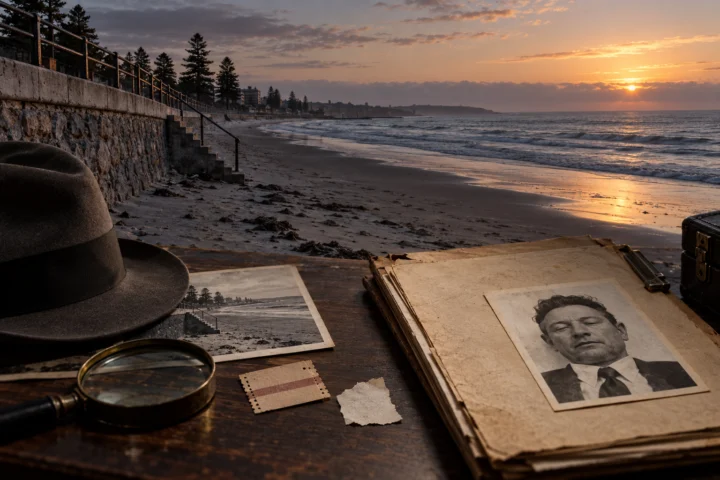
On 1 December 1948, a well-dressed man was found dead against the seawall at Somerton Beach near Adelaide. He carried no identification. Labels had been removed from much of his clothing, and fingerprints circulated internationally did not produce a name.
Police linked a suitcase at Adelaide railway station to the dead man. Months later, a tiny rolled paper reading “Tamám Shud”—“finished” or “ended”—was found in a concealed pocket. It had been torn from a copy of the Rubáiyát of Omar Khayyám; a recovered book contained a telephone number and marks widely described as a code.
The Cold War setting encouraged espionage theories, but unusual objects are not proof of intelligence work. The autopsy did not establish a definitive cause, while poisoning remained a debated possibility. The book marks have never yielded a verified decipherment.
In 2022, Derek Abbott and Colleen Fitzpatrick announced that DNA recovered from hairs embedded in the plaster death mask led through genetic genealogy to Carl “Charles” Webb, born in Melbourne in 1905. Documentary records and descendant matches supported the reconstruction.
The method echoes forensic genetic genealogy, identity testing in the Kaspar Hauser case, and uncertainty management in missing-person investigations.
Claim, Context and Cautions
The original file and its gaps
Contemporary photographs, autopsy findings, clothing and the suitcase anchor the case. The link between suitcase and body rests on timing and unusual thread rather than a name tag. The Rubáiyát fragment is documented, but the history of the matching book includes human hand-offs and uncertainty.
Each object should retain its own provenance instead of becoming one cinematic spy kit.
A code that may not be a code
Letters written in the book could represent a cipher, initials, a mnemonic, verse indexing or meaningless notes. Short strings permit many forced solutions because there is too little material to distinguish them statistically. No claimed decryption has produced independent, verifiable information about the man's identity or death.
The telephone number led to a local woman, but acquaintance and causation were never established from that fact alone.
How the DNA identification worked
Hair shafts associated with the death mask supplied genetic data separate from the exhumed remains. Genealogists matched segments to people in consumer databases, built family trees through civil records and converged on Carl Webb. The claim was presented at a forensic-science meeting with a high probability based on matching relatives.
This is powerful convergent evidence, while contamination, sample provenance and official comparison remain important audit questions.
A name does not solve the death
Webb’s background makes the dead man less anonymous and allows documents to be sought, but it does not convert speculation about poison, suicide, accident or homicide into a finding. In 2026 South Australia Police reported that its investigation and report to the coroner were nearing completion; public official confirmation had not yet supplied a final cause.
The responsible status is therefore divided. Carl Webb is the strongly supported identification advanced by forensic genealogy. The mechanism and intention of his death, the meaning of the book marks, and parts of his final movements remain unresolved. Solving one proposition should narrow a mystery, not falsely close every question attached to it. Records published later may revise that status.
Contextual glossary
Terms used in this entry
Definitions are offered as reading aids, not as conclusions about the case.
- Forensic genetic genealogy
- The use of a forensic DNA profile with genealogical records and genetic matches to develop identity or kinship leads. Documentary research and direct confirmation are still required before a proposed identification is treated as established.
- Reconstruction
- A later model, image or account made to represent an event from surviving information. It can clarify a hypothesis but should remain visibly separate from contemporary evidence.
- Uncertainty
- The stated limit on what a measurement, reconstruction or body of evidence can establish. Describing uncertainty is not indecision; it prevents a result from appearing more precise than the evidence allows.
- Contamination
- The introduction of outside material or information into evidence. It may affect DNA, objects, recordings or witness accounts and must be considered before treating a match as independent.
- Provenance
- The documented history of an object’s origin, ownership, location and handling. A dramatic claim with weak provenance cannot reliably establish where or when an object came from.
Reference trail
Sources
- American Academy of Forensic Sciences, 2023 proceedings (opens in a new tab)Conference abstract detailing the hair source, genetic genealogy and Carl Webb identification.
- South Australia Police, Somerton Man exhumation briefing (opens in a new tab)Official 2021 briefing on exhumation, DNA strategy and the continuing investigation.
- ABC News, police report to coroner nearing completion (opens in a new tab)Current reporting distinguishing the private DNA identification from pending official findings.
Case Book
Photographs, Maps and Supporting Images
Supporting images provide documentary, geographic or visual context. Read each caption for its date, source and evidential limits.

Continue researching
Follow the evidence, context and comparisons
Curated connections
Selected editorially for this entry.
Investigative genetic genealogy is a powerful lead-generating method, not a machine that names a person automatically. Its results depend on sample quality, database rules, documentary genealogy and independent confirmation.
Curated connection · Case fileKaspar Hauser: The Foundling, the Prince Claim and the DNA ResultKaspar Hauser was a real unidentified youth whose changing story attracted patrons and suspicion. Modern mitochondrial DNA excludes the House of Baden maternal line; it does not reveal his parents or fully resolve his fatal wound.
Curated connection · ArticleSearch Without a Story: How Missing-Person Investigations Manage UncertaintyA practical guide to search theory: how planners separate likely location from detectability, update search areas and avoid turning an unsuccessful search into proof of an extraordinary disappearance.
More through shared context
Additional routes based only on existing topics, themes and metadata.
Dyatlov Pass remains an archive of frozen conditions, injuries and competing explanations, with the strongest case still grounded in the mountain rather than the supernatural.
Same primary topic · Shared theme: Unsolved deaths · Case fileThe Franklin Expedition: Wrecks, Testimony and a Fatal RetreatThe Franklin expedition was destroyed by a compound Arctic disaster rather than a single mysterious event. Inuit knowledge and archaeology have recovered its ships, while the exact movements and deaths of the crews remain incomplete.