Disappearances & Unresolved Identities
Search Without a Story: How Missing-Person Investigations Manage Uncertainty
A practical guide to search theory: how planners separate likely location from detectability, update search areas and avoid turning an unsuccessful search into proof of an extraordinary disappearance.
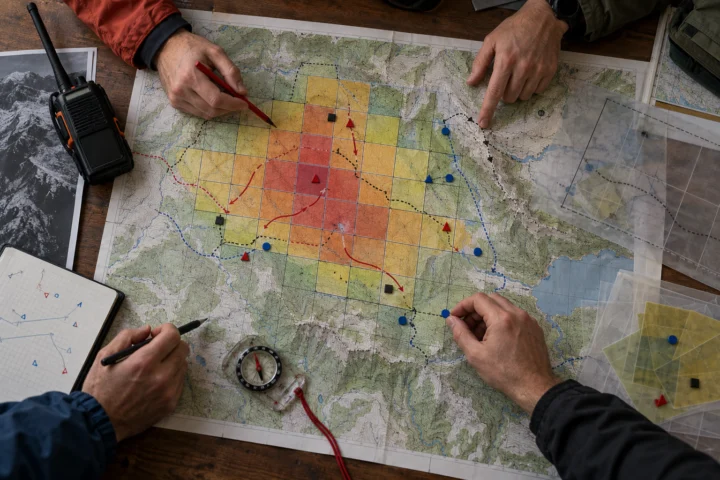
Missing-person stories often acquire a clean shape only after the search has failed. A last sighting becomes an exact point, an unsearched patch becomes a forbidden zone, and the absence of a find becomes evidence that the person could not have been there. Operational search planning is less tidy. It treats location, movement, detection and available resources as uncertain quantities that change with every report and completed sweep.
The first distinction is between probability of area and probability of detection. A sector may be the likeliest place for the missing person while still being difficult to search because of vegetation, terrain, weather or the size of the search object. Conversely, an open field may be easy to clear but unlikely to contain the person. Good planning weighs both instead of treating a line on a map as certainty.
A last known position is also an evidential claim, not a magical centre. Investigators ask when the person was reliably observed, whether a vehicle or phone changed the possible range, and whether witness times came from clocks, estimates or later reconstruction. Scenarios are assigned relative weight, searched, and revised. In maritime work, drift models add wind and current; on land, route choices, mobility and hazards shape the distribution.
This method explains why “they searched everywhere” is almost never literal. Teams record where they went, how they searched and what they could reasonably have detected. Search effort raises the chance that an object would have been found in a sector; it seldom makes that chance one hundred per cent.
The method clarifies the uncertain route in the Yuba County Five case, the incomplete maritime record of USS Cyclops, and the archive’s guide to evidence, testimony and legend.
Claim, Context and Cautions
Probability is not a prediction
A probability map is a disciplined statement of uncertainty. It can combine the last reliable position, likely routes, known intentions, terrain, transport and behaviour appropriate to the circumstances. The result ranks areas for attention; it does not declare where the person is.
New evidence may move probability sharply. An apparently minor timestamp correction, verified sighting or recovered item can change the useful search area more than another day of repeating the same pattern.
Coverage is not detection
A team can walk through a grid without seeing everything inside it. Detection depends on spacing, speed, fatigue, light, concealment, sensor limits and the contrast between the target and background. Search planners therefore record effective effort rather than colouring a whole sector as simply searched.
This is why later discoveries inside earlier search areas need not imply conspiracy or incompetence. They require a careful comparison of the original track, conditions and target visibility.
How searches learn
After a sweep, planners update the chance that the target remains in that area and decide where the next unit can add the most probability of success. Repeated searches can still be rational when conditions change or the first detection probability was low. They can also waste scarce daylight when a different scenario has become stronger.
The Coast Guard's SAROPS system uses many simulated trajectories for drifting objects and allocates resources to improve overall success. The mathematics supports judgement; it does not replace local knowledge or command responsibility.
Reading an old disappearance responsibly
A historical file should preserve the difference between a planned area, the tracks actually covered and claims made later about completeness. Ask whether search logs survive, whether weather or terrain limited observation, and whether the supposed last sighting was independently confirmed.
A failed search is important evidence about effort and conditions. It is not, by itself, an explanation for the disappearance. The archive should preserve what teams could detect, not silently promote an operational judgement into certainty.
Contextual glossary
Terms used in this entry
Definitions are offered as reading aids, not as conclusions about the case.
- Last known position
- The most recent location supported by reliable evidence for a missing person, ship or aircraft. Search planning distinguishes it from a planned destination or an unverified later sighting.
- Search theory
- The use of probability, detection performance and resource planning to decide where and how to search. The search plan is revised as new evidence changes likely locations or detectability.
- Probability of detection
- The estimated chance that a search or test would find the target if it were present. A failed search is stronger evidence of absence when coverage and detection probability were high.
- Search area
- The geographic region selected for a search from the last reliable position, likely movement, terrain and available time. It is a planning model, not proof that the missing subject entered every part of it.
- Uncertainty
- The stated limit on what a measurement, reconstruction or body of evidence can establish. Describing uncertainty is not indecision; it prevents a result from appearing more precise than the evidence allows.
Reference trail
Sources
- International Maritime Organization, IAMSAR Manual overview (opens in a new tab)Official description of the joint IMO/ICAO framework for organising, coordinating and conducting search and rescue.
- US Coast Guard, Theory of Search (opens in a new tab)Official technical explanation of probability of area, probability of detection, coverage and cumulative search effectiveness.
- US Coast Guard, Search and Rescue Optimal Planning System (opens in a new tab)Official account of the Monte Carlo planning system used for maritime drift and resource allocation.
Case Book
Photographs, Maps and Supporting Images
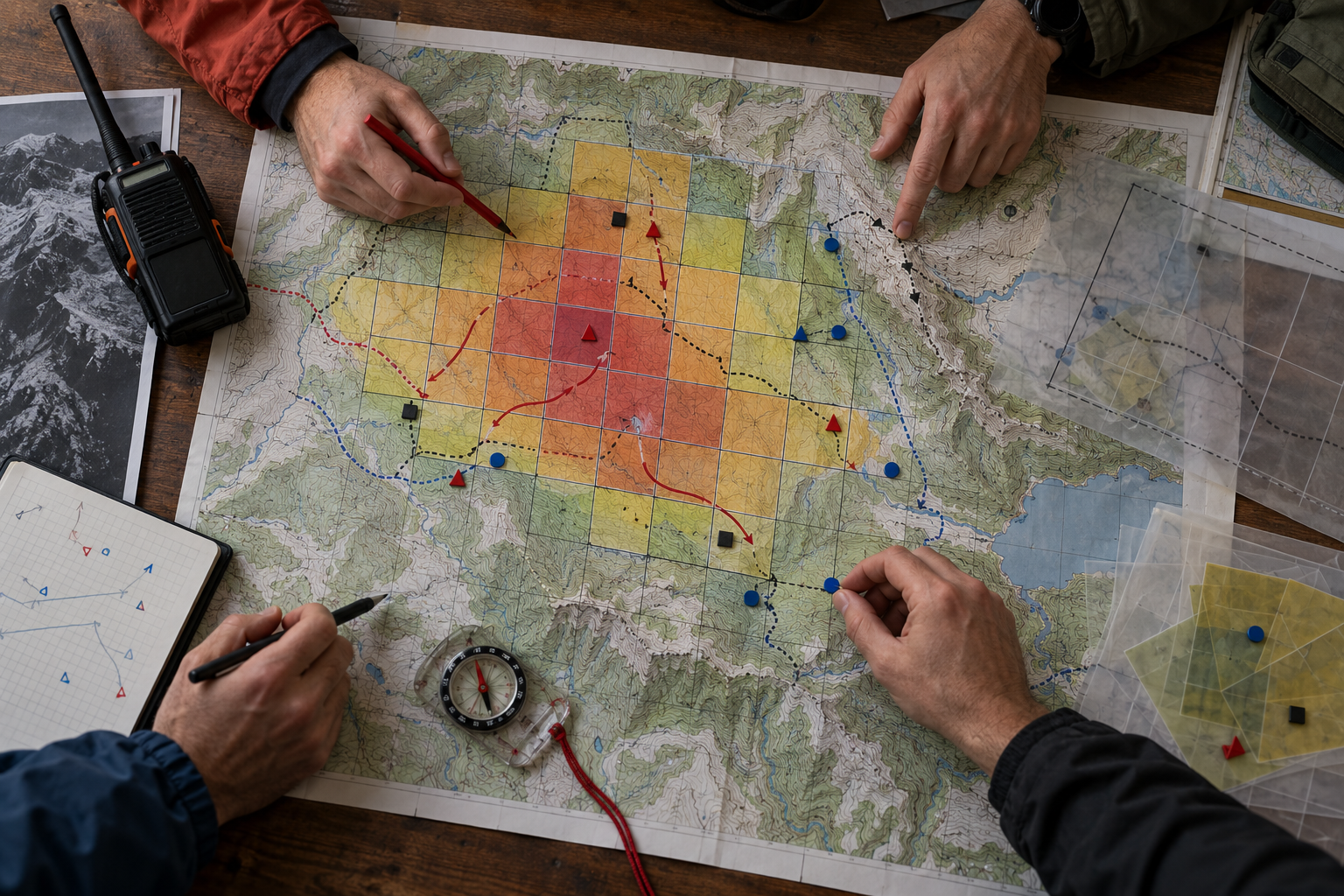
Supporting images provide documentary, geographic or visual context. Read each caption for its date, source and evidential limits.

Continue researching
Follow the evidence, context and comparisons
Curated connections
Selected editorially for this entry.
A field guide to three words that often get tangled in mystery research.
Curated connection · Case fileThe Yuba County Five: A Road Into the SnowA disappearance case where winter road, confusion and delayed discovery created a mystery larger than any one clue.
Curated connection · Case fileUSS Cyclops: The Collier That Never Reached BaltimoreThe disappearance of USS Cyclops is a major United States Navy loss without a recovered wreck. Structural, loading, weather and wartime explanations remain constrained by missing evidence.