Disappearances & Unresolved Identities
The Franklin Expedition: Wrecks, Testimony and a Fatal Retreat
The Franklin expedition was destroyed by a compound Arctic disaster rather than a single mysterious event. Inuit knowledge and archaeology have recovered its ships, while the exact movements and deaths of the crews remain incomplete.
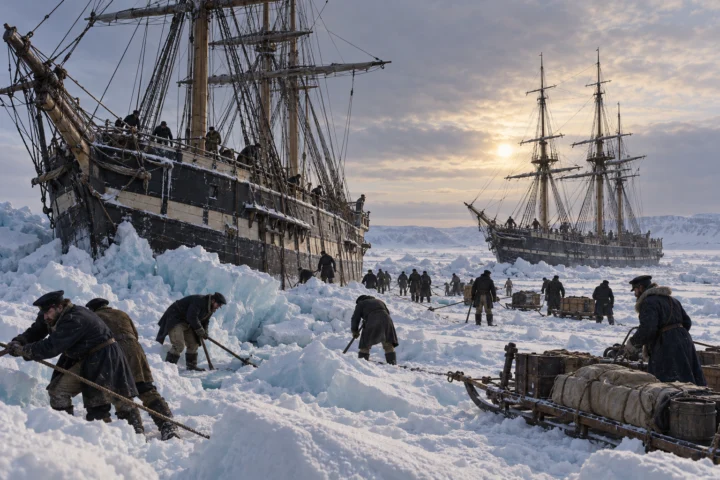
HMS Erebus and HMS Terror sailed from Britain in May 1845 to chart a Northwest Passage. Sir John Franklin commanded 129 officers and men with reinforced ships, steam engines and provisions intended for several years. After contact with whalers in Baffin Bay, the expedition disappeared from European view.
A note later found at Victory Point supplies the central chronology. The ships became trapped in ice in September 1846. Franklin died on 11 June 1847. By April 1848, twenty-four men were dead; the 105 survivors abandoned the vessels and intended to travel south toward Back’s Fish River.
None reached a settlement. Search expeditions found graves, camps, artefacts and human remains over a wide route. Inuit witnesses reported encounters, bodies and a ship that sank farther south. Some European searchers discounted or distorted this knowledge, although it proved essential to later reconstruction.
Parks Canada and Inuit partners found Erebus in 2014 and Terror in 2016. Their locations confirmed important testimony and transformed the investigation from a search for ships into underwater archaeology. The positions also raise questions about whether one vessel drifted, was reoccupied or moved after abandonment.
The expedition demonstrates the search limits discussed in missing-person investigations and can be compared with the environmental crises behind the Dyatlov Pass incident and the lost keepers of the Flannan Isles lighthouse.
Claim, Context and Cautions
What the Victory Point note says
The document combines a reassuring 1847 message with a marginal update written in 1848. It records the wintering locations, ice entrapment, Franklin's death, total deaths and the decision to march. Its brevity leaves medical condition, ship damage, food quality and command debates unstated.
Because it is the only substantial written record recovered from the expedition, later narratives can place too much weight on each phrase. The note establishes milestones, not the entire causal sequence.
A compound disaster
Scurvy, tuberculosis, respiratory illness, injury, hunger, cold and exhaustion have all been investigated. Elevated lead in some remains prompted theories of poisoning from tinned food or ship systems, but later work questions whether lead alone caused collapse. Cut marks on bones provide evidence that some survivors processed bodies for food.
No single diagnosis explains every death. Years trapped in ice, declining manpower and a long overland retreat created interacting failures in an environment where rescue was remote.
Inuit evidence and the wrecks
Inuit accounts placed a ship near the Adelaide Peninsula and described objects, bodies and encounters. Searchers collected this information unevenly, sometimes filtering it through assumptions about what survivors should have done. Modern searches used oral knowledge alongside remote sensing and historical research.
The discoveries of both wrecks vindicated the geographic value of that testimony. They do not mean every retelling is identical; oral accounts, like written records, must be compared by date, route of transmission and detail.
Questions below the decks
Archaeologists are mapping cabins and recovering sealed assemblages that may preserve papers, instruments, food and personal effects. Each object can clarify life aboard, but its final position may reflect sinking, ice damage and later movement. Conservation also takes years.
The broad outcome is established: the ships were trapped, the crews suffered mounting deaths, and survivors abandoned them before dying along a southward route. What remains unresolved is the sequence aboard each vessel, any return to the ships, the last survivor groups and the balance of disease, nutrition, exposure and injury. Discovery has narrowed the mystery without turning it into a simple story.
Contextual glossary
Terms used in this entry
Definitions are offered as reading aids, not as conclusions about the case.
- Remote sensing
- Collecting information about a place or object from a distance, commonly by satellite, aircraft, radar or sonar. Interpretation depends on sensor resolution, wavelength, viewing conditions and processing.
- Reconstruction
- A later model, image or account made to represent an event from surviving information. It can clarify a hypothesis but should remain visibly separate from contemporary evidence.
Reference trail
Sources
- Parks Canada, The Wrecks of HMS Erebus and HMS Terror (opens in a new tab)Government overview of the expedition, the two wreck discoveries and the protected national historic site.
- Parks Canada, Inuit knowledge and the Franklin wrecks (opens in a new tab)Official account of Inuit testimony, its historical treatment and its role in locating the wrecks.
- Parks Canada, Searching for Erebus and Terror (opens in a new tab)Detailed official chronology of historical and modern searches and archaeological methods.
Case Book
Photographs, Maps and Supporting Images
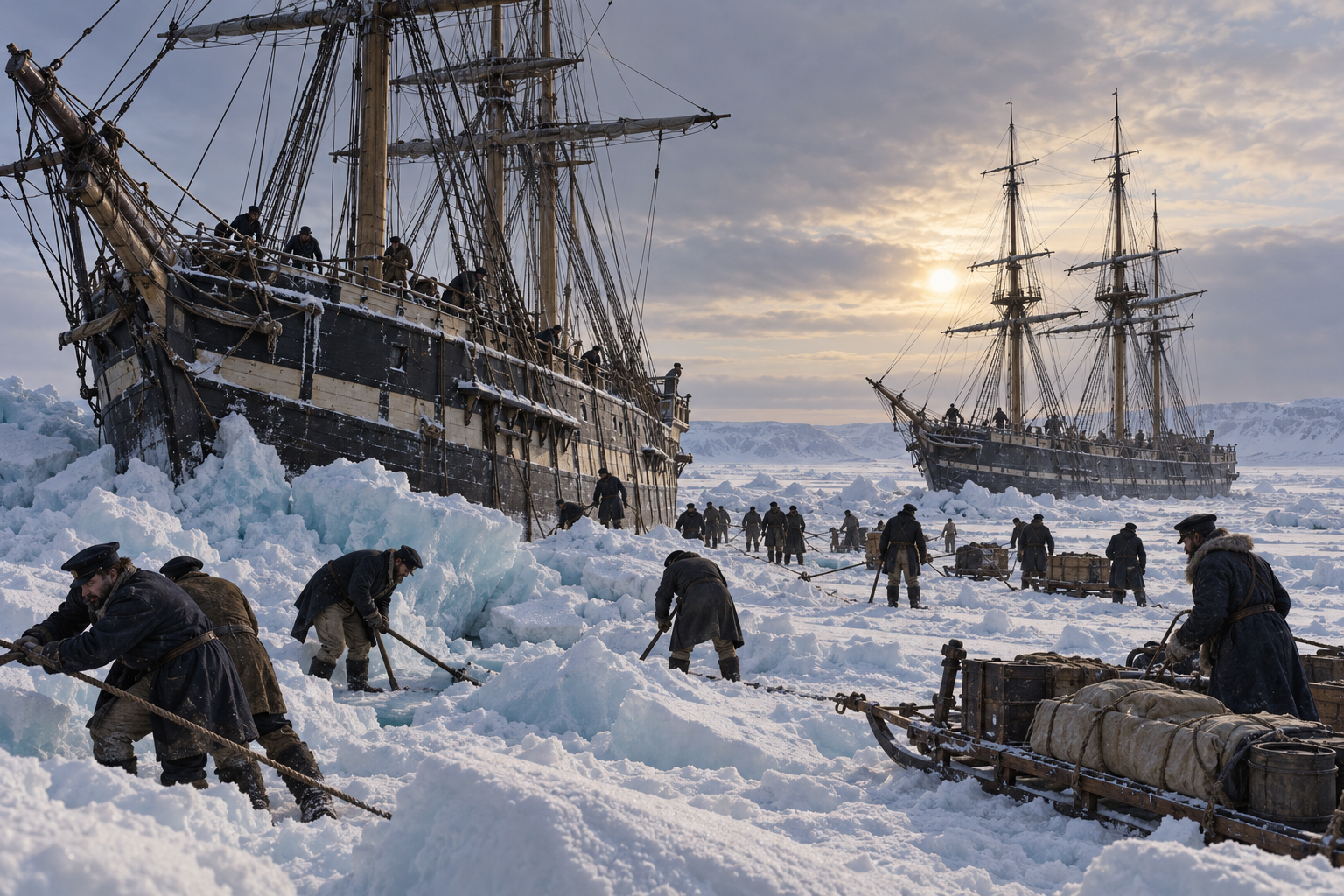
Supporting images provide documentary, geographic or visual context. Read each caption for its date, source and evidential limits.

Continue researching
Follow the evidence, context and comparisons
Curated connections
Selected editorially for this entry.
A practical guide to search theory: how planners separate likely location from detectability, update search areas and avoid turning an unsuccessful search into proof of an extraordinary disappearance.
Curated connection · Case fileDyatlov Pass: A Winter File That Still Resists a Single Easy StoryDyatlov Pass remains an archive of frozen conditions, injuries and competing explanations, with the strongest case still grounded in the mountain rather than the supernatural.
Curated connection · Case fileThe Flannan Isles Lighthouse Keepers: A Vanishing at the Edge of WeatherThree lighthouse keepers disappeared from Eilean Mor in 1900, leaving a mystery where official records point toward sea, weather and working risk rather than fantasy.
More through shared context
Additional routes based only on existing topics, themes and metadata.
The famous 1872 maritime mystery is less a ghost story than a stubborn problem of evidence, weather, cargo and missing people.
Same primary topic · Shared theme: Maritime · Case fileMV Joyita: The Waterlogged Ship and Its Missing Twenty-FiveJoyita’s seaworthiness problems and failed communications explain how an emergency could develop. The decision to abandon a buoyant vessel, and what happened afterward, remain unresolved.