Disappearances & Unresolved Identities
The Princes in the Tower: A Disappearance Inside a Succession Crisis
The princes probably died after entering the Tower of London, and Richard III had custody and benefited politically. The surviving evidence supports suspicion, not a proved murder method or uniquely identified culprit.
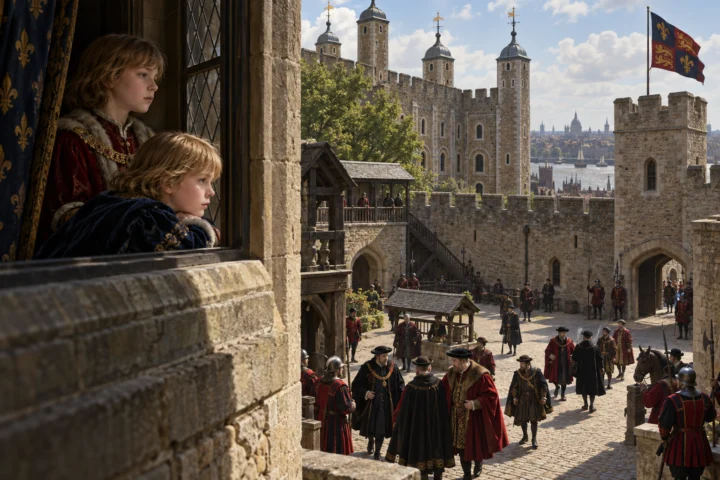
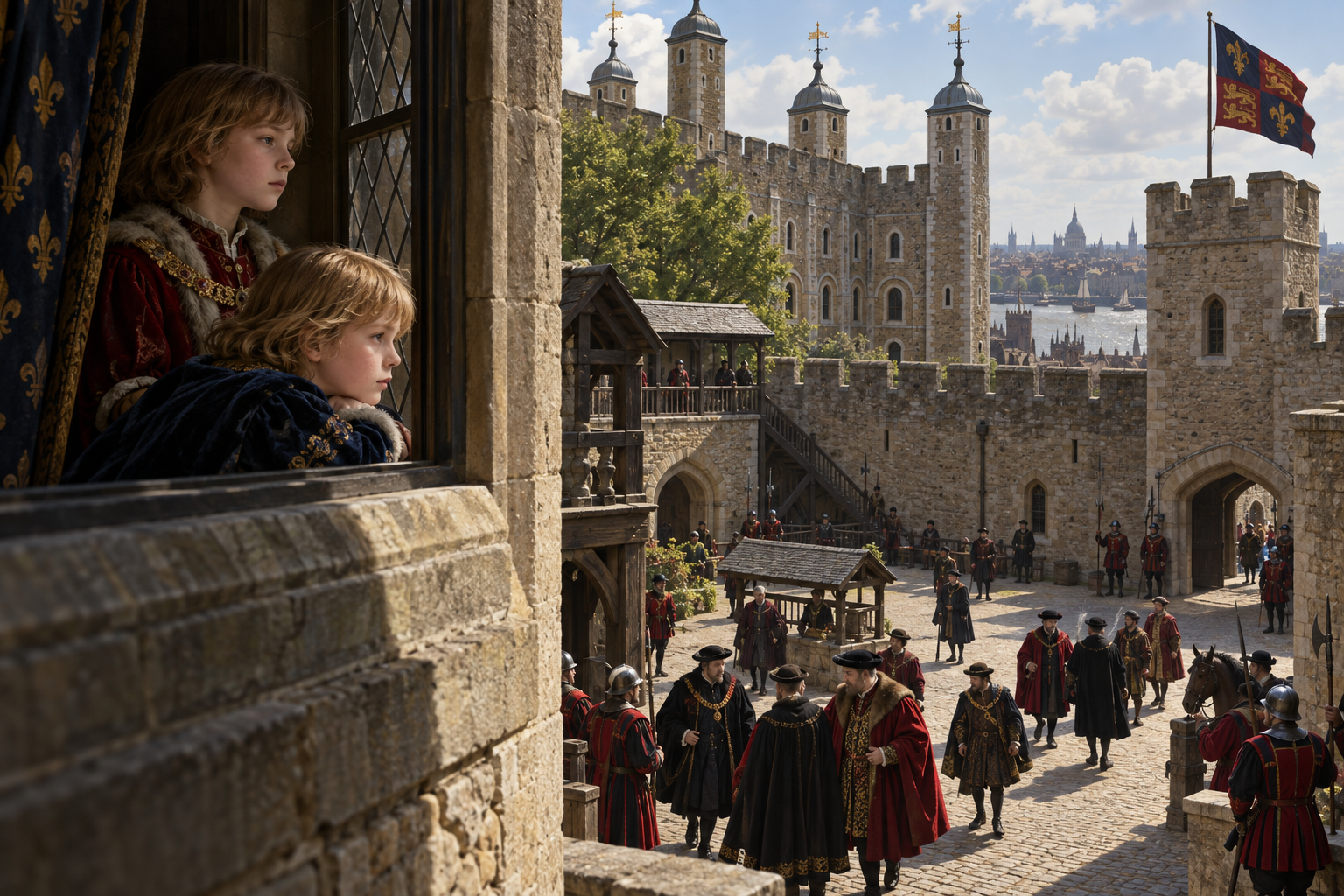
When Edward IV died in April 1483, his twelve-year-old son became Edward V. The boy’s uncle Richard, Duke of Gloucester, was appointed protector. Edward and his nine-year-old brother Richard were lodged in the Tower of London, then both royal residence and fortress, while preparations for a coronation changed into a struggle for power.
Parliament declared the brothers illegitimate, and Gloucester became Richard III in June. The boys were seen less often and then disappeared from public record. Their mother and supporters did not recover them, and no secure document records their release, survival or burial.
Richard controlled access to the Tower and benefited from their removal, giving him the clearest opportunity and motive. That is powerful circumstantial evidence, not a surviving order or eyewitness account of murder. Other suspects proposed over time include Henry Stafford, Duke of Buckingham, Sir James Tyrell and, less plausibly for the timing, the future Henry VII.
Later writers supplied vivid details. Thomas More described smothering by agents connected to Tyrell, but wrote decades afterward and left the work unfinished. Shakespeare’s drama further fixed Richard as the villain. Neither literary force nor Tudor political context automatically makes the underlying allegation false; both affect how it should be weighed.
The case benefits from the archive’s distinction between evidence, testimony and legend, the contested object history of the Shroud of Turin, and the documentary gaps surrounding the lost Roanoke colony.
Claim, Context and Cautions
A crown transferred
Edward V's household was separated during his journey to London, and leading Woodville relatives were arrested. The planned coronation was postponed. Claims that Edward IV's children were illegitimate then supplied a legal framework for Richard's accession.
These steps establish a rapid political takeover. They also explain why the boys' fate mattered: their existence could anchor opposition whether or not they were legally barred from succession.
Sources close to 1483
Foreign diplomats and chroniclers recorded rumours that the princes had been killed, but rumours are evidence of contemporary belief rather than direct observation. No known account identifies a body, place and witnessed act with an unbroken chain to 1483. Silence in royal accounts after the summer is significant but cannot date a death precisely.
A disciplined reconstruction separates documents produced during the crisis from later works shaped by Tudor rule, while recognising that near-contemporary writers also had limited access and political interests.
Bones and later accusations
Workmen found children's bones beneath a Tower staircase in 1674. They were placed in Westminster Abbey as the presumed princes, but the original context was poorly documented and an examination in 1933 could not establish identity. Without modern authorised testing, the remains cannot close the case.
Thomas More's later narrative associated the killing with Sir James Tyrell, and a purported confession entered subsequent histories. No surviving contemporary confession supplies a secure evidential chain. The accusation is historically important without proving that Tyrell killed the boys or acted for Richard.
What can responsibly be concluded
The brothers vanished while under the king's authority, were not credibly produced after rebellions invoked them, and were widely believed dead. Richard III carries the strongest responsibility because custody creates both opportunity and a duty to account for them. Assigning the physical act to him, Buckingham, Tyrell or unknown guards exceeds the surviving record.
Survival theories must explain the absence of secure contemporary reappearance and the weakness of later pretenders' identities. Murder is more probable than a long secret life, but probability is not a named killer. The mystery persists because the political result is visible while the decisive event was concealed.
Contextual glossary
Terms used in this entry
Definitions are offered as reading aids, not as conclusions about the case.
- Reconstruction
- A later model, image or account made to represent an event from surviving information. It can clarify a hypothesis but should remain visibly separate from contemporary evidence.
Reference trail
Sources
- The National Archives, Richard III (opens in a new tab)Official archival overview of Richard III, the 1483 succession and records held by The National Archives.
- Historic Royal Palaces, The Princes in the Tower (opens in a new tab)Institutional history of the princes, contemporary reports, More narrative and competing survival and murder interpretations.
- Westminster Abbey, Edward V and Richard, Duke of York (opens in a new tab)Official record of the 1674 bones, their interment and the 1933 examination.
Case Book
Photographs, Maps and Supporting Images
Supporting images provide documentary, geographic or visual context. Read each caption for its date, source and evidential limits.

Continue researching
Follow the evidence, context and comparisons
Curated connections
Selected editorially for this entry.
A field guide to three words that often get tangled in mystery research.
Curated connection · Case fileThe Shroud of Turin: An Evidence Problem Wrapped as a RelicThe Shroud of Turin is valuable to the archive because it forces every question about provenance, authentication and interpretation into the same room.
Curated connection · Case fileRoanoke: The Lost Colony and the Word on the TreeThe Roanoke disappearance endures because one carved word, missing people and colonial uncertainty leave room for both evidence and imagination.
More through shared context
Additional routes based only on existing topics, themes and metadata.
Dyatlov Pass remains an archive of frozen conditions, injuries and competing explanations, with the strongest case still grounded in the mountain rather than the supernatural.
Same primary topic · Shared theme: Unsolved deaths · Case fileThe Franklin Expedition: Wrecks, Testimony and a Fatal RetreatThe Franklin expedition was destroyed by a compound Arctic disaster rather than a single mysterious event. Inuit knowledge and archaeology have recovered its ships, while the exact movements and deaths of the crews remain incomplete.