Disappearances & Unresolved Identities
Roanoke: The Lost Colony and the Word on the Tree
The Roanoke disappearance endures because one carved word, missing people and colonial uncertainty leave room for both evidence and imagination.
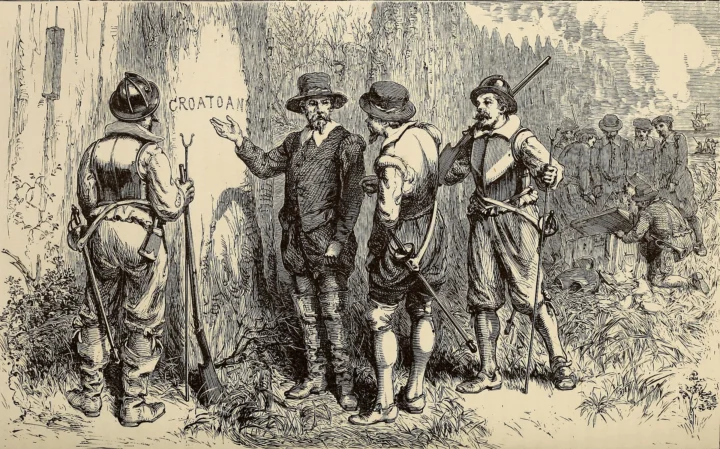
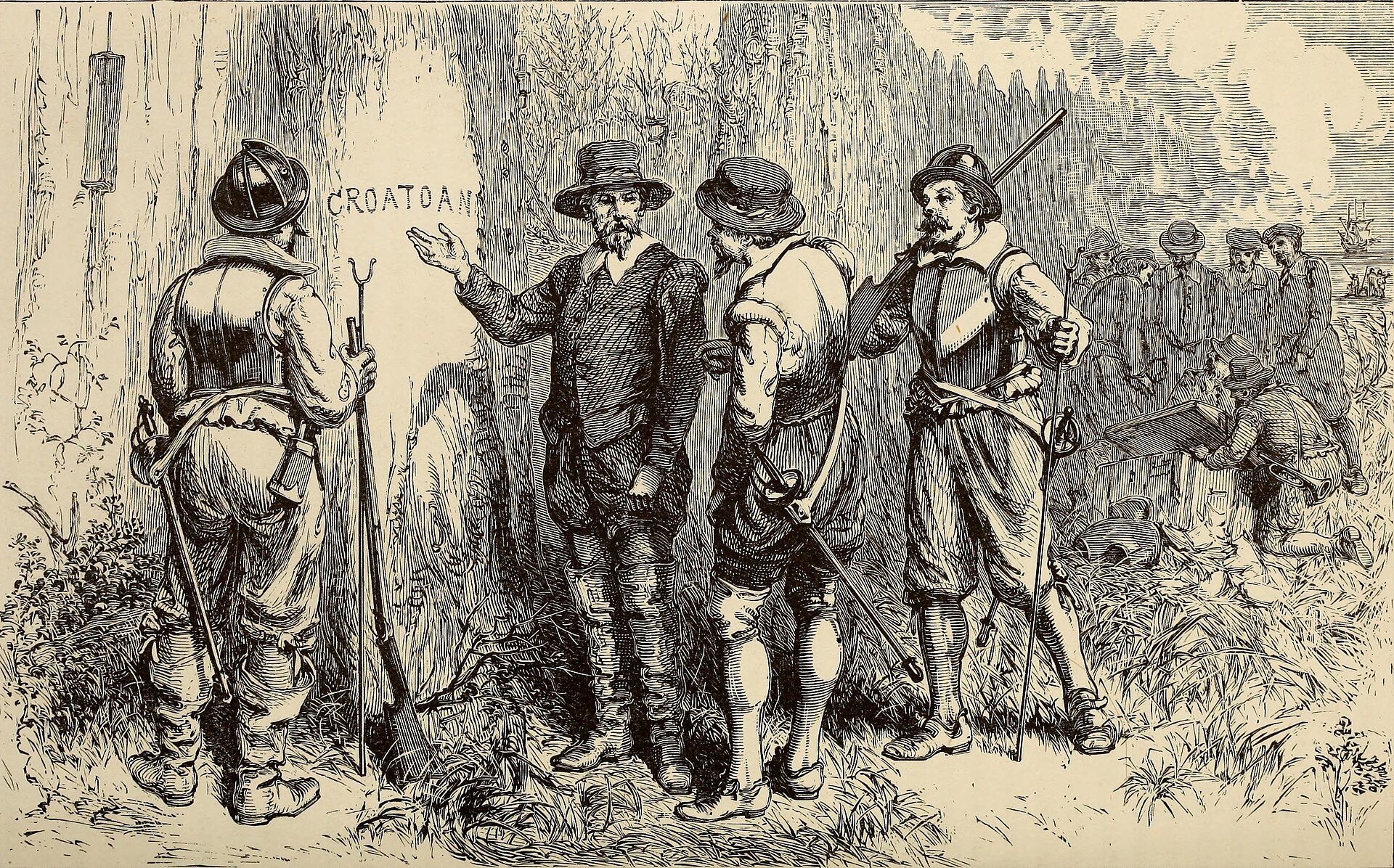
The Roanoke colony did not vanish from a sealed room. It disappeared from an exposed settlement whose supply line crossed the Atlantic, whose intended destination had already changed and whose relations with neighbouring communities had been damaged by earlier English violence. The surviving clue, Croatoan, points toward a people and a place. Later retellings often turn it into a cipher because a cipher feels stranger than a destination.
1587: a colony placed under pressure
John White led roughly 118 men, women and children from England in 1587. Their stated destination was the Chesapeake Bay, but they were left at Roanoke Island, where a previous English garrison had failed. The colonists repaired abandoned structures while food, security and the approaching winter became immediate concerns. Virginia Dare was born there in August.
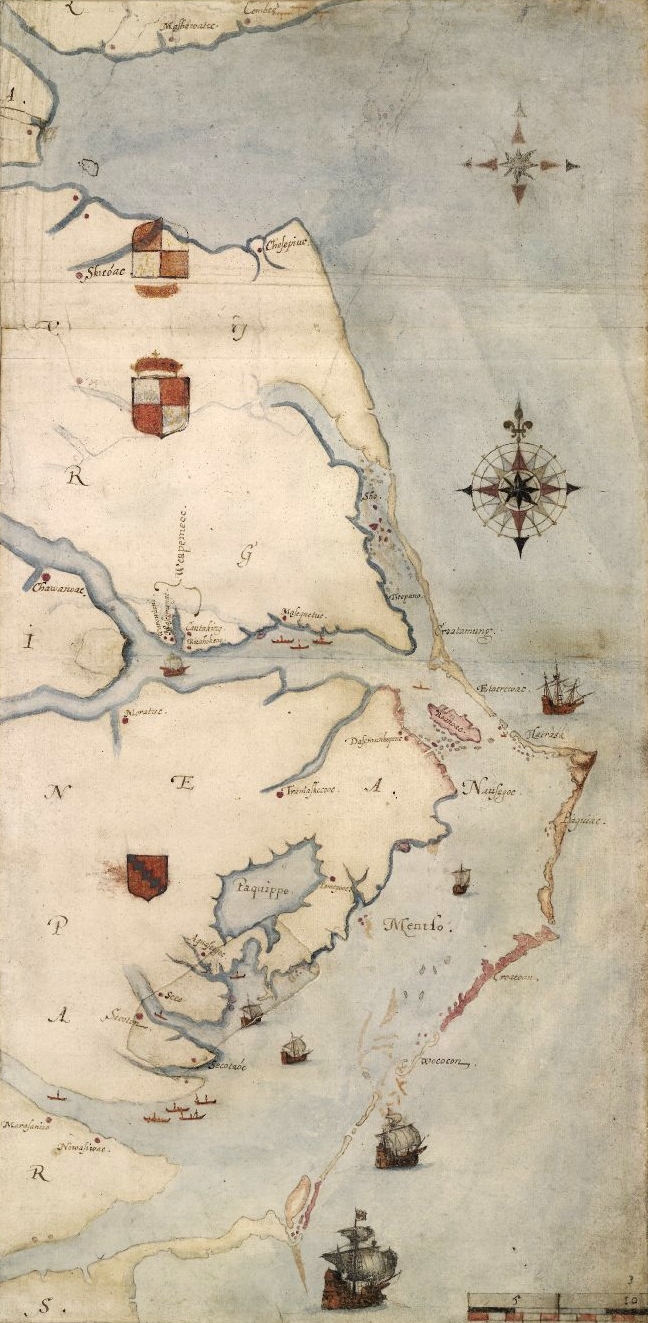
Relations with Carolina Algonquian communities were not a blank page. English expeditions had already traded, negotiated, raided and killed in the region. After settler George Howe was killed, White’s party attacked a village they believed belonged to hostile Secotan people; it was a Croatoan village. Manteo, a Croatoan man who had travelled to England and worked with the colonists, remained an important intermediary, but English actions made survival through local alliance more difficult.
White leaves and cannot return
The colonists asked White to sail back for supplies. Before he left, they agreed that if they moved they would carve their destination into a tree. A Maltese cross would indicate that they had departed under distress. White reached England in November 1587, but war with Spain and the demand for ships delayed a relief voyage. He did not return to Roanoke until August 1590.
The settlement had been dismantled rather than destroyed. “CRO” appeared on a tree and “CROATOAN” on a post, with no cross reported. White interpreted the message as an indication that the colonists had moved to Croatoan, now associated with Hatteras Island. Weather and damaged anchors prevented his party from making the intended search. That failure left a destination untested and transformed an incomplete rescue into an enduring disappearance.
What archaeology can and cannot settle
English artefacts of the relevant era have been reported on Hatteras Island and at inland sites around Albemarle Sound. Such finds make relocation or dispersal plausible, but an English object is not a colonist’s identity card. Trade, earlier voyages and later movement can place material far from its original owner. No graves, settlement or group of remains has been conclusively tied to all the missing colonists.
The most reasonable models allow the colony to split. Some people may have gone toward Croatoan, some inland, and some may have died from disease, hunger, violence or exposure. Assimilation need not leave an English-style village waiting to be found. The question may resist a single ending because there was no single ending.
A mystery shaped by whose record survives
The familiar phrase “Lost Colony” centres the missing English record. Croatoan, Secotan and Roanoke communities were not scenery surrounding that absence. They were political actors living through repeated incursions, negotiation and violence. Claims about descendants or absorption require evidence and should not be used to turn Indigenous people into a convenient solution to an English mystery.
Roanoke remains unresolved in the strict sense: the final locations and fates of the individuals are not known. Yet the surviving sequence does not resemble a supernatural disappearance. It resembles a vulnerable colonial project, a delayed relief effort and a population forced to move without leaving the continuous paper trail later historians wanted.
Claim, Context and Cautions
Claim
The 1587 English colony was absent when John White returned in 1590. The carved word Croatoan was the clearest surviving message.
What is solid?
White left for supplies, war delayed him for almost three years, the settlement was dismantled, and Croatoan was carved without the agreed distress cross. White understood it as a destination.
What remains uncertain?
No evidence identifies the final fate of every colonist. Archaeological finds support movement and contact but have not established one complete destination or outcome.
Possible explanations
Relocation to Croatoan, inland dispersal, integration with Indigenous communities, disease, hunger and conflict may all have affected different members of the colony.
Sceptical view
The absence of a complete record is not evidence of an impossible event. The known conditions strongly favour movement and attrition over paranormal disappearance.
Why it still matters
Roanoke demonstrates how a failed rescue, colonial violence and an incomplete archive can be compressed into one haunting word.
Contextual glossary
Terms used in this entry
Definitions are offered as reading aids, not as conclusions about the case.
- Uncertainty
- The stated limit on what a measurement, reconstruction or body of evidence can establish. Describing uncertainty is not indecision; it prevents a result from appearing more precise than the evidence allows.
- Haunting
- A pattern of unusual experiences attributed to a place, including apparitions, sounds, movement or sensed presences. A location log is more informative than treating every incident as one cause.
Reference trail
Sources
- National Park Service: 1587 - The Lost Colony (opens in a new tab)Detailed official chronology of the 1587 settlement and White’s departure.
- National Park Service: 1590 Voyage (opens in a new tab)Official account of White’s return and the carved messages.
- National Park Service: Major Theories of the Lost Colony (opens in a new tab)Evidence and limitations surrounding major relocation theories.
- National Park Service: The Lost Colony (opens in a new tab)Fort Raleigh overview and expedition timeline.
Case Book
Photographs, Maps and Supporting Images
Supporting images provide documentary, geographic or visual context. Read each caption for its date, source and evidential limits.
Continue researching
Follow the evidence, context and comparisons
Curated connections
Selected editorially for this entry.
Three lighthouse keepers disappeared from Eilean Mor in 1900, leaving a mystery where official records point toward sea, weather and working risk rather than fantasy.
Curated connection · Case fileMary Celeste: The Empty Ship That Would Not Explain ItselfThe famous 1872 maritime mystery is less a ghost story than a stubborn problem of evidence, weather, cargo and missing people.
Curated connection · Case fileThe Yuba County Five: A Road Into the SnowA disappearance case where winter road, confusion and delayed discovery created a mystery larger than any one clue.