Archaeology & Disputed Artefacts
The Plain of Jars: An Iron Age Mortuary Landscape in Laos
The Plain of Jars is not an archaeological void: burials, quarries and dating evidence support mortuary use over a long period. The exact sequence, social meaning and identity of its builders remain active research questions.
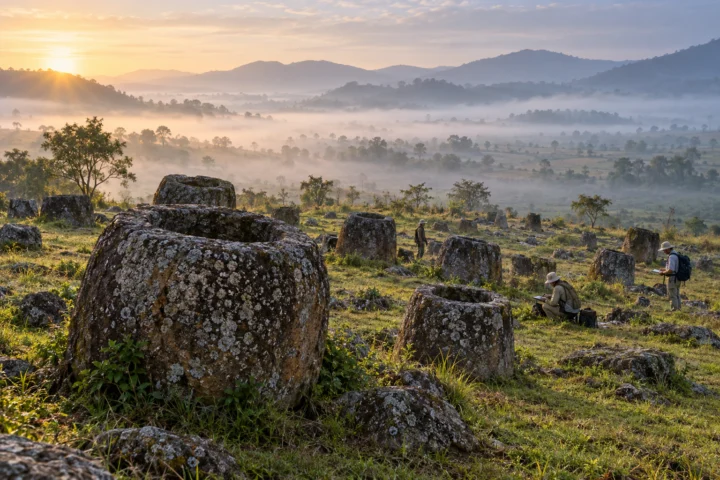
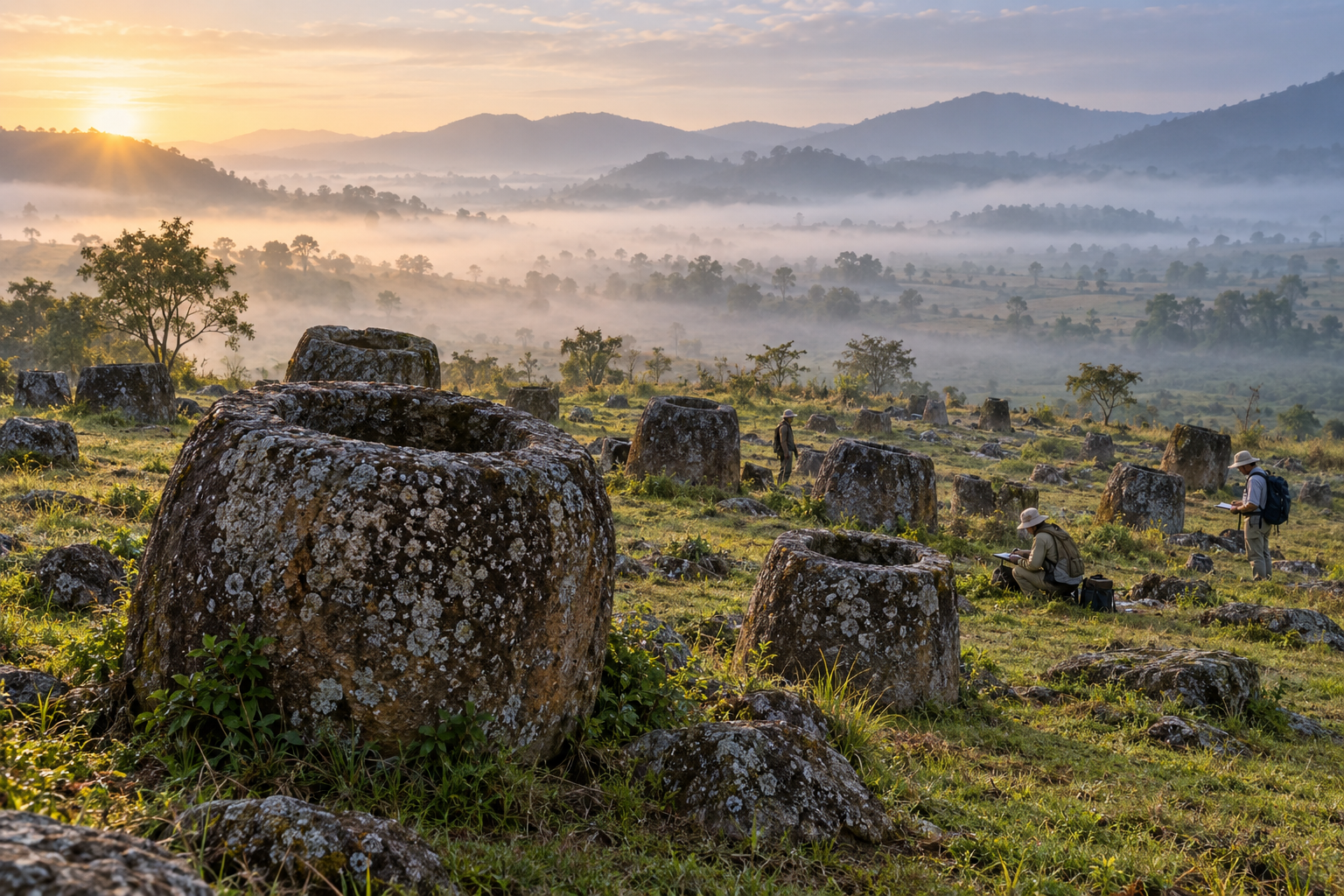
Across the Xiengkhouang Plateau of northern Laos stand thousands of large stone vessels. Some are squat and broad; others rise well above a person. They occur in groups on ridges and slopes with stone discs, boulders, quarry traces and burials, forming a landscape rather than one isolated monument.
UNESCO lists more than 2,100 jars and interprets the protected components as evidence of Iron Age funerary practices. Excavations have recovered primary and secondary burials, ceramics, beads and other grave goods. These associations make storage for food or alcohol less persuasive as a general explanation, although a jar’s role may have changed over time.
Dating is complicated because stone cannot be radiocarbon dated directly. Researchers date material around burials and use optically stimulated luminescence on sediment beneath jars to estimate when the ground was last exposed to light. Results suggest some megaliths were placed much earlier than nearby dated burials, raising the possibility of long use or later reuse.
Quarries and unfinished jars show that people selected and shaped local rock. Moving multi-ton vessels demanded labour and planning, but it does not require lost technology. Experimental work and landscape survey address practical routes without claiming to reproduce every ancient decision.
The evidence belongs beside the caution urged for out-of-place artefacts, the function problem of Roman dodecahedra, and the natural-versus-cultural debate at Yonaguni.
Claim, Context and Cautions
Jars, discs and burials
The jars are only the most visible part of the sites. Archaeologists document ceramic burial vessels, pits, human bone, stone markers and objects placed with the dead. Discs once described simply as lids do not consistently sit over jar mouths and may have marked graves.
This broader assemblage supports mortuary activity while leaving open whether bodies decomposed inside jars, were processed elsewhere or were represented symbolically.
Dating different events
Radiocarbon dates apply to organic samples such as bone or charcoal. Luminescence estimates when mineral grains were last exposed to light before burial beneath a jar. These methods date different events and carry different assumptions.
A gap between jar placement and a burial is therefore evidence for a multi-period site, not necessarily a laboratory contradiction. Later communities may have reused an already ancient ceremonial landscape.
Who made the monuments
No surviving inscription names the builders, and modern ethnic identities cannot simply be projected backwards across millennia. Distribution along upland routes suggests movement and exchange between wider cultural systems. Differences in jar form and stone source may encode local workshops or phases.
Legends of giant King Khun Cheung and victory feasts are important cultural narratives but do not replace archaeological dating.
Research under dangerous conditions
Xiengkhouang was heavily bombed during the twentieth century, and unexploded ordnance restricts excavation and public access. Clearance status shapes which sites can be surveyed, producing a modern sampling limit that is unrelated to ancient importance.
The broad purpose is less mysterious than headlines imply: the landscape is strongly connected to death and commemoration. The unresolved questions concern chronology, treatment of bodies, transport organisation and the societies that maintained the sites over many generations. Continuing clearance and excavation can therefore change both the known distribution and the chronology without making the earlier work careless.
Contextual glossary
Terms used in this entry
Definitions are offered as reading aids, not as conclusions about the case.
- Stratigraphy
- The study of layered deposits and their sequence. An undisturbed lower layer is generally earlier than one above it, but digging, erosion and later intrusion can rearrange material.
- Excavation
- The controlled removal and recording of archaeological deposits. Because digging destroys the original arrangement, plans, photographs, samples and layer records are as important as the objects recovered.
Reference trail
Sources
- UNESCO World Heritage Centre, Megalithic Jar Sites in Xiengkhuang (opens in a new tab)Authoritative site description, inventory, chronology and mortuary interpretation.
- University of Melbourne, new dating at the Plain of Jars (opens in a new tab)University account of luminescence, radiocarbon and quarry-provenance results.
- Plain of Jars Archaeological Research Project (opens in a new tab)Lao Department of Heritage and university project repository for surveys, excavations and site data.
Case Book
Photographs, Maps and Supporting Images
Supporting images provide documentary, geographic or visual context. Read each caption for its date, source and evidential limits.

Continue researching
Follow the evidence, context and comparisons
Curated connections
Selected editorially for this entry.
Why disputed objects need context, chain of custody and patient interpretation before becoming extraordinary evidence.
Curated connection · Case fileRoman Dodecahedra: Twelve Sides and No Surviving InstructionsRoman dodecahedra are genuine, technically demanding provincial objects. Their variable sizes, scattered contexts and missing textual record keep practical and ritual explanations provisional.
Curated connection · Case fileYonaguni: Monumental Geometry in Layered SandstoneThe Yonaguni formation is a genuine underwater landform. Claims of extensive human construction exceed the archaeological evidence, while limited modification of a natural outcrop remains possible.
More through shared context
Additional routes based only on existing topics, themes and metadata.
The Antikythera Mechanism is genuinely astonishing, but its lesson is ancient technical skill, not a shortcut to fringe claims.
Same primary topic · Shared theme: Disputed artefacts · Case fileThe Baghdad Battery: A Jar, a Theory and a Long ShadowA classic strange-archaeology case in which a plausible object became a magnet for much larger claims than the evidence supports.