Archaeology & Disputed Artefacts
Roman Dodecahedra: Twelve Sides and No Surviving Instructions
Roman dodecahedra are genuine, technically demanding provincial objects. Their variable sizes, scattered contexts and missing textual record keep practical and ritual explanations provisional.
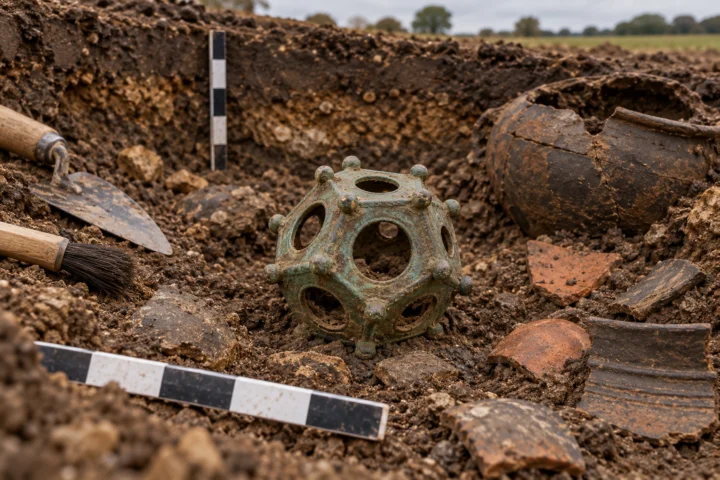
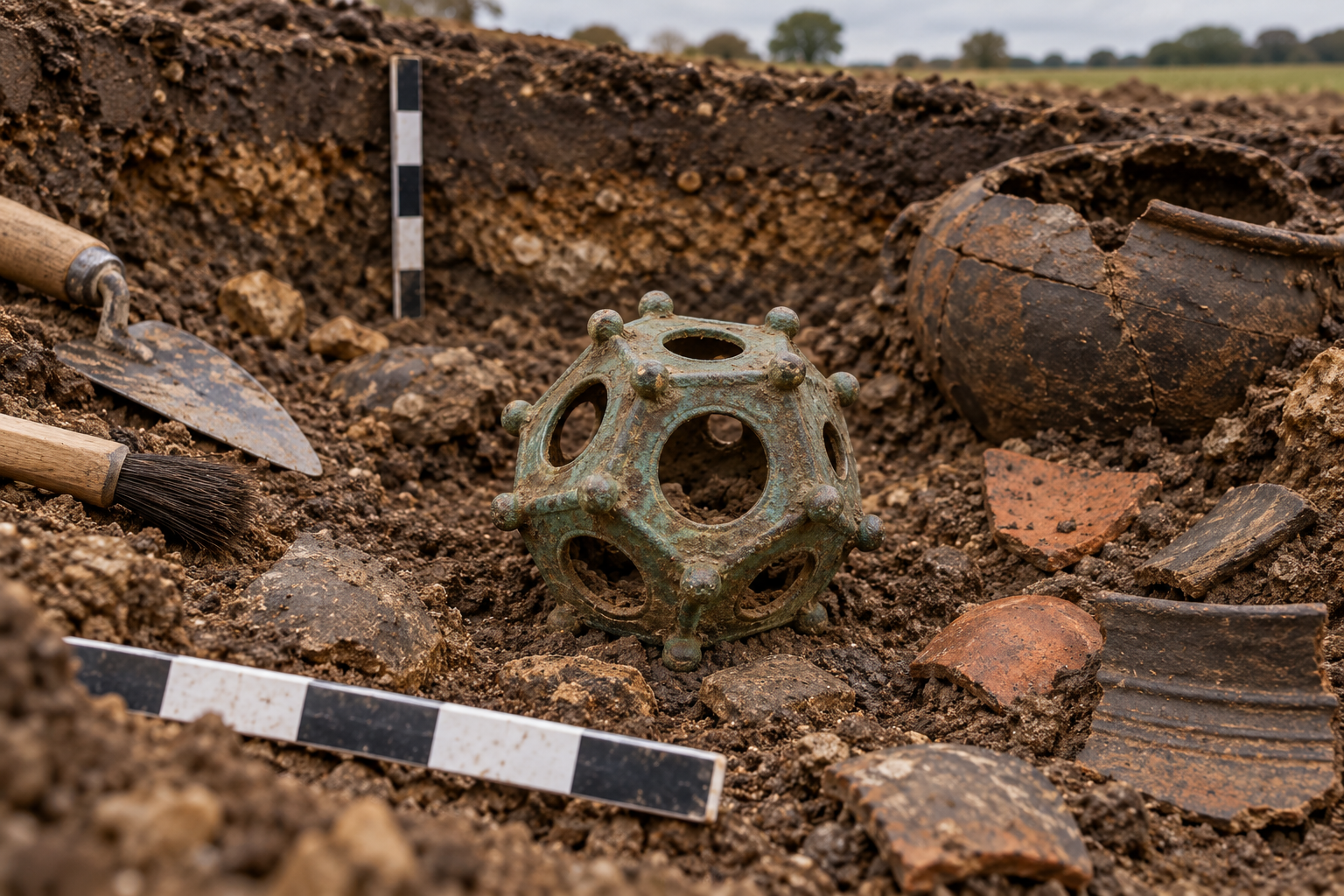
A Roman dodecahedron is a hollow copper-alloy object with twelve pentagonal faces, a circular opening in each face and a knob at every corner. More than a hundred complete and fragmentary examples have been reported from the north-western provinces of the Roman Empire. They vary in size, weight, hole diameter and detail.
The objects are archaeological facts; their purpose is not. No known Roman text names them, no surviving image clearly depicts one in use, and few early finds retained precise contexts. That vacuum has attracted proposals ranging from rangefinder and candleholder to knitting tool, calendar, gaming piece, craft test and ritual instrument.
A complete example excavated at Norton Disney, Lincolnshire, in 2023 is especially valuable because it came from a recorded deposit with Roman pottery rather than the antiquities market. Analysis identified a leaded copper alloy and continuing excavation examined the pit around it. Context narrows possibilities, but it has not supplied an instruction manual.
The problem resembles the Phaistos Disc, the archive’s caution around out-of-place artefacts, and the better-constrained Antikythera mechanism.
Claim, Context and Cautions
A recognisable but non-standard object
The common geometry makes the class real, not a modern collage of unrelated finds. Yet dimensions and apertures differ from object to object. That variability creates difficulty for explanations requiring a standard unit of measurement or a fixed optical calculation.
Casting thin, complex faces around a hollow centre required skill and material. Any proposed purpose must explain why this costly form was preferable to simpler wood, ceramic or metal tools.
Distribution and context
Finds cluster in Britain, Gaul, Germania and neighbouring regions rather than across the whole empire. They occur in settlements, forts, graves, hoards, river deposits and disturbed ground. Some contexts suggest careful deposition; others are too poorly recorded to support ritual or domestic certainty.
The distribution argues for a provincial tradition. It does not by itself tell whether the objects had one function or several meanings.
Testing attractive solutions
A useful hypothesis must fit wear, residue, dimensions, geography and chronology across the group. Demonstrating that a replica can knit a glove, estimate distance or hold wax only establishes possibility. Archaeologists then ask whether ancient materials, marks and contexts support regular use that way.
Recent scholarship has renewed symbolic and ritual interpretations, partly because the dodecahedral form had philosophical associations and several deposits have religious possibilities. That interpretation remains an argument, not a decoded label.
Why uncertainty is the result
The responsible conclusion is not that the Romans possessed a mysterious lost technology. It is that a familiar object category has outlived the practices and words that once made it ordinary. Better-contextualised discoveries, residue analysis and comparative catalogues can still shift the balance.
The Norton Disney find illustrates what progress looks like: record the soil layer, associated pottery, alloy and later excavation rather than rushing from shape to solution. Even a perfect context may reveal only deposition, not everyday use, but it can eliminate stories that do not fit the object's date or setting.
Inscriptions and surviving components constrain the function of some ancient devices. For dodecahedra, those constraints are still missing. Their mystery comes from missing cultural context, not from evidence that Roman technology exceeded ordinary archaeology.
Contextual glossary
Terms used in this entry
Definitions are offered as reading aids, not as conclusions about the case.
- Excavation
- The controlled removal and recording of archaeological deposits. Because digging destroys the original arrangement, plans, photographs, samples and layer records are as important as the objects recovered.
- Ritual
- A repeated, structured action carrying social, religious or symbolic meaning. Similar-looking actions can have very different meanings, so local and historical context is essential.
- Uncertainty
- The stated limit on what a measurement, reconstruction or body of evidence can establish. Describing uncertainty is not indecision; it prevents a result from appearing more precise than the evidence allows.
Reference trail
Sources
- British Museum collection record, Romano-British dodecahedron (opens in a new tab)Catalogue record documenting the material, dimensions, acquisition and bibliography of a large example from Fishguard.
- Archaeology Data Service, Norton Disney dodecahedron appendix (opens in a new tab)Excavation report describing the 2023 find context, regional distribution, form and limits of proposed functions.
- The Antiquaries Journal, The Gallo-Roman Dodecahedron and the Receptacle of All Becoming (opens in a new tab)Peer-reviewed reassessment of distribution, contexts and a possible cosmological or divinatory interpretation; treated as a hypothesis.
Case Book
Photographs, Maps and Supporting Images
Supporting images provide documentary, geographic or visual context. Read each caption for its date, source and evidential limits.

Continue researching
Follow the evidence, context and comparisons
Curated connections
Selected editorially for this entry.
The Phaistos Disc is a genuine-looking Minoan artefact with 45 sign types and no adequate parallel text. Its script, language and purpose remain undeciphered.
Curated connection · ArticleOut-of-Place Artefacts and the Value of CautionWhy disputed objects need context, chain of custody and patient interpretation before becoming extraordinary evidence.
Curated connection · Case fileThe Antikythera Mechanism: Ancient Gears Without Ancient AliensThe Antikythera Mechanism is genuinely astonishing, but its lesson is ancient technical skill, not a shortcut to fringe claims.
More through shared context
Additional routes based only on existing topics, themes and metadata.
Scientifically examined crystal skulls do not support claims of ancient or paranormal origin. Tool marks, quartz provenance and sales records place prominent examples in the modern era.
Same primary topic · Shared theme: Disputed artefacts · Case fileThe Baghdad Battery: A Jar, a Theory and a Long ShadowA classic strange-archaeology case in which a plausible object became a magnet for much larger claims than the evidence supports.