Archaeology & Disputed Artefacts
Crystal Skulls: Modern Tools Behind an Ancient Legend
Scientifically examined crystal skulls do not support claims of ancient or paranormal origin. Tool marks, quartz provenance and sales records place prominent examples in the modern era.
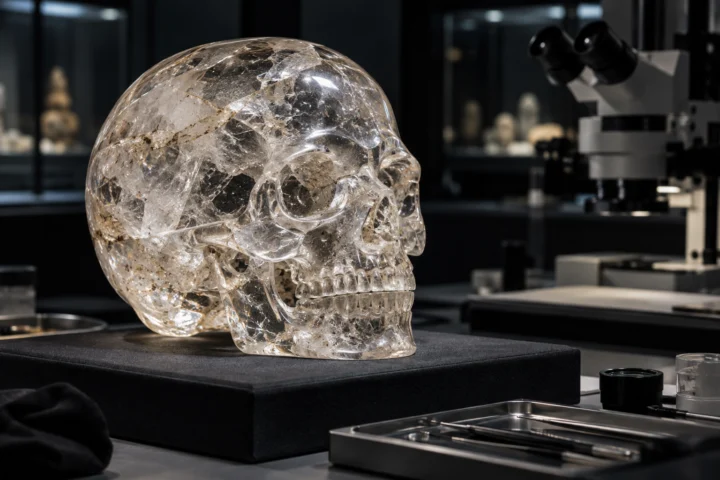
Large human skulls carved from clear or milky quartz have been promoted as Aztec, Maya or Atlantean objects with healing, prophetic or information-storing powers. Famous examples reached the British Museum, the Smithsonian and private collections through dealers and owners—not through documented archaeological excavation.
Quartz cannot be dated like organic material, but manufacture leaves evidence. Researchers examined carved grooves with optical and scanning electron microscopes, compared them with securely provenanced Mesoamerican lapidary work, and analysed mineral inclusions and abrasives.
The prominent skulls showed regular rotary-tool marks and modern abrasives unavailable to pre-Columbian carvers. Archival research also connected the nineteenth-century market to dealer Eugène Boban, while the celebrated Mitchell-Hedges skull appeared in a London auction record before the discovery story attached to it.
The case demonstrates the provenance rules in out-of-place artefacts, the museum correction behind Piltdown Man, and the narrative power explored in stories attached to objects.
Claim, Context and Cautions
Objects without excavated context
No scientifically examined large crystal skull has a documented pre-Columbian excavation context. Instead, objects appeared through art markets, donations and retrospective ownership stories. A museum accession can preserve an attribution without proving it.
Secure context matters because style can be copied and a hard material can look ageless after polishing.
What a tool mark remembers
Hand abrasion and stone drilling create different microscopic surfaces from high-speed rotary wheels coated with hard modern abrasives. Researchers moulded and imaged grooves in skulls, then compared their profiles with authenticated carvings and experimental references.
The regular marks are manufacturing evidence independent of legends about psychic effects or secret custodians.
Quartz and the paper trail
Inclusions in the British Museum and Smithsonian material were consistent with quartz sources outside ancient Mexican supply claims. Archival records traced collecting histories into the nineteenth and twentieth centuries. The Mitchell-Hedges skull’s auction appearance directly contradicts the later claim that it was found at Lubaantun.
No single test supplies the whole date; material, technology and provenance converge.
Modern carvings with genuine cultural history
Calling the skulls modern does not make them worthless. They reveal how European and American collectors projected occult power and imagined Mesoamerica, and how museums revise labels when evidence changes.
Claims of supernatural function remain unsupported. The established mystery is social: why uncertain provenance and extraordinary stories were more attractive than the visible marks left by manufacture.
The “thirteen skulls” story and modern belief
A later legend says that thirteen ancient skulls must be reunited to reveal knowledge or prevent catastrophe. No pre-Columbian text or excavated assemblage supplies that tradition. It developed in modern spiritual and popular writing around objects whose individual histories were already unstable. Film, television and touring displays then allowed separate carvings to borrow authority from one another.
Scientific results apply to the specimens tested; they do not prove that every quartz skull in existence came from one workshop. They do establish a demanding standard for any future ancient claim: documented excavation, continuous custody, microscopic comparison and mineral analysis. A private story of inheritance cannot substitute for those steps.
The museum response is part of the case. Relabelling a once-celebrated object as modern is not an embarrassment to conceal but evidence that collections can be corrected. The skulls now teach provenance and the history of collecting more reliably than they teach ancient Mesoamerican technology.
Contextual glossary
Terms used in this entry
Definitions are offered as reading aids, not as conclusions about the case.
- Provenance
- The documented history of an object’s origin, ownership, location and handling. A dramatic claim with weak provenance cannot reliably establish where or when an object came from.
- Excavation
- The controlled removal and recording of archaeological deposits. Because digging destroys the original arrangement, plans, photographs, samples and layer records are as important as the objects recovered.
- Occult
- A broad historical label for hidden or esoteric knowledge and practices, including divination, ritual magic and spirit communication. Meaning varies sharply by period and community.
Reference trail
Sources
- British Museum collection record, crystal skull (opens in a new tab)Museum catalogue documenting acquisition history, changing attribution and research bibliography.
- Journal of Archaeological Science, origins of two crystal skulls (opens in a new tab)Peer-reviewed optical, SEM, Raman and mineral-inclusion study of the British Museum and Smithsonian skulls.
- Smithsonian, Mysterious Crystal Skull on Exhibit (opens in a new tab)Institutional summary of provenance research and modern tool marks across studied examples.
- Archaeology Magazine, “The Skull of Doom” (opens in a new tab)Archaeological Institute of America account of microscopy, auction provenance and testing of the Mitchell-Hedges skull.
Case Book
Photographs, Maps and Supporting Images
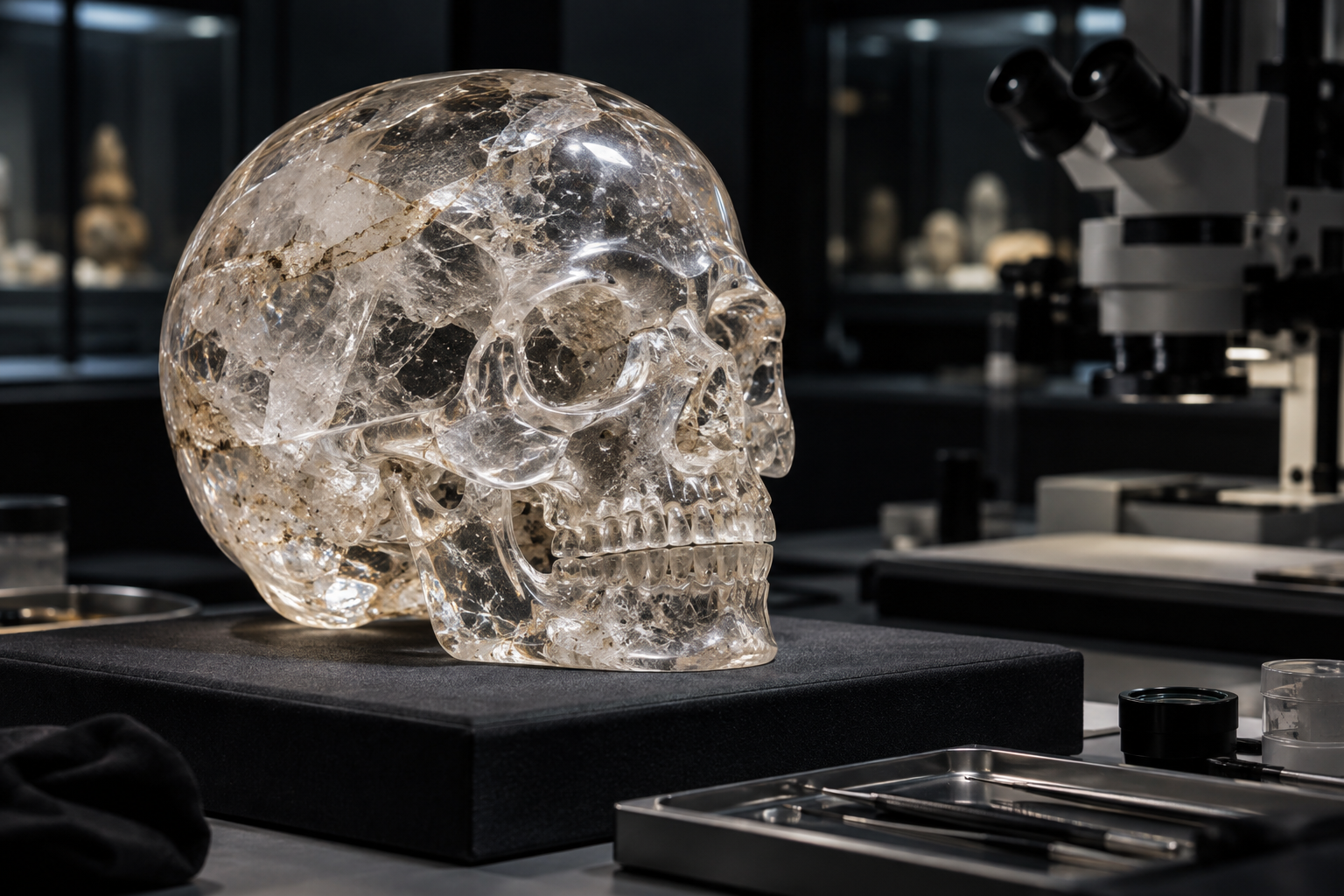
Supporting images provide documentary, geographic or visual context. Read each caption for its date, source and evidential limits.

Continue researching
Follow the evidence, context and comparisons
Curated connections
Selected editorially for this entry.
Why disputed objects need context, chain of custody and patient interpretation before becoming extraordinary evidence.
Curated connection · Case filePiltdown Man: The Fossil That Flattered an ExpectationPiltdown Man fooled parts of the scientific world for decades because forged evidence appeared to fit a story people were ready to hear.
Curated connection · ArticleCursed Objects and the Stories We Attach to ThingsWhy ordinary objects can gather blame, awe and dread when misfortune needs a visible container.
More through shared context
Additional routes based only on existing topics, themes and metadata.
Roman dodecahedra are genuine, technically demanding provincial objects. Their variable sizes, scattered contexts and missing textual record keep practical and ritual explanations provisional.
Same primary topic · Shared theme: Disputed artefacts · Case fileThe Kensington Runestone: A Viking Claim in a Minnesota FieldThe Kensington Runestone is a real carved object with disputed origins. Its language, runes and discovery context favour a nineteenth-century creation, while the identity and precise motive of its maker remain unresolved.