Archaeology & Disputed Artefacts
The Kensington Runestone: A Viking Claim in a Minnesota Field
The Kensington Runestone is a real carved object with disputed origins. Its language, runes and discovery context favour a nineteenth-century creation, while the identity and precise motive of its maker remain unresolved.
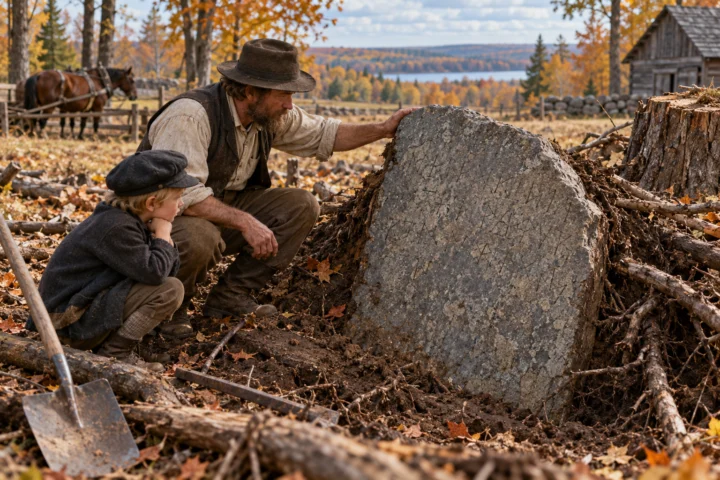
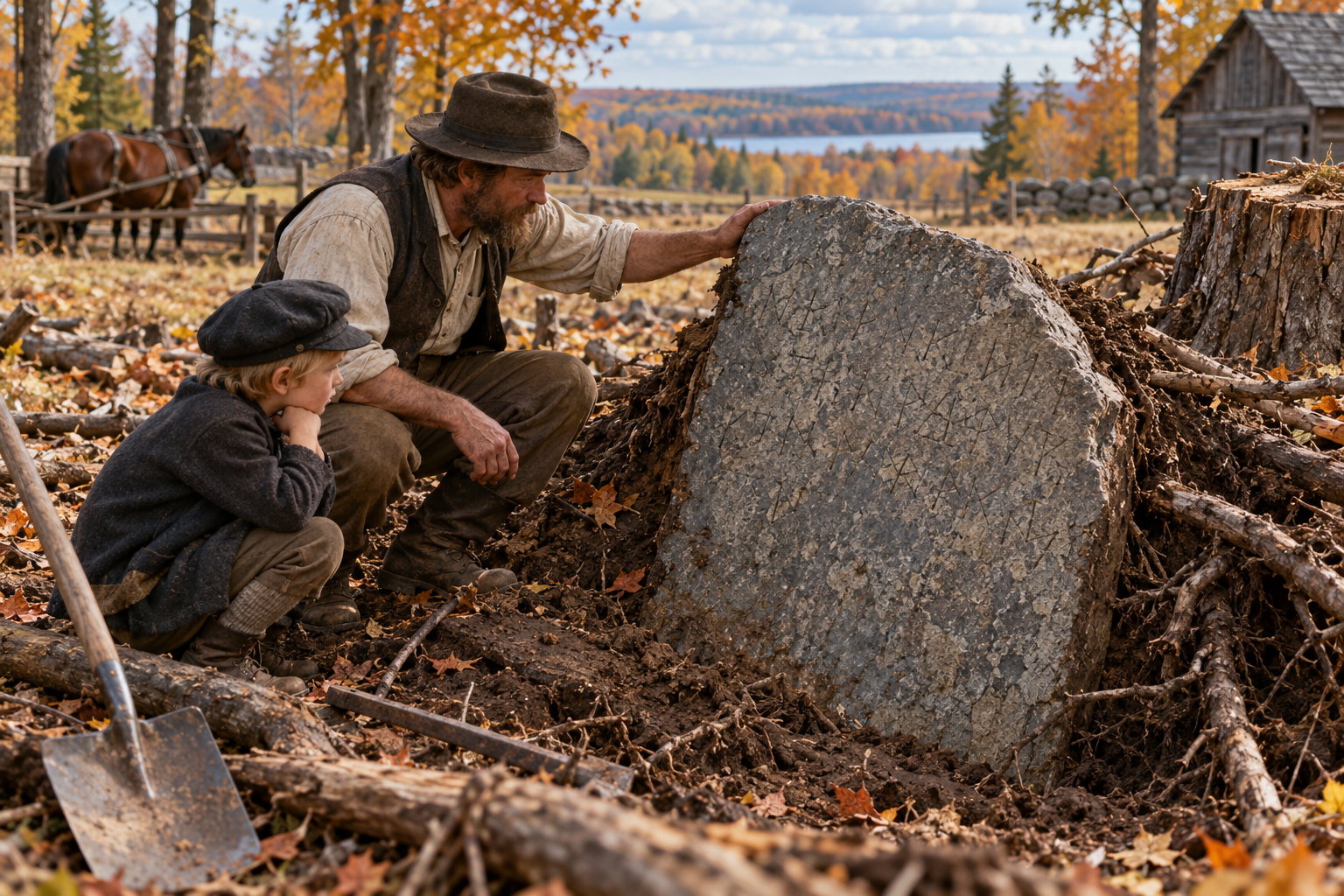
In 1898, Swedish immigrant farmer Olof Ohman reported finding a heavy greywacke slab among the roots of a tree near Kensington, Minnesota. Runes on its face and edge described thirty Scandinavian explorers travelling west from Vinland and dated their expedition to 1362. If authentic, it would place Norse travellers deep inside North America before Columbus.
The stone immediately divided investigators. Early Scandinavian-language experts rejected its vocabulary, grammar, numerals and rune forms as modern or anachronistic. Geologist Newton Winchell considered the discovery setting and weathering favourable to age, while promoter Hjalmar Holand defended the object for decades.
Later runologists continued to find forms closer to nineteenth-century Scandinavian usage than medieval inscription. Geological arguments about surface alteration cannot independently date the carving to 1362, and the object lacks an excavated archaeological context. No matching Norse settlement, equipment or route evidence has been found in Minnesota.
The stone is therefore two historical objects at once: a slab bearing a disputed inscription and a record of Scandinavian-American identity, promotion and argument after 1898. The second history is well documented even if the first claimed history is not.
The claim belongs beside the archive’s caution on out-of-place artefacts, the functionally uncertain Roman dodecahedra, and the modern manufacture revealed in crystal skulls.
Claim, Context and Cautions
The find and inscription
Ohman said the slab emerged while clearing an aspen on his farm. The inscription describes eight Geats and twenty-two Norwegians, ten men found dead, companions guarding ships and a journey from an island. Its precise date and dramatic narrative invited historical testing.
Affidavits about roots and discovery were gathered years later. They establish the community history of the object more securely than an undisturbed medieval deposit.
The linguistic case
Language is the central evidence because runes encode words used by a particular community. Specialists noted modern Swedish features, unusual forms and numerals not expected together in a fourteenth-century inscription. Supporters have proposed dialect survivals or rare medieval parallels.
An isolated resemblance can be found for many signs; authenticity requires the whole system, grammar and historical setting to cohere. Most Scandinavian specialists have judged that combination modern.
Stone weathering and context
The slab itself is old rock, but geological age does not date carving. Weathering comparisons depend on exposure, burial chemistry, cleaning and the uncertain history of surfaces. Claims that grooves must be centuries old have not displaced the linguistic evidence.
Professional archaeology values provenance: recorded layers, associated artefacts and an undisturbed find. The 1898 recovery occurred before such documentation and produced no medieval assemblage.
Forgery, identity and meaning
Calling the inscription modern does not identify a carver. Ohman owned material about runes, and associates have been proposed; later oral claims implicated local participants, but no uncontested confession survives. Motives suggested include a joke, ethnic pride and hostility toward experts.
The stone became meaningful within Scandinavian-American settlement regardless of authenticity, appearing in exhibitions and regional identity. That cultural importance should not be mistaken for proof of the dated expedition. The most supported conclusion is a late nineteenth-century inscription whose exact authorship remains uncertain. Genuine Norse presence at L’Anse aux Meadows shows that pre-Columbian Atlantic travel is archaeological fact; it does not authenticate an unrelated object hundreds of miles inland. Each claim requires its own provenance.
Contextual glossary
Terms used in this entry
Definitions are offered as reading aids, not as conclusions about the case.
- Archaeological context
- An object’s recorded relationship to its layer, feature, surrounding finds and excavation location. Once that context is lost, claims about the object’s date and use become much harder to test.
- Forgery
- An object, document or image made or altered so that it will be accepted as something it is not. Demonstrating forgery requires evidence about manufacture, materials, provenance or transmission, not merely an unusual claim.
- Provenance
- The documented history of an object’s origin, ownership, location and handling. A dramatic claim with weak provenance cannot reliably establish where or when an object came from.
- Bearing
- A direction measured clockwise from north, usually in degrees. A bearing gives a line of direction rather than a distance; two or more reliable bearings may help locate a source.
Reference trail
Sources
- Minnesota Historical Society, MNopedia: Kensington Runestone (opens in a new tab)Institutional history of the discovery, investigations, expert opinions, object chronology and continuing controversy.
- Minnesota Historical Society Museum Committee, preliminary report (1915) (opens in a new tab)Public-domain early inquiry preserving affidavits, geological arguments, linguistic material and the initial institutional debate.
- Minnesota History, Kensington Runestone Revisited (opens in a new tab)Historical Society journal review of modern publications and the continuing linguistic and geological dispute.
Case Book
Photographs, Maps and Supporting Images
Supporting images provide documentary, geographic or visual context. Read each caption for its date, source and evidential limits.

Continue researching
Follow the evidence, context and comparisons
Curated connections
Selected editorially for this entry.
Why disputed objects need context, chain of custody and patient interpretation before becoming extraordinary evidence.
Curated connection · Case fileRoman Dodecahedra: Twelve Sides and No Surviving InstructionsRoman dodecahedra are genuine, technically demanding provincial objects. Their variable sizes, scattered contexts and missing textual record keep practical and ritual explanations provisional.
Curated connection · Case fileCrystal Skulls: Modern Tools Behind an Ancient LegendScientifically examined crystal skulls do not support claims of ancient or paranormal origin. Tool marks, quartz provenance and sales records place prominent examples in the modern era.
More through shared context
Additional routes based only on existing topics, themes and metadata.
Nan Madol remains archaeologically challenging, but its builders and broad chronology are not unknowable. Local oral histories, settlement evidence and scientific dating converge on Pohnpeian construction and Saudeleur power.
Same primary topic · Shared theme: Disputed artefacts · Case fileThe Antikythera Mechanism: Ancient Gears Without Ancient AliensThe Antikythera Mechanism is genuinely astonishing, but its lesson is ancient technical skill, not a shortcut to fringe claims.