UFOs & Aerial Phenomena
Lakenheath–Bentwaters: Radar, Interceptors and an Unresolved Night
The Lakenheath–Bentwaters incident combines multiple radar reports and an interceptor account, yet gaps in timing, weather and original records prevent a secure identification or extraordinary conclusion.
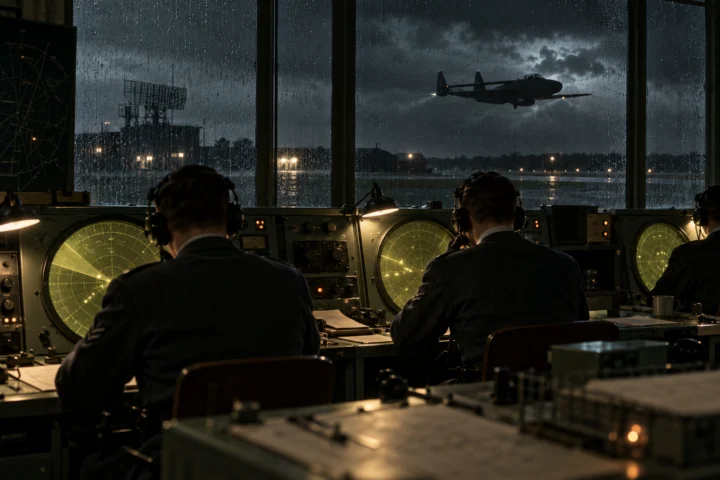
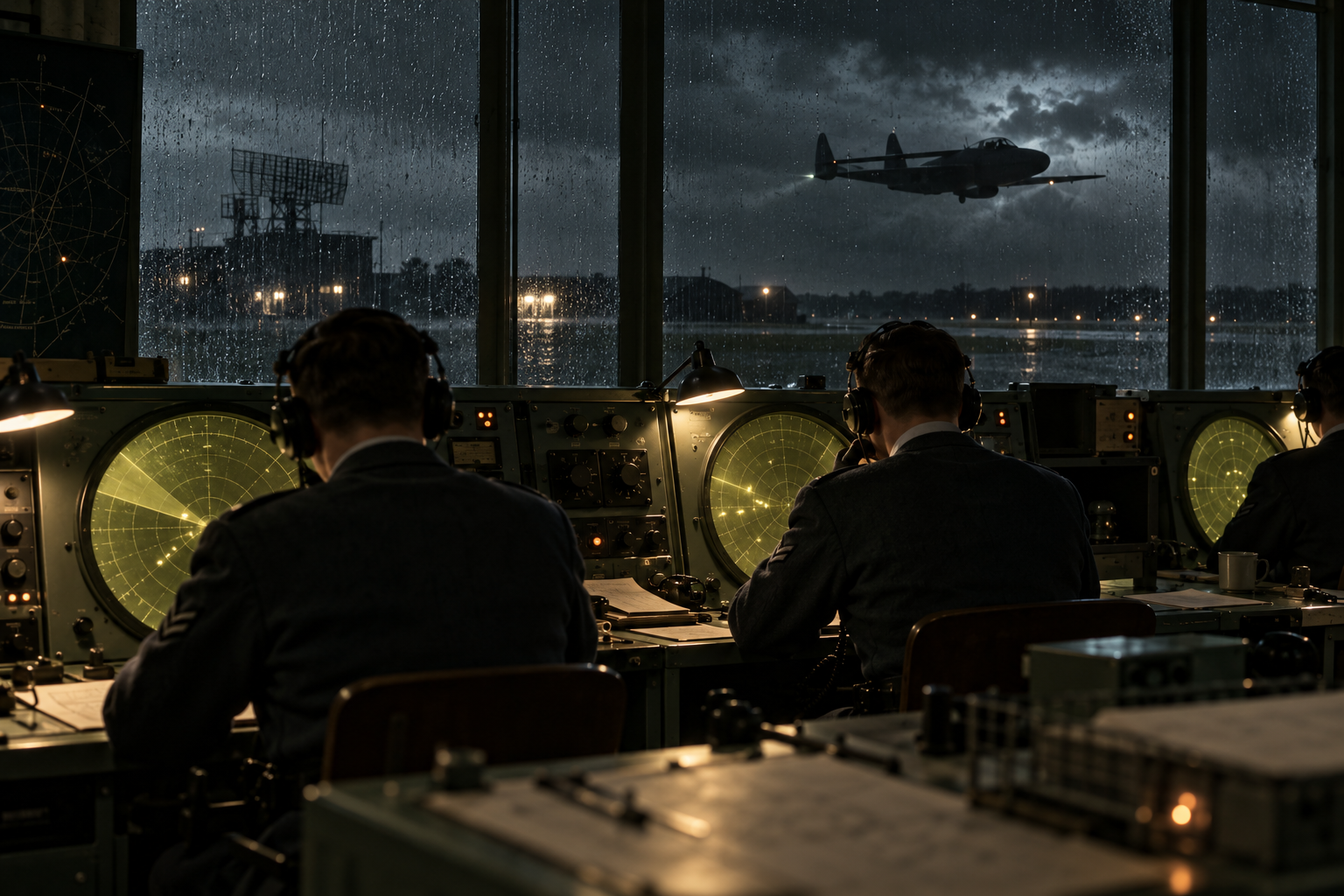
On the night of 13–14 August 1956, personnel at RAF Bentwaters and RAF Lakenheath in Suffolk reported unusual radar returns and lights. The sequence began at Bentwaters, where an operator described a fast target crossing the scope. Lakenheath later tracked intermittent or stationary returns and requested an RAF night fighter to investigate.
The Venom crew reportedly saw a bright object and was told that a target had moved behind the aircraft. After manoeuvring, the crew lost contact and returned. Project Blue Book retained the case as unidentified. That label records an investigative outcome; it does not identify extraterrestrial technology.
The record is stronger than a single recollection because several personnel and radar systems were involved. It is weaker than the familiar compressed story suggests: exact synchronization is uncertain, original British files are incomplete, and later interviews were conducted years after the event. Weather, anomalous propagation, aircraft, stars and equipment effects may explain parts without explaining every reported moment.
The evidential problem connects this case to Washington’s 1952 radar returns, the archive’s guide to ordinary lights and extraordinary reports, and the better-preserved official trail at Rendlesham Forest.
Claim, Context and Cautions
Reconstructing the sequence
The Blue Book file assembles teletype summaries and later statements rather than one continuous log. Returns reported at Bentwaters and Lakenheath are often presented as the same object, although their timing, speed and behaviour varied. The fighter episode came after the ground observations had already developed.
Separating each track matters. A series of unusual indications can have several causes, and narrative continuity is not the same as instrument continuity.
Radar as evidence
Experienced operators could recognise many common echoes, and multiple stations increase interest. Even so, 1950s radar did not print an identity onto a return. Propagation, side lobes, ground clutter and aircraft can produce convincing targets, especially when range, altitude and calibration records are incomplete.
A claimed match between visual light and radar requires shared time and position. The surviving summaries support some association but not enough precision to bind every observation into a single physical craft.
The interceptor account
The aircrew report is the most dramatic element: a light ahead, loss during pursuit, and radar advice that a target had moved behind the fighter. No gun-camera image, physical trace or recovered object followed. Later retellings differ over crew identity and detail, demonstrating why the contemporary wording deserves priority.
Stars or another aircraft may explain a visual component, while operator expectation could influence interpretation after unusual returns were already under discussion.
Why the case remains uncertain
No ordinary explanation has been demonstrated for every statement in the file. Conversely, the file does not contain the measurements needed to establish performance beyond known aircraft or atmospheric effects. Missing records cannot be treated as evidence of suppression without an independent chain showing what existed and why it disappeared.
The narrow conclusion is durable: military personnel reported a serious multi-part incident, the Air Force did not identify it, and the archive is insufficient to determine whether one cause linked all observations. That is genuine uncertainty, not a blank cheque for a preferred origin. Later confidence cannot recreate the range, altitude and timing values that were not preserved.
Contextual glossary
Terms used in this entry
Definitions are offered as reading aids, not as conclusions about the case.
- Anomalous propagation
- Unusual bending of radar or radio waves through layers of air with changing temperature or moisture. It can produce returns from beyond the normal horizon or place a return at a misleading apparent position.
- Ground clutter
- Radar echoes from terrain, buildings, vegetation or other stationary surroundings. Filtering removes much of it, but changing atmospheric or equipment conditions can make clutter appear unusual.
- Uncertainty
- The stated limit on what a measurement, reconstruction or body of evidence can establish. Describing uncertainty is not indecision; it prevents a result from appearing more precise than the evidence allows.
Reference trail
Sources
- National Archives, Project BLUE BOOK records (opens in a new tab)Official guide to the Air Force case-file series and the meaning and limits of its conclusions.
- National Archives, UAP records by record group (opens in a new tab)Official catalogue guide identifying the 1954–1956 Air Intelligence and Blue Book case collections.
- UK National Archives, The UFO Files extract (opens in a new tab)Official archival publication placing Lakenheath–Bentwaters within the British government record and later review.
Case Book
Photographs, Maps and Supporting Images
Supporting images provide documentary, geographic or visual context. Read each caption for its date, source and evidential limits.

Continue researching
Follow the evidence, context and comparisons
Curated connections
Selected editorially for this entry.
The Washington sightings combined radar returns, visual reports and official alarm. Temperature inversions offer a plausible mechanism for some returns, but the heterogeneous evidence does not support one neat solution.
Curated connection · ArticleHow Ordinary Lights Become Extraordinary UFO ReportsAircraft, satellites, planets, drones and atmospheric effects can become strange when context is missing.
Curated connection · Case fileRendlesham Forest: Lights, Logs and the British UFO ArchiveRendlesham remains one of the most famous UFO cases in Britain because it produced sightings, notes and later arguments in the shadow of a military base.
More through shared context
Additional routes based only on existing topics, themes and metadata.
The crew’s visual report was real and professionally documented. Radar returns were intermittent and disputed, while darkness, cloud and uncertain distance made size estimates especially fragile.
Same primary topic · Shared theme: Aviation, Witness & memory · Case fileSocorro: Lonnie Zamora and the Object in the ArroyoThe Socorro incident rests on a prompt police report and documented ground traces, yet neither the marks nor later theories securely identify what Lonnie Zamora saw.