Archaeology & Disputed Artefacts
The Bosnian Pyramids: Natural Hills and an Archaeological Claim
The Bosnian pyramid claim lacks diagnostic construction evidence and conflicts with regional geology. Human activity occurred around Visoko, but that does not make the underlying hills artificial monuments.
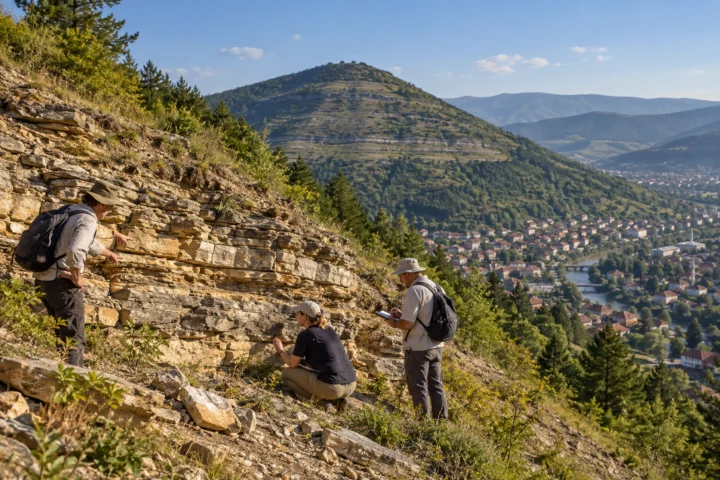
In 2005, Semir Osmanagić proposed that Visočica hill above Visoko concealed a vast human-built pyramid. Its broadly triangular face, orientation claims and exposed slabs became the centre of a tourism and volunteer-excavation project. Nearby hills received names corresponding to other supposed monuments.
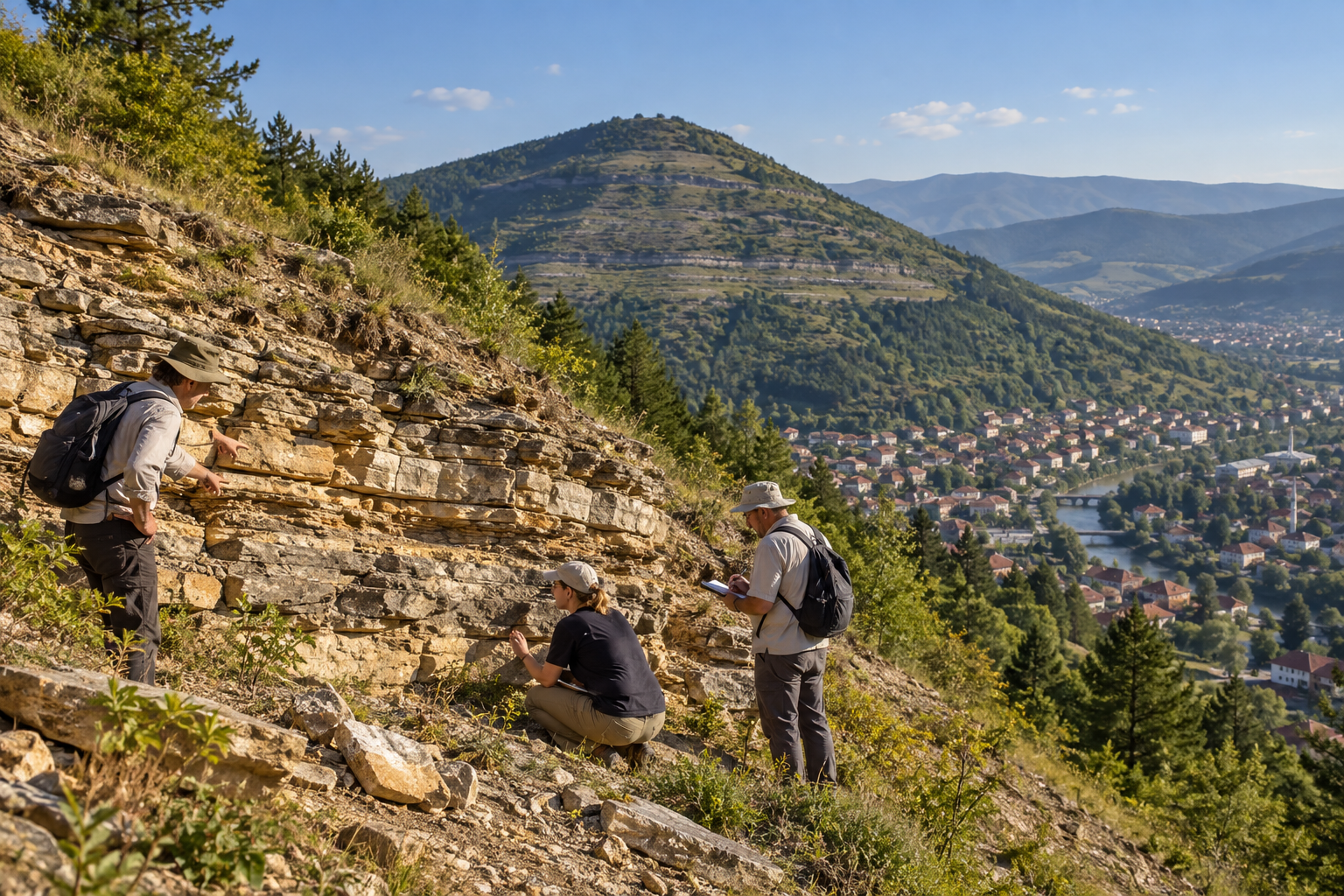
Geologists identify the hill as layered sandstone, clay and conglomerate shaped by uplift, fracture and erosion. Natural bedding can produce flat surfaces and repeating blocks; intersecting slopes can create a pyramid-like outline from selected viewpoints. Similar forms occur elsewhere in the regional basin.
An artificial pyramid should provide architecture distinct from bedrock: constructed courses, prepared foundations, transported material, datable building contexts and a coherent boundary between monument and natural hill. The excavated surfaces have not produced that assemblage.
Visoko does contain genuine heritage, including medieval structures associated with the Bosnian royal centre and older occupation. Finding pottery or modified ground near a long-used hill cannot date or manufacture the entire geological mass. Context is damaged when excavation begins with a predetermined monumental answer.
The case echoes the natural geometry of Yonaguni, the context rules in out-of-place artefacts, and the demonstrated construction evidence behind the Nazca Lines.
Claim, Context and Cautions
Why a hill looks engineered
Humans readily connect edges into intended forms, especially when a feature is photographed head-on. Vegetation clearance can sharpen a face, and trenches expose bedding planes that resemble laid paving. Orientation has limited meaning when a large irregular hill offers many possible axes.
Geometry becomes archaeological evidence only when it corresponds to construction details not expected from local geology.
Conglomerate is not concrete
Conglomerate consists of rounded rock fragments naturally cemented in a finer matrix. Weathered surfaces can break into slabs and appear poured. Chemical strength tests do not reveal whether a material was manufactured unless sampling, petrography and comparison exclude the surrounding formation.
Regional stratigraphy explains the same layers beyond the areas labelled as pyramid walls.
Claims and professional response
Project publications argue for modification, tunnels, alignments and unusual dates. European archaeologists protested that the evidence did not support pyramids and warned that work could divert resources and damage authentic remains. Evaluating that dispute requires methods and context, not counting credentials listed by either side.
A testable construction claim should publish precise stratigraphy, artefact provenance and independent analyses.
A real landscape without a pyramid
People occupied and altered the Visoko valley over many periods. Paths, fortifications, burials or mines may therefore be discovered without validating a prehistoric megastructure. Natural origin does not make the landscape culturally empty.
The hill's pyramid resemblance and the modern movement around it are worthy subjects. The archaeological conclusion is narrower: no demonstrated built pyramid underlies Visočica, and extraordinary ages or technologies remain unsupported by controlled excavation. Tourism can make a claim socially durable even when its scientific basis fails. Visitors see cleared terraces, named monuments and explanatory signs produced by the project itself. Those features are evidence of a modern cultural landscape, not independent confirmation of prehistoric construction. Protecting genuine remains requires keeping those two histories distinct. Future evidence would need to expose an unmistakable construction interface under controlled conditions, document it independently and connect it to a datable culture. Rebranding ordinary beds or isolated human artefacts cannot meet that burden, regardless of the number of seasons spent enlarging trenches.
Contextual glossary
Terms used in this entry
Definitions are offered as reading aids, not as conclusions about the case.
- Excavation
- The controlled removal and recording of archaeological deposits. Because digging destroys the original arrangement, plans, photographs, samples and layer records are as important as the objects recovered.
- Stratigraphy
- The study of layered deposits and their sequence. An undisturbed lower layer is generally earlier than one above it, but digging, erosion and later intrusion can rearrange material.
- Provenance
- The documented history of an object’s origin, ownership, location and handling. A dramatic claim with weak provenance cannot reliably establish where or when an object came from.
- Artefact
- An object made, modified or used by people. Its material, manufacture, wear and archaeological context are evidence; an unusual appearance alone does not establish an unusual age or origin.
Reference trail
Sources
- European Association of Archaeologists statement on the Visoko project (opens in a new tab)Copy of the professional declaration warning that the pyramid claim lacks archaeological support and threatens heritage.
- The geological probes, English documentation of the Tuzla geological report (opens in a new tab)Source-based discussion and translated material from geological drilling and regional interpretation.
- Bosnian Pyramid Foundation, geological and geo-archaeological observations (opens in a new tab)The project’s own competing interpretation, included to represent its claims and acknowledged natural geology.
Case Book
Photographs, Maps and Supporting Images
Supporting images provide documentary, geographic or visual context. Read each caption for its date, source and evidential limits.

Continue researching
Follow the evidence, context and comparisons
Curated connections
Selected editorially for this entry.
The Yonaguni formation is a genuine underwater landform. Claims of extensive human construction exceed the archaeological evidence, while limited modification of a natural outcrop remains possible.
Curated connection · ArticleOut-of-Place Artefacts and the Value of CautionWhy disputed objects need context, chain of custody and patient interpretation before becoming extraordinary evidence.
Curated connection · Case fileThe Nazca Lines: Huge Drawings Without Impossible BuildersThe Nazca Lines are extraordinary landscape works, but careful archaeology explains them through human labour, ritual geography and desert preservation.
More through shared context
Additional routes based only on existing topics, themes and metadata.
Scientifically examined crystal skulls do not support claims of ancient or paranormal origin. Tool marks, quartz provenance and sales records place prominent examples in the modern era.
Same primary topic · Shared theme: Disputed artefacts · Case fileNan Madol: Engineering a Ceremonial City on the ReefNan Madol remains archaeologically challenging, but its builders and broad chronology are not unknowable. Local oral histories, settlement evidence and scientific dating converge on Pohnpeian construction and Saudeleur power.