Cryptids & Animal Reports
The Beast of Gévaudan: Predators, Panic and the Making of a Monster
Lethal attacks in Gévaudan prompted royal hunts and national coverage from 1764 to 1767. The deaths are historical; whether one unusual animal caused them is disputed.
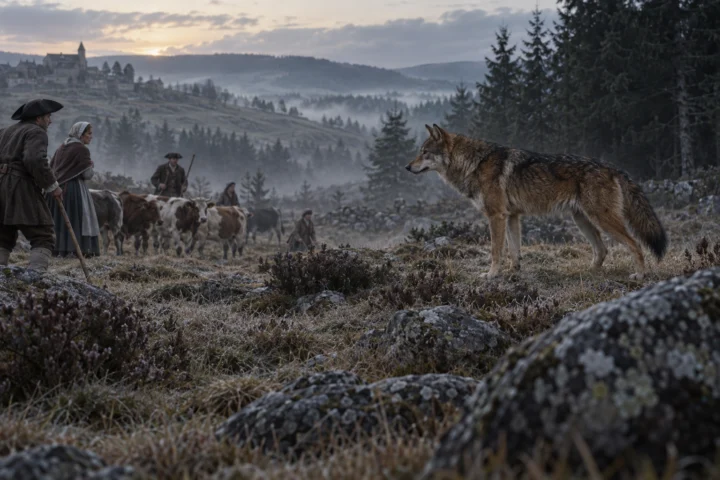
From 1764 to 1767, people in the former French province of Gévaudan suffered a real series of fatal animal attacks. Many victims were children or women tending livestock in isolated country. Officials organised hunts, rewards were offered and newspapers turned the predator into a national monster.
The record supports deaths, injuries and repeated searches. It does not supply a reliable final total or prove that one animal caused every attack. Descriptions varied, incidents were assigned retrospectively and two celebrated wolf kills—one by François Antoine in 1765 and another associated with Jean Chastel in 1767—became competing endings.
Large wolves, possibly more than one, fit the region and the nature of much of the evidence. Exotic cats, hybrids, trained animals and supernatural creatures belong to later or weakly supported interpretation unless tied to a specific record.
The Beast’s making can be compared with the Jersey Devil newspaper panic, the circulation of strange news and modern moorland cat reports.
Claim, Context and Cautions
Attacks in an exposed landscape
The first incidents associated with the series occurred in 1764 in a sparsely populated upland region. Victims were often alone or poorly protected while working with animals. Survivors and communities described a large, aggressive predator, sometimes emphasising unusual colouring, proportions or behaviour.
Contemporary records and later parish research make the lethal pattern more than folklore. Totals nevertheless depend on which deaths are counted and whether doubtful cases are attributed to the Beast. Round figures such as one hundred dead should be treated as estimates, not a forensic ledger.
How a predator became national news
The Gazette de France and other publications carried reports beyond Gévaudan. Heroic resistance, especially the defence led by the young Jacques Portefaix and companions, attracted royal attention. The crown's involvement transformed a regional danger into a test of authority and competence.
Press descriptions also encouraged readers to imagine a singular adversary. Separate attacks across distance and time could be narrated as the movements of one cunning creature. Administrative labels helped organise the crisis while making the Beast seem more coherent than the evidence allowed.
Hunters, soldiers and Antoine’s wolf
Local drives and professional hunters failed to end the attacks. In 1765, François Antoine, the king's gun-bearer, killed a very large wolf at the Abbey of Chazes. The animal was displayed and the royal mission was declared a success.
Reports of attacks later resumed. That does not prove Antoine killed the wrong species; it suggests either that another predator remained, that unrelated attacks were grouped together or that the series had never depended on one animal. The official ending and lived danger did not coincide.
Jean Chastel and the 1767 ending
On 19 June 1767, Jean Chastel killed an animal during a hunt near Mont Mouchet. A notarial examination the next day described a large animal that appeared to be a wolf, while noting proportions and features that fed later argument. The sustained series ended around this time.
Folklore later supplied silver bullets, prayerful pauses and conspiratorial motives. Those additions are not required by the contemporary description. Chastel's kill is a plausible part of the historical resolution, but the absence of modern remains prevents definitive identification.
What kind of animal?
Historical analysis most often favours wolves, potentially several animals amid a period of serious predation. Individual wolves can become unusually bold, and repeated attacks do not require a species unknown to France. Dogs or wolf-dog hybrids are possible components but are not demonstrated for every incident.
Hyenas, lions and trained attack animals are visually dramatic proposals with poor documentary support. Descriptions made during trauma and repeated through print cannot be combined into a precise anatomical profile. The record concerns a category of attacks more securely than a single body.
From predation history to cryptid
The Beast of Gévaudan sits at the junction of environmental danger, institutional failure and story-making. Its victims should not disappear behind the monster. Communities faced lethal predation while officials and publishers shaped what distant readers believed the predator to be.
The unexplained remainder is narrower than the legend suggests: which animals committed which attacks, and why the cluster became so severe. A wolf-based explanation best fits the known ecology and contemporary examination, while the exact number and identity of the animals remain disputed.
Contextual glossary
Terms used in this entry
Definitions are offered as reading aids, not as conclusions about the case.
- Cryptid
- An animal or animal-like being reported in testimony or tradition but not established by accepted zoological evidence. The term covers very different claims and should not be treated as a biological category.
Reference trail
Sources
- Bibliothèque nationale de France: Lettre écrite d’Auvergne au sujet de la bête féroce (1767) (opens in a new tab)BnF catalogue record for a contemporary printed letter describing the animal killed in 1767.
- “Description de la bête du Gévaudan”, Rapport Marin (20 June 1767) (opens in a new tab)Transcription of the notarial examination after Chastel’s kill; the animal is described as appearing to be a wolf.
- Smithsonian Magazine, “The Beast of Gévaudan Terrorized France” (opens in a new tab)Historical overview of the attacks, royal hunts, Antoine and Chastel; numerical totals are treated as estimates.
- INA, “La Bête du Gévaudan: du fait divers à la légende” (opens in a new tab)French audiovisual archive account of the 1764–1767 crisis and its later cultural memory.
- Paul Williams, Cultural Impressions of the Wolf (University of York thesis) (opens in a new tab)Academic research using parish, official and press evidence to place the Gévaudan attacks within the history of man-eating wolves.
Case Book
Photographs, Maps and Supporting Images
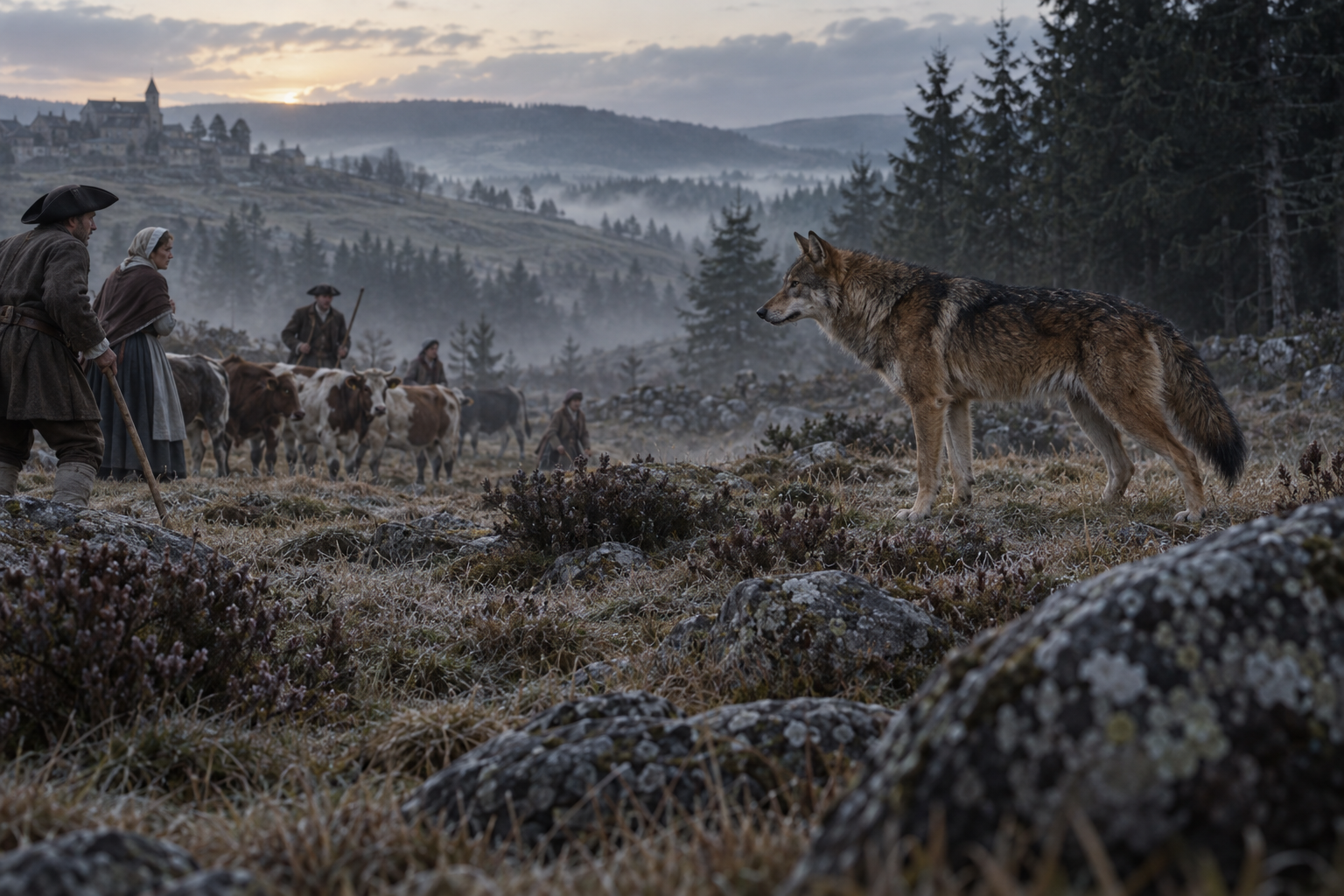
Supporting images provide documentary, geographic or visual context. Read each caption for its date, source and evidential limits.

Continue researching
Follow the evidence, context and comparisons
Curated connections
Selected editorially for this entry.
The Jersey Devil shows how regional folklore, landscape and newspaper appetite can turn a local creature story into a durable public monster.
Curated connection · ArticleThe Role of Newspapers in Spreading Strange TalesOld newspapers preserved remarkable local reports, but they also shaped them for appetite, humour and alarm.
Curated connection · Case fileThe Moorland Cat ReportsA careful look at Britain and Ireland large-cat reports, where escaped-animal context, distance errors and local rumour overlap.
More through shared context
Additional routes based only on existing topics, themes and metadata.
The Tatzelwurm is a durable Alpine animal tradition assembled from inconsistent sightings, regional names and later illustration. Familiar wildlife and folklore explain more than an undiscovered species.
Same primary topic · Shared theme: Media & rumour · Case fileMothman and the Silver Bridge: When a Creature Story Met a DisasterMothman is interesting not because the creature is easy to prove, but because the legend gathered itself around a town, a bridge and a tragic collapse.