Archaeology & Disputed Artefacts
Nan Madol: Engineering a Ceremonial City on the Reef
Nan Madol remains archaeologically challenging, but its builders and broad chronology are not unknowable. Local oral histories, settlement evidence and scientific dating converge on Pohnpeian construction and Saudeleur power.

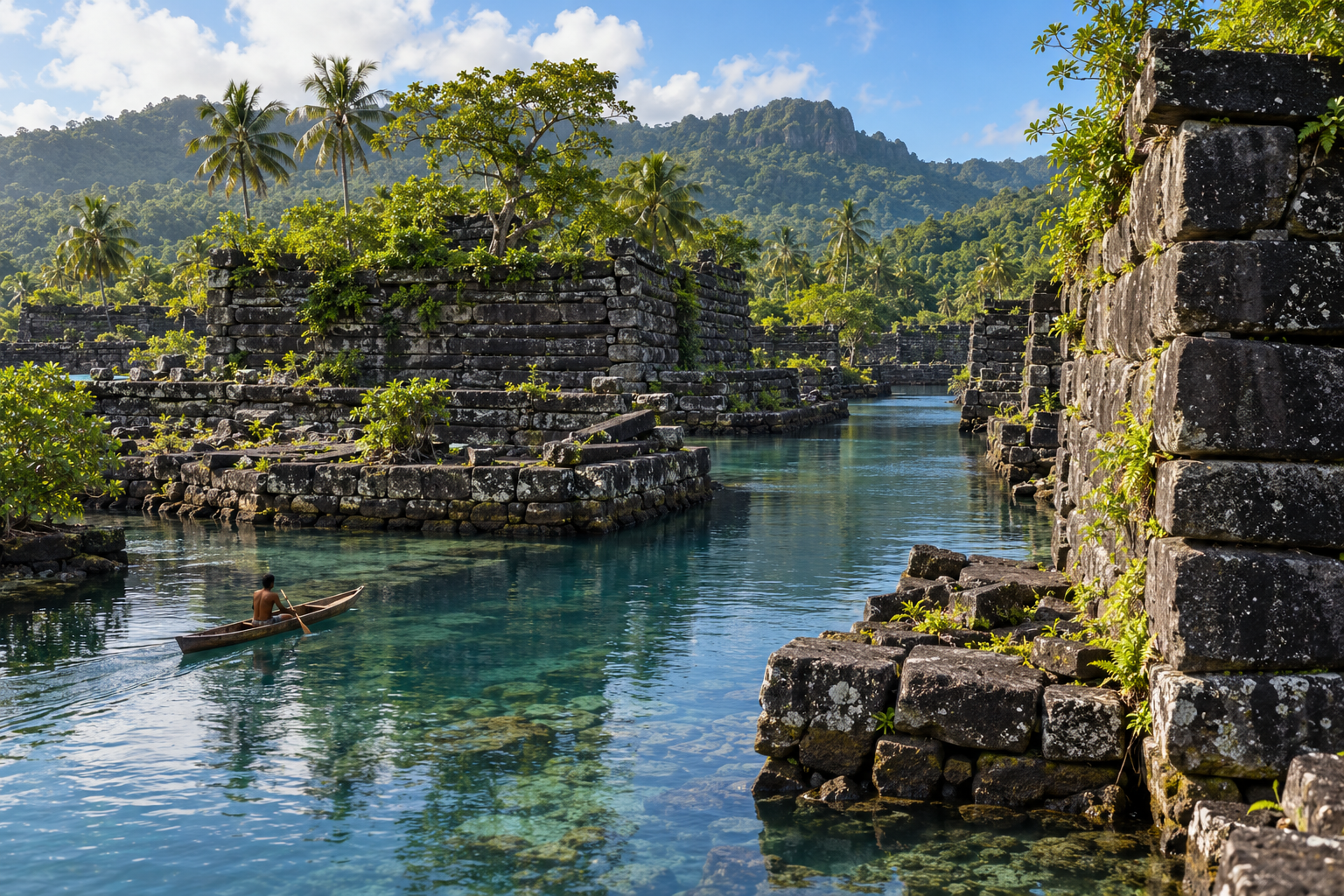
Off Pohnpei’s south-east coast, more than one hundred artificial islets and tidal channels carry the remains of Nan Madol. Builders stacked naturally columnar basalt in alternating courses and packed platforms with coral rubble. Palaces, ritual spaces, residences and monumental tombs formed a political and ceremonial centre.
The scale is real, but mystery marketing often removes the people who built it. Archaeological sequences show occupation and smaller islet construction before the monumental phase. Around the late twelfth and thirteenth centuries, Saudeleur authority concentrated labour and stone into the architecture now visible.
Researchers can source basalt by its chemistry to areas of Pohnpei and date coral fill or associated contexts. These methods do not produce a diary of every building operation, but they replace claims of unknowable or foreign builders with testable transport routes and construction phases.
Pohnpeian oral traditions describe the Saudeleur dynasty, sacred foundations and Isokelekel’s overthrow. Oral history and archaeology ask different questions; points of correspondence should not force every symbolic element into literal engineering history. Traditional ownership and continuing ceremonial meaning are evidence about a living heritage, not decorative additions.
Nan Madol complements the dated landscape of the Plain of Jars, the visible workmanship of the Nazca Lines, and the context-first caution in out-of-place artefacts.
Claim, Context and Cautions
Basalt, coral and accumulated labour
Columnar basalt fractures naturally into long prisms, but selecting, transporting and stacking it was human engineering. Boats, rafts, shallow-water movement and organised workforces offer mechanisms without requiring wheels, steel or levitation. Coral rubble raised and stabilised platforms within a reef environment.
The precise logistics are still researched. Uncertainty about crew size or one quarry route is not evidence for a vanished global technology.
Dating the monumental phase
Radiocarbon dates provide ranges from organic material, while uranium-series dating of construction coral can constrain when living coral was quarried and emplaced. At Nandauwas, direct dating supports major monument construction around the late twelfth century. Geochemical comparison links architectural basalt with Pohnpei sources.
Dates apply to sampled contexts, so archaeologists avoid assigning one year to the entire complex. The city developed in stages.
Oral history as historical evidence
Traditions preserve named rulers, places, genealogies and moral accounts of political change. They also operate in performance and sacred life, where meanings need not correspond one-to-one with excavation units. Comparing versions and recording who holds authority over a story are essential.
The responsible synthesis neither dismisses tradition as fantasy nor extracts convenient lines while ignoring Pohnpeian interpretation.
A threatened heritage, not an abandoned puzzle
Nan Madol was inscribed on UNESCO's World Heritage List in 2016 and simultaneously placed on the List in Danger. Mangrove growth, siltation, storm surge, vegetation and stone collapse threaten the site. Conservation must work with traditional owners under the Nahnmwarki system.
The strongest conclusion is impressive enough: generations of Pohnpeians created a specialised ceremonial centre through local knowledge, political organisation and sustained labour. Some construction details and settlement transitions remain open research questions. They should not be filled with lost-continent claims that erase the communities whose archaeology, oral history and governance identify the achievement. Conservation records also remind investigators that the ruins continue to change; modern collapse cannot be projected backward as an original plan.
Contextual glossary
Terms used in this entry
Definitions are offered as reading aids, not as conclusions about the case.
- Oral history
- A recorded interview about remembered experience, usually created with attention to the speaker, context and purpose. It is a source to interpret, not a transcript of the past without mediation.
- Excavation
- The controlled removal and recording of archaeological deposits. Because digging destroys the original arrangement, plans, photographs, samples and layer records are as important as the objects recovered.
- Uncertainty
- The stated limit on what a measurement, reconstruction or body of evidence can establish. Describing uncertainty is not indecision; it prevents a result from appearing more precise than the evidence allows.
- Ritual
- A repeated, structured action carrying social, religious or symbolic meaning. Similar-looking actions can have very different meanings, so local and historical context is essential.
Reference trail
Sources
- UNESCO World Heritage Centre, Nan Madol (opens in a new tab)Authoritative site description, chronology, significance, coordinates and conservation status.
- FSM Office of National Archives, Culture and Historic Preservation, Nan Madol (opens in a new tab)National heritage portal linking the nomination dossier and archaeological documentation.
- McCoy et al., earliest direct evidence of monument building at Nan Madol (opens in a new tab)Peer-reviewed study combining uranium-series coral dates and geochemical basalt sourcing.
Case Book
Photographs, Maps and Supporting Images
Supporting images provide documentary, geographic or visual context. Read each caption for its date, source and evidential limits.

Continue researching
Follow the evidence, context and comparisons
Curated connections
Selected editorially for this entry.
The Plain of Jars is not an archaeological void: burials, quarries and dating evidence support mortuary use over a long period. The exact sequence, social meaning and identity of its builders remain active research questions.
Curated connection · Case fileThe Nazca Lines: Huge Drawings Without Impossible BuildersThe Nazca Lines are extraordinary landscape works, but careful archaeology explains them through human labour, ritual geography and desert preservation.
Curated connection · ArticleOut-of-Place Artefacts and the Value of CautionWhy disputed objects need context, chain of custody and patient interpretation before becoming extraordinary evidence.
More through shared context
Additional routes based only on existing topics, themes and metadata.
The Shroud of Turin is valuable to the archive because it forces every question about provenance, authentication and interpretation into the same room.
Same primary topic · Shared theme: Disputed artefacts · Case fileCrystal Skulls: Modern Tools Behind an Ancient LegendScientifically examined crystal skulls do not support claims of ancient or paranormal origin. Tool marks, quartz provenance and sales records place prominent examples in the modern era.