UFOs & Aerial Phenomena
The Belgian UFO Wave: Triangular Lights and an Inconclusive Intercept
The Belgian wave combined sincere observations, institutional openness and an ambiguous radar episode. It did not produce a verified craft, and its reports likely include multiple stimuli.
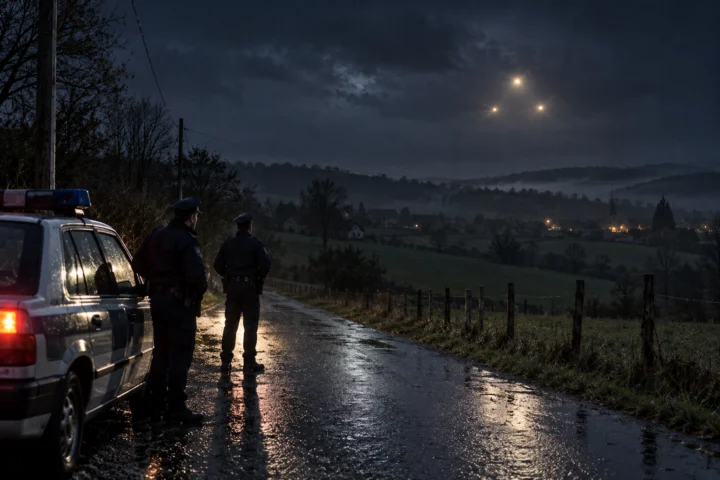
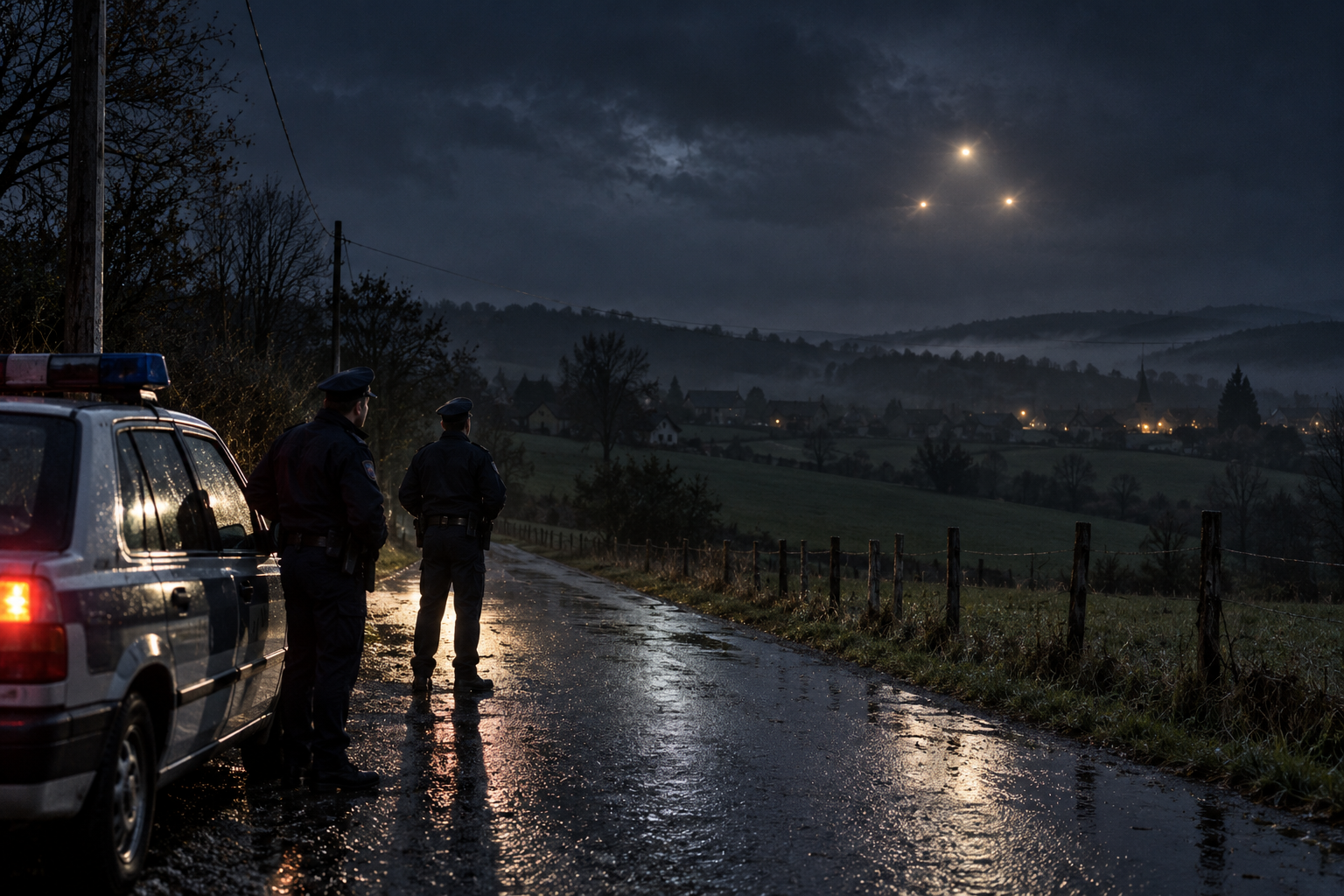
On 29 November 1989, gendarmes near Eupen reported bright lights arranged in a triangle moving slowly and silently. Other observers across eastern Belgium described related shapes and lights. Reports continued for months, creating a “wave” rather than one event with one evidential record.
Belgian authorities did not simply deny the observations. Police forwarded statements, the Air Force discussed cases publicly, and on the night of 30–31 March 1990 two F-16s were launched after ground radar reports. Their onboard radars recorded short-lived contacts and apparent rapid changes, but the pilots saw no corresponding object.
The Air Force report treated the contacts as unexplained while noting that no track could be maintained and no visual confirmation occurred. Radar can register interference, propagation effects and mismatched targets; a dramatic calculated acceleration is not automatically the path of a solid craft.
The best-known triangular photograph from Petit-Rechain was later claimed as a model hoax by its maker. That removes one iconic image, not the earlier police observations. Conversely, the sincerity of those observers cannot authenticate every later photograph or turn many reports into one vehicle.
The wave should be read with Washington’s radar alerts, the Phoenix Lights, and ordinary lights in UFO reports.
Claim, Context and Cautions
A wave is not a single case
Reports varied in place, time, shape, altitude and duration. Publicity helped witnesses know which features were expected, and later reports cannot all be treated as independent of earlier coverage. Some may describe aircraft, stars or advertising lights; others retain insufficient information.
Grouping them is useful for social chronology, but causal analysis must return to individual statements.
The March intercept
Ground controllers and F-16 systems registered intermittent returns. The aircraft repeatedly lost contacts, and pilots never acquired the reported target visually. Automatic lock and displayed speed depend on tracking assumptions when returns are weak or discontinuous.
The records demonstrate an operational response and anomalous indications. They do not independently demonstrate a triangular vehicle performing the full calculated manoeuvres.
Police testimony and scale
Police observations made close in time and recorded through official channels deserve weight. Night lights still provide poor distance cues, and a triangle can be inferred from three separate sources. Slow apparent motion may reflect a distant object or the observer's movement.
Training helps preserve sequence, but it does not supply range when the scene lacks a known reference.
What remains
No recovered material, stable multi-sensor track or close image identifies a craft. The hoaxed photograph shows why a compelling illustration cannot stand in for the reports it came to symbolise. At the same time, dismissing the entire wave as that photograph reverses the chronology.
The defensible conclusion is plural: Belgium experienced many reports, some official witnesses saw unusual lights, and the most famous intercept remained technically ambiguous. A single extraordinary cause is not required or established. Contemporary weather, air-traffic and astronomy records can test individual times, while witness independence must be established rather than assumed. A report made before publicity carries a different evidential history from one submitted after television coverage. Preserving that chronology explains why some Belgian observations remain more interesting than the wave's raw total. That hierarchy is more useful than forcing every witness into belief or dismissal.
Contextual glossary
Terms used in this entry
Definitions are offered as reading aids, not as conclusions about the case.
- UFO
- Unidentified flying object, historically used for an aerial observation that remains unidentified at the time of reporting. In popular culture it often implies a spacecraft, which is a separate claim.
- Hoax
- A deliberate attempt to make false evidence or a false story appear genuine. A hoax can still become culturally important, but its later influence should not be confused with the original claim.
Reference trail
Sources
- Defense Intelligence Agency, Belgian UFO reporting (opens in a new tab)Declassified reporting that records Belgian military attention and discussion of possible aircraft explanations.
- Belgian Air Force, report on 30–31 March 1990 (opens in a new tab)English-language copy of the military report on radar contacts and the F-16 response.
- Les OVNIS vus de près, Lambrechts report transcription (opens in a new tab)Full French transcription used to check the report wording and conclusions.
Case Book
Photographs, Maps and Supporting Images
Supporting images provide documentary, geographic or visual context. Read each caption for its date, source and evidential limits.

Continue researching
Follow the evidence, context and comparisons
Curated connections
Selected editorially for this entry.
The Washington sightings combined radar returns, visual reports and official alarm. Temperature inversions offer a plausible mechanism for some returns, but the heterogeneous evidence does not support one neat solution.
Curated connection · Case fileThe Phoenix Lights: Two Events, One NightOn 13 March 1997, reports of a moving light formation crossed Arizona before a separate row of lights appeared near Phoenix. One event has a strong military-flare explanation; the other remains disputed.
Curated connection · ArticleHow Ordinary Lights Become Extraordinary UFO ReportsAircraft, satellites, planets, drones and atmospheric effects can become strange when context is missing.
More through shared context
Additional routes based only on existing topics, themes and metadata.
The crew’s visual report was real and professionally documented. Radar returns were intermittent and disputed, while darkness, cloud and uncertain distance made size estimates especially fragile.
Same primary topic · Shared theme: Aviation, Strange signals, Witness & memory · Case fileLakenheath–Bentwaters: Radar, Interceptors and an Unresolved NightThe Lakenheath–Bentwaters incident combines multiple radar reports and an interceptor account, yet gaps in timing, weather and original records prevent a secure identification or extraordinary conclusion.