Cryptids & Animal Reports
The Saint Augustine Monster: From Giant Octopus to Whale Tissue
The Saint Augustine Monster was a real stranded carcass whose decayed form misled early observers. Preserved samples support degraded whale tissue, not a giant octopus.
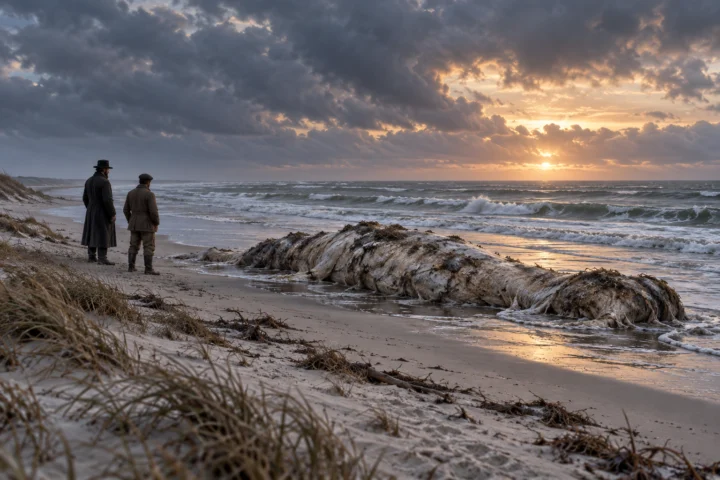
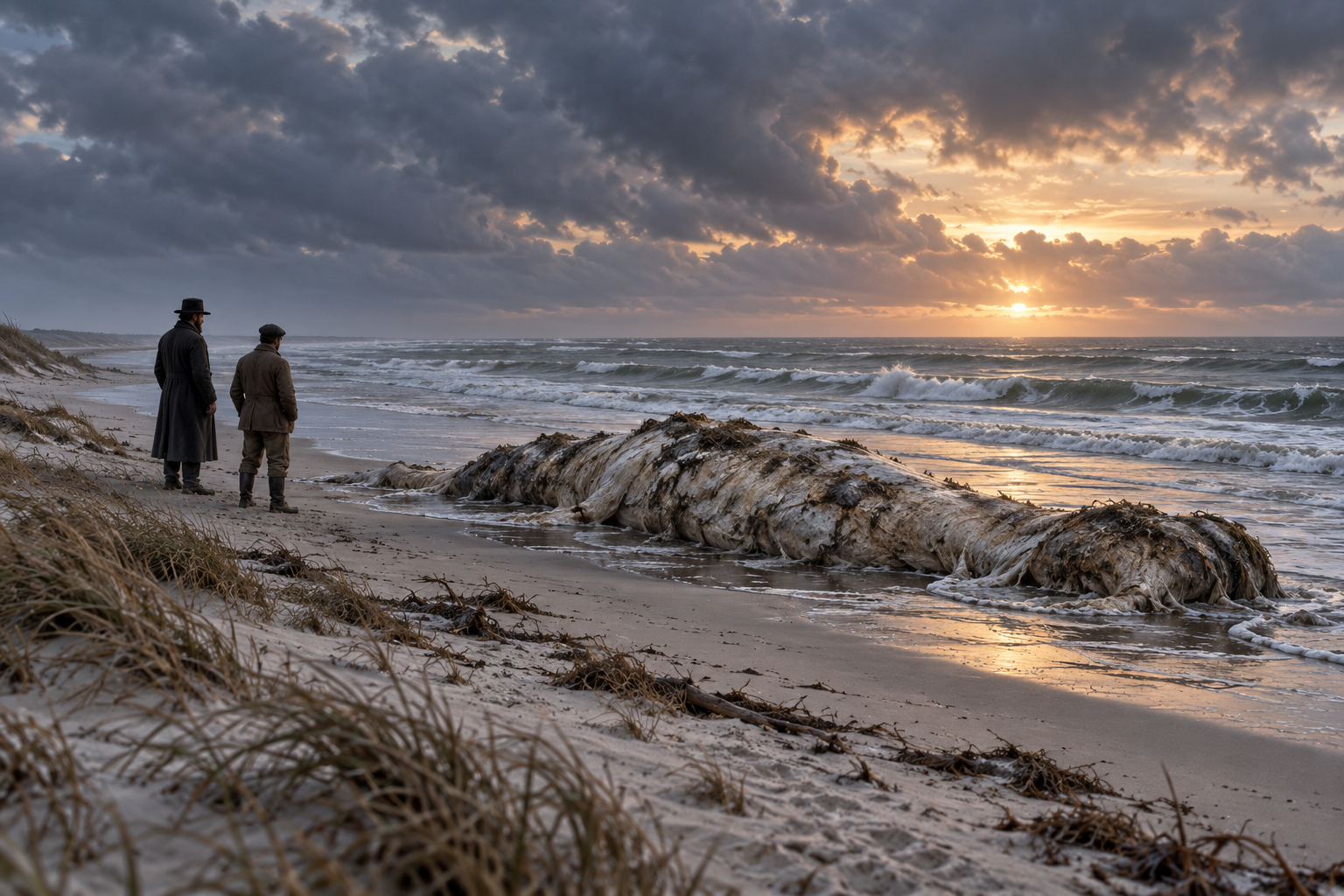
In November 1896, two boys found an enormous pale mass on Anastasia Island, Florida. Local physician DeWitt Webb examined and photographed it, measured projections interpreted as arms, and sent tissue to zoologists. Yale professor Addison Emery Verrill initially proposed a gigantic octopus and named it Octopus giganteus.
Decay had removed the features normally used to identify an animal. A “globster” can lose skin, bone and recognisable anatomy while tough connective tissue survives as a fibrous mass. Early experts were reasoning from an incomplete body whose apparent arms and shape had been altered by surf and decomposition.
Preserved material allowed the claim to be revisited. Electron microscopy and biochemical analysis reported in 1995 found collagen consistent with a warm-blooded mammal, not octopus tissue. The most likely source was decomposed whale blubber and connective tissue.
The case offers a biological counterpart to the staged Surgeon’s Photograph, the uncertain scale in creature traditions, and the archive’s caution about objects removed from context.
Claim, Context and Cautions
A carcass without a readable body plan
Webb documented a very large, resilient mass and projections that seemed tentacle-like. The absence of obvious bones encouraged a cephalopod identification. Newspapers and scientific correspondence gave the proposal a durable name.
But decomposition is destructive evidence. Structures stretch, separate and disappear, leaving shapes that do not reproduce the living animal’s anatomy.
Why Verrill changed his mind
Verrill first accepted a giant octopus, then reconsidered as descriptions and samples raised doubts. That revision is part of the scientific record, not a weakness to hide. Identification from a beach mass was provisional from the start.
Later retellings often preserve the dramatic first name more readily than the correction.
Collagen as a better clue
Microscopy revealed organised collagen fibres, and biochemical comparison placed the material with mammalian tissue. Octopus mantle does not produce the same collagen architecture. Whale tissue can remain as an enormous pale mat after other parts disperse.
The analysis identifies a source class more securely than it identifies an individual whale species.
How a monster survives an explanation
The original size, photographs and changing expert opinion keep the story attractive. “Globster” is also a useful descriptive word because it admits that a carcass may be unrecognisable before analysis.
The monster was not imaginary: the material existed. What changed was its interpretation, from a new animal inferred by shape to familiar tissue identified through preserved microscopic structure.
A chain of corrections across a century
Verrill’s early giant-octopus identification depended heavily on descriptions sent from Florida. As better photographs and tissue reached specialists, he moved towards a whale interpretation. Later tests briefly revived octopus claims when limited amino-acid comparisons were read too confidently. The 1995 work examined fibre arrangement and chemistry directly, and a 2004 comparative study placed the St Augustine material among several whale-derived globsters.
This sequence is useful because science did not deliver one instant verdict. Methods, reference samples and questions improved. Preserving tissue made correction possible long after waves and weather destroyed the original carcass.
The lesson is not that experts are immune to a monster story. It is that provisional names must remain provisional, samples need curation, and conclusions should change when a test distinguishes vertebrate collagen from cephalopod mantle. That evidential chain is why “explained” is appropriate here.
Reference trail
Sources
- Smithsonian Institution Archives, “The Saint Augustine Monster” (opens in a new tab)Institutional history drawing on Smithsonian correspondence, photographs and the later collagen analysis.
- Biological Bulletin, “The St. Augustine Monster” (opens in a new tab)Peer-reviewed report of electron-microscope and biochemical analysis identifying mammalian collagen.
- PubMed, “Nothing but whales” comparative globster study (opens in a new tab)Peer-reviewed 2004 molecular and microscopic comparison confirming that the St Augustine sample belongs with decomposed whale remains.
Case Book
Photographs, Maps and Supporting Images
Supporting images provide documentary, geographic or visual context. Read each caption for its date, source and evidential limits.

Continue researching
Follow the evidence, context and comparisons
Curated connections
Selected editorially for this entry.
The famous Loch Ness image became a visual shorthand for lake monsters, then a lesson in scale, cropping and media appetite.
Curated connection · ArticleWhy Phantom Black Dogs Haunt So Many Local LegendsBlack dog stories reveal how roads, boundaries, danger and memory gather into a repeated supernatural form.
Curated connection · ArticleOut-of-Place Artefacts and the Value of CautionWhy disputed objects need context, chain of custody and patient interpretation before becoming extraordinary evidence.
More through shared context
Additional routes based only on existing topics, themes and metadata.
Giant squid demonstrate that extraordinary animals can be real while legendary behaviour remains unsupported. Specimens, anatomy, DNA and live imaging establish Architeuthis without validating ship-attacking kraken tales.
Shared theme: Maritime · Same country or region · Case fileThe Carroll A. Deering: An Empty Schooner on Diamond ShoalsThe Carroll A. Deering was found abandoned on Diamond Shoals in January 1921. Missing boats, papers and crew suggested an organised departure, but its cause remains unknown.