Disappearances & Unresolved Identities
The Carroll A. Deering: An Empty Schooner on Diamond Shoals
The Carroll A. Deering was found abandoned on Diamond Shoals in January 1921. Missing boats, papers and crew suggested an organised departure, but its cause remains unknown.
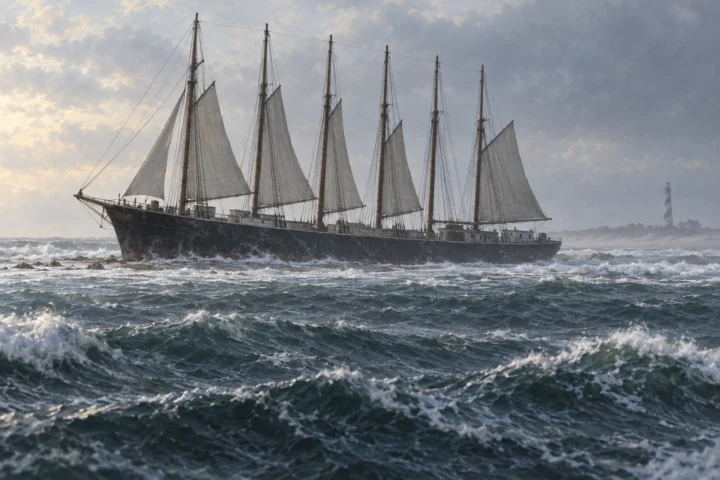
On 31 January 1921, the five-masted schooner Carroll A. Deering was seen aground on Diamond Shoals off Cape Hatteras. Her sails were set, the decks appeared empty and heavy seas prevented boarding for several days. When salvors finally reached her, the crew, lifeboats, logbook and key navigation equipment were gone.
The ship had recently returned from delivering coal to Rio de Janeiro. Near Cape Lookout, a man who did not appear to be an officer hailed the lightship and reported lost anchors. A passing vessel did not relay the message. This last contact later encouraged mutiny theories, but the stranger’s role was never established.
Five federal departments examined possibilities including storm, collision, piracy, Bolshevik hijacking and mutiny. A dramatic message in a bottle alleging capture was exposed as a local forgery. No bodies, boats or reliable distress communication were recovered.
The record rewards the same care applied to the Mary Celeste, the vanished keepers of the Flannan Isles, and the source discipline described in evidence, testimony and legend.
Claim, Context and Cautions
A new schooner with a troubled voyage
Built in 1919, the Deering was a large commercial sailing vessel with an auxiliary engine. Captain William Merritt fell ill before the return voyage and Captain Willis Wormell took command with a replacement first mate. Later recollections described tension between them, but the evidential basis is limited.
Crew conflict is relevant because the final abandonment appeared organised; it is not proof that a mutiny occurred.
The Cape Lookout hail
On 29 January, the schooner passed the Cape Lookout Lightship. A crewman said the vessel had lost both anchors and asked for the company to be notified. The lightship's radio was out, and a passing steamer failed to answer signals.
Witnesses thought the speaker's clothing and manner unusual for an officer. Identification from a distance remained uncertain, and no transcript captured his exact status.
What boarding parties found
The wreck showed evidence of departure: lifeboats were absent, as were personal effects, papers, chronometer and other navigational equipment. Food preparation has often been dramatised as a meal abandoned in progress, though inventories and retellings differ.
The sails and steering arrangement indicated that someone had continued working the ship. Heavy weather then battered the stranded hull before a complete inspection was possible.
A bottle note becomes evidence—and collapses
A note allegedly found ashore stated that an oil-burning vessel had captured the Deering. Early handwriting opinions encouraged attention, and newspapers expanded the piracy story. Federal investigators later obtained a confession from finder Christopher Columbus Gray that he had written it.
Removing the forged note also removes the strongest direct claim of capture. It is a reminder that a clue's provenance matters more than its dramatic fit.
Mutiny, accident or forced abandonment?
Mutiny could explain missing equipment and the non-officer at Cape Lookout, but supplies no destination or surviving witness. A navigational emergency and evacuation could place the crew in boats that were lost in winter seas. Piracy requires an unobserved second vessel and motive, while collision evidence was absent.
Every theory explains part of the scene and leaves a gap.
The limit of an empty ship
The abandoned schooner proves that the crew left or was removed before salvage. It does not preserve why, when or under whose authority. Subsequent federal inquiry gathered extensive correspondence without recovering the men or boats.
Unlike supernatural ghost-ship folklore, the Deering case is a human maritime loss. Its mystery is the missing interval between a witnessed hail and an empty hull on the shoals.
Contextual glossary
Terms used in this entry
Definitions are offered as reading aids, not as conclusions about the case.
- Provenance
- The documented history of an object’s origin, ownership, location and handling. A dramatic claim with weak provenance cannot reliably establish where or when an object came from.
- Forgery
- An object, document or image made or altered so that it will be accepted as something it is not. Demonstrating forgery requires evidence about manufacture, materials, provenance or transmission, not merely an unusual claim.
Reference trail
Sources
- U.S. National Park Service, “The Ghost Ship of the Outer Banks” (opens in a new tab)Official Cape Hatteras history covering last sightings, boarding, missing items, hoax note and federal inquiry.
- Herbert Hoover Presidential Library, “The Wreck of the Carroll A. Deering” (opens in a new tab)National Archives account based on Lawrence Richey’s investigation files and Hoover-era correspondence.
- Library of Congress, “The Mysterious Disappearance of Ghost Ship Carroll A. Deering’s Crew” (opens in a new tab)Contemporary newspaper evidence and the later exposure of the bottle-note hoax.
- United States Coast Guard, “Ghostship Carroll A. Deering” (opens in a new tab)Coast Guard historical account of the wreck, response and unresolved crew disappearance.
Case Book
Photographs, Maps and Supporting Images
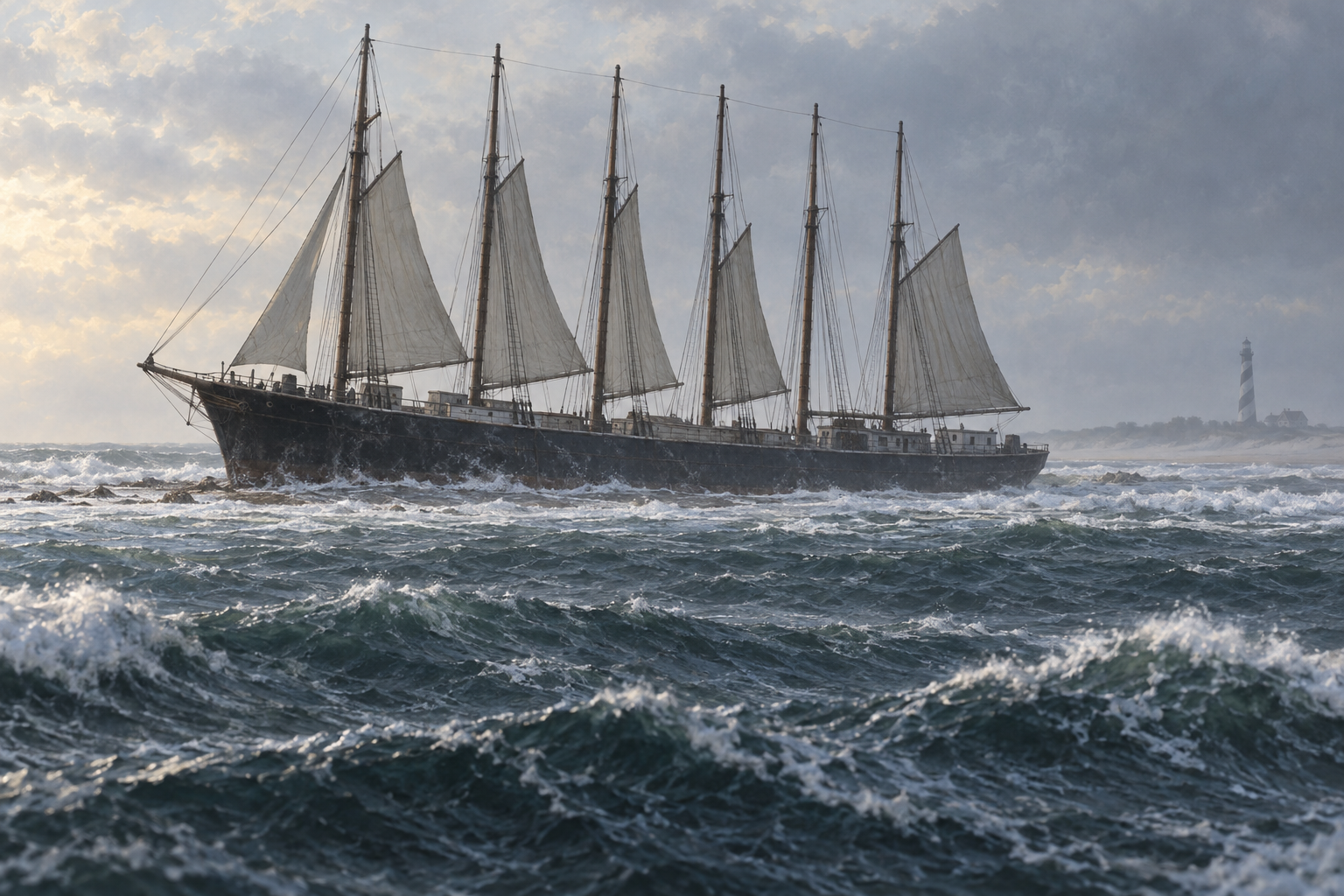
Supporting images provide documentary, geographic or visual context. Read each caption for its date, source and evidential limits.

Continue researching
Follow the evidence, context and comparisons
Curated connections
Selected editorially for this entry.
The famous 1872 maritime mystery is less a ghost story than a stubborn problem of evidence, weather, cargo and missing people.
Curated connection · Case fileThe Flannan Isles Lighthouse Keepers: A Vanishing at the Edge of WeatherThree lighthouse keepers disappeared from Eilean Mor in 1900, leaving a mystery where official records point toward sea, weather and working risk rather than fantasy.
Curated connection · ArticleThe Difference Between Evidence, Testimony and LegendA field guide to three words that often get tangled in mystery research.
More through shared context
Additional routes based only on existing topics, themes and metadata.
The disappearance of USS Cyclops is a major United States Navy loss without a recovered wreck. Structural, loading, weather and wartime explanations remain constrained by missing evidence.
Same primary topic · Shared theme: Maritime · Case fileMV Joyita: The Waterlogged Ship and Its Missing Twenty-FiveJoyita’s seaworthiness problems and failed communications explain how an emergency could develop. The decision to abandon a buoyant vessel, and what happened afterward, remain unresolved.