Folklore & Legends
Why Phantom Black Dogs Haunt So Many Local Legends
Black dog stories reveal how roads, boundaries, danger and memory gather into a repeated supernatural form.
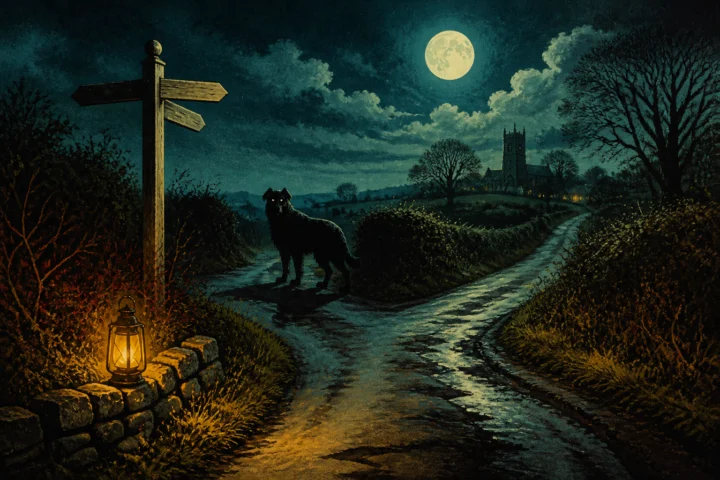
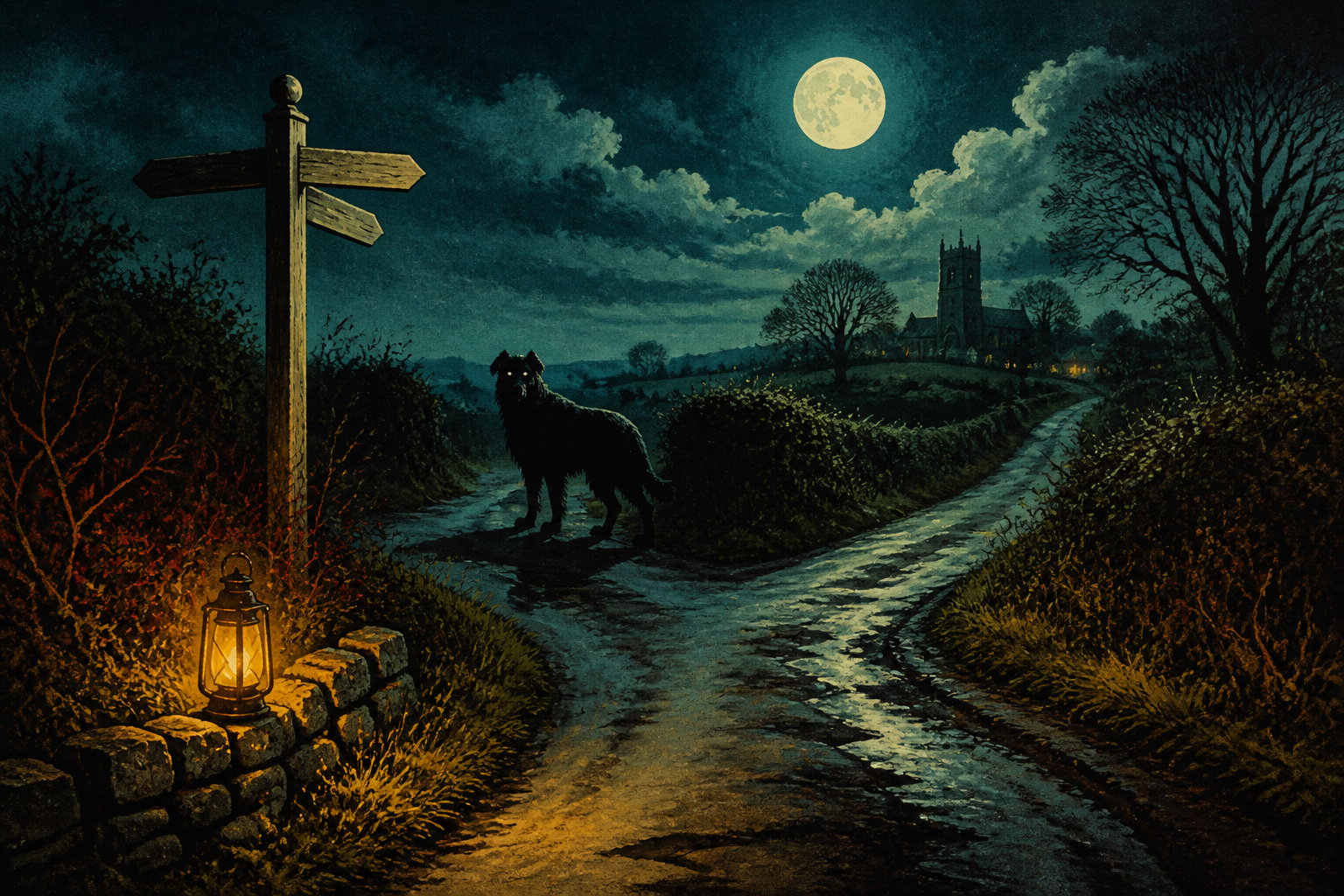
A black dog at the edge of a road is an ordinary animal until the story gives it a route, a warning and a habit of vanishing. Across Britain and Ireland, that story has attached itself to lanes, bridges, churchyards, gates, coast paths and moorland tracks. The repetition is striking, but repetition in folklore is not the same thing as repeated zoological evidence.
Phantom black dogs are useful precisely because they sit between experience and tradition. A witness may have seen a real dog in poor light, heard a story about the same place, or encountered something they could not identify. The archive should preserve those possibilities separately instead of forcing every report into one supernatural creature.
A shape that travels
The names change by region. East Anglia has Black Shuck; other districts have barghests, padfoots, skrikers or unnamed black dogs. Details change too. One animal is enormous, another silent, another associated with storms, death or protection. Some have burning eyes; others are remembered only as a dark form keeping pace beside a traveller.
Those differences matter. They show a tradition adapting to local speech and landscape rather than a single description being copied intact. A churchyard dog can become a guardian of the dead. A road dog becomes a warning to a late traveller. On a coast path or marsh edge, the same shape gathers weather, isolation and the danger of losing the route.
Why boundaries attract stories
Many encounters happen at places of transition: a gate between fields, a bridge over water, a lane leaving a village, a churchyard wall or a crossroads. These are practical points where choices, risks and jurisdictions change. Before street lighting and reliable transport, they were also places where darkness made distance and movement hard to judge.
Folklore does not merely decorate such places. It remembers how they were used. A warning dog can encode a dangerous bend, a flooded crossing or a route avoided after dark. A protective dog can turn a frightening journey into one in which the traveller was accompanied. The supernatural image gives local experience a form that is easy to tell again.
From an animal to an apparition
Large dogs do escape, roam and become unfamiliar when seen at a distance. Wet fur can absorb light, eye-shine can flash briefly, and fog or rain removes the lower outline of an animal. A dog crossing behind a hedge may appear to vanish. Expectation then supplies the feature that was never clearly seen.
Memory adds another stage. People usually retain the surprise and emotional force of an encounter better than its exact duration or distance. After a local legend is mentioned, uncertain details may acquire a familiar pattern. This does not mean the witness is lying. It means a report can be sincere and still become more traditional each time it is retold.
Black Shuck as a case study
The Black Shuck case file follows one named East Anglian tradition, including the famous 1577 storm narratives connected with Bungay and Blythburgh. It should not be treated as proof that every black-dog story shares one origin. The value of the case is comparative: printed accounts, church marks, later tourism and local identity can be examined alongside one another.
Historic England’s account of the tradition usefully shows how a legend becomes attached to surviving fabric. Scorch marks on a church door can be real marks while their supernatural attribution remains folklore. The object and the interpretation have different evidential status.
How to record a black-dog report
- Record the exact route, direction of travel and nearest fixed landmark.
- Note lighting, weather, visibility, ground conditions and whether vehicle headlights were involved.
- Describe size by comparison with a gate, wall or known dog rather than using “huge” alone.
- Record sound, tracks, smell and interaction with other animals separately.
- Ask when the witness first heard the local legend and whether it was discussed before the account was written.
- Search newspapers and oral-history collections for earlier versions, but do not assume similar wording means a second sighting.
What the pattern can and cannot show
The distribution of black-dog stories shows that a durable supernatural form has travelled through local culture. It does not establish a population of unknown animals or one entity moving between counties. The strongest archive keeps the reported experience, the physical setting and the inherited story in view at the same time.
That balance leaves room for wonder without confusing folklore with field biology. The black dog remains compelling because it can be animal, warning, guardian, omen and memory – sometimes within the same telling.
Contextual glossary
Terms used in this entry
Definitions are offered as reading aids, not as conclusions about the case.
- Black dog
- A spectral or uncanny dog associated in British and Irish traditions with roads, churchyards, boundaries, storms or death omens. Similar motifs do not make every local story the same tradition.
- Oral history
- A recorded interview about remembered experience, usually created with attention to the speaker, context and purpose. It is a source to interpret, not a transcript of the past without mediation.
- Apparition
- A reported figure or presence seen without an obvious physical person present. The word describes the experience without deciding whether its cause was environmental, psychological or unknown.
Reference trail
Sources
- Historic England: A Vampire Rabbit, a Devil Dog and Other Tales (opens in a new tab)Black Shuck as a local tradition attached to Bungay, Blythburgh and surviving church fabric.
- Library of Congress: Legends and Belief Tales (opens in a new tab)Archive guidance on legends, belief and the question of whether a narrated event happened.
- Library of Congress: Einstein's Folklore (opens in a new tab)A clear discussion of friend-of-a-friend transmission in contemporary legend.
Case Book
Photographs, Maps and Supporting Images
Supporting images provide documentary, geographic or visual context. Read each caption for its date, source and evidential limits.
Continue researching
Follow the evidence, context and comparisons
Curated connections
Selected editorially for this entry.
Black Shuck endures because it is a black-dog legend that can stand for warning, death, landscape and local memory at the same time.
Curated connection · ArticleFairy Lore as Local GeographyHills, rings, paths and boundaries often matter more than wings or glitter in older fairy traditions.
Curated connection · ArticleUrban Legends Before the InternetChain letters, photocopies, local radio and schoolyard retellings show that viral folklore did not need a screen.