UFOs & Aerial Phenomena
The Phoenix Lights: Two Events, One Night
On 13 March 1997, reports of a moving light formation crossed Arizona before a separate row of lights appeared near Phoenix. One event has a strong military-flare explanation; the other remains disputed.
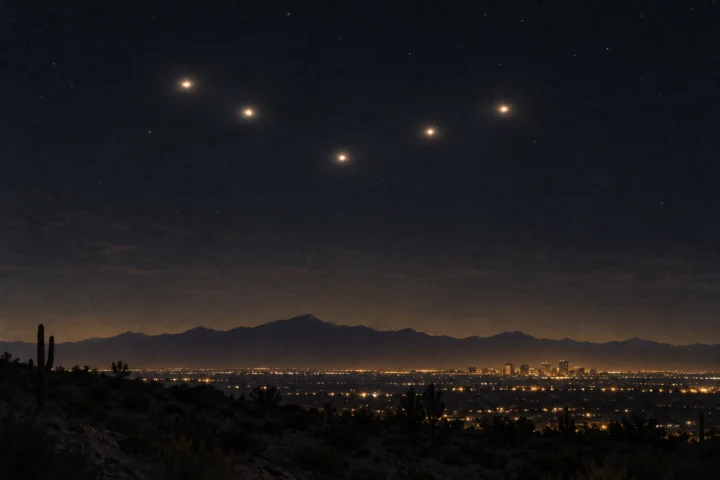
The Phoenix Lights are usually remembered as one enormous object hanging over an American city. The surviving record is less tidy and more useful. On the evening of 13 March 1997, witnesses across Arizona reported a formation of lights moving south. Later, at about 10 p.m., another set of lights appeared southwest of Phoenix, seemed to hang above a mountain ridge and faded one after another. Footage of that later display became the case’s defining image.
Those sequences should not be treated as a single continuous observation. They occurred at different times, behaved differently and are supported by different evidence. The later lights have a strong explanation in a military illumination-flare exercise. The earlier formation produced varied testimony: some witnesses perceived one vast, silent object; others saw separate lights, and at least one telescopic observer identified aircraft.
Separating the two events does not make the night uninteresting. It shows how witness perception, military activity, video and later retelling can compress several observations into one enduring UFO story.
For context, the archive’s guides to ordinary lights and expert perception set out the identification limits used here; the Battle of Los Angeles offers a historical comparison.
Claim, Context and Cautions
The first sequence: a formation moving south
The National UFO Reporting Center says its first call came at about 8:16 p.m. from a former police officer near Paulden, north of Prescott. The caller described a cluster of red-orange lights, with four or five leading lights and another behind. More calls followed from Prescott, Prescott Valley, Dewey and places farther south. Reports differed in colour, number, height, speed and apparent structure, but a V, wedge or boomerang arrangement recurred.
As the reports reached metropolitan Phoenix, some witnesses described lights passing overhead without audible engine noise. Some interpreted the dark area between the lights as a single solid craft. Others did not. A Tempe report filed later that month described five red lights and explicitly concluded that they were separate objects rather than one body.
The route is reconstructed from calls and later interviews, not from one continuous instrument track. It is therefore safer to describe a sequence of related reports than a proven single object travelling the length of Arizona.
The second sequence: lights above the southwest horizon
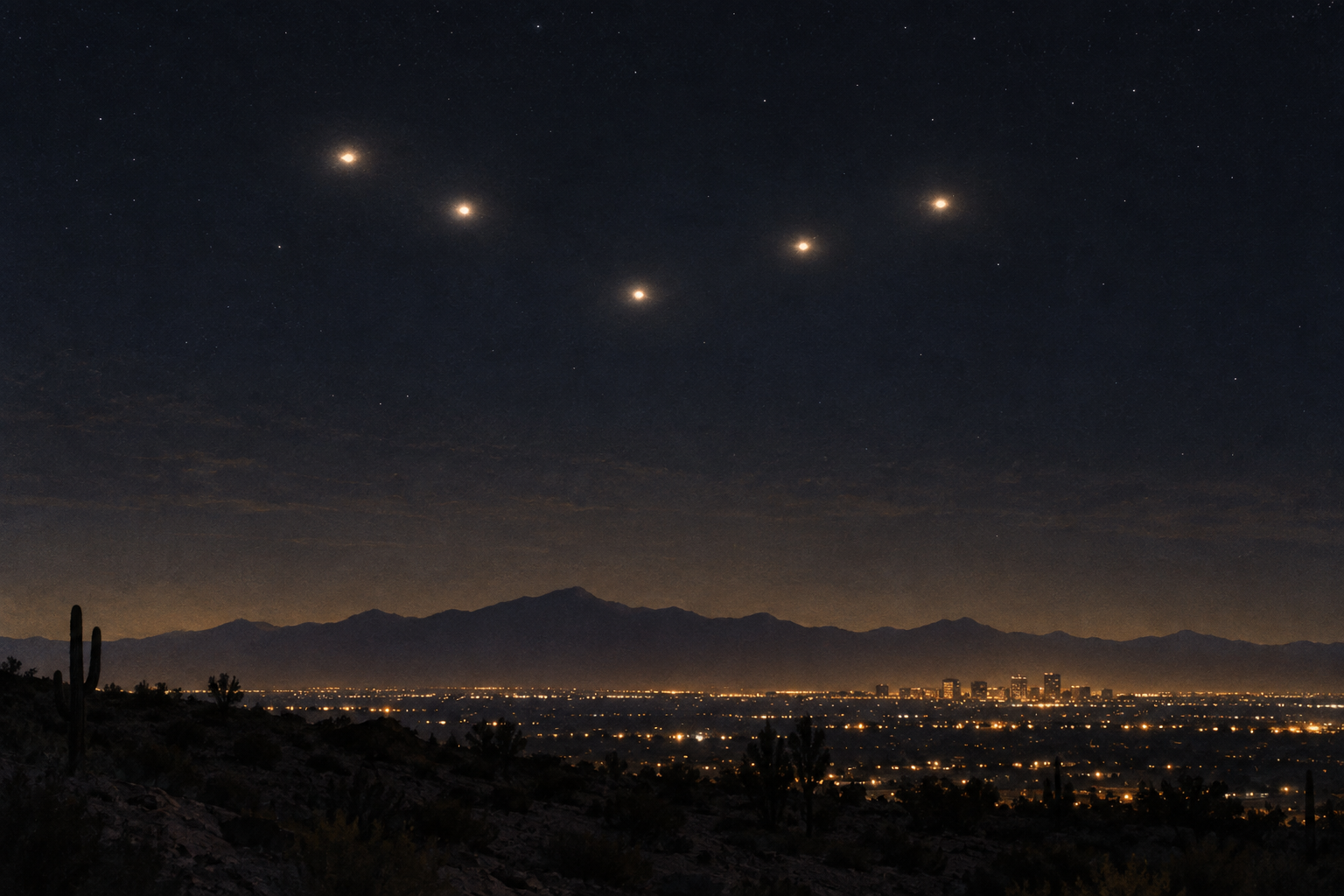
At roughly 10 p.m., Phoenix-area observers saw a different display: bright lights arranged in a line or arc toward the southwest. Several people filmed this sequence. The lights appeared relatively stationary, descended or faded in turn, and seemed to vanish near the distant mountain skyline.
Visiting A-10 aircraft from the Maryland Air National Guard had been training at the Barry M. Goldwater Range southwest of Phoenix that night. In July 1997, military spokespeople confirmed that the aircraft had released high-intensity illumination flares. Contemporary reporting said the remaining flares were released at high altitude before the aircraft returned to Davis–Monthan Air Force Base.
Later image comparisons placed the filmed lights beyond the Sierra Estrella ridge and found that their apparent disappearances were consistent with descending flares passing behind the mountains. This explanation applies strongly to the later, widely filmed display. It does not by itself explain every earlier moving-light report.
What is solid?
Multiple people reported unusual-looking lights on 13 March, and calls began while the evening's events were still unfolding. Surviving reports establish that descriptions were not uniform. Witnesses disagreed about colour, altitude, number of lights, speed and whether a body connected them. That variation belongs in the record rather than being edited away.
It is also solid that military aircraft were conducting training in southern Arizona and that illumination flares were released over the range. The time, direction and behaviour of the later lights, together with the videos and ridge-line analysis, make flares the best-supported explanation for the approximately 10 p.m. display.
What the evidence does not establish is a measured mile-wide craft. Apparent size and speed cannot be recovered reliably without known distance. Silence does not establish proximity, and a dark space between bright points is not independent evidence that a solid surface blocked the stars.
What remains disputed?
The earlier travelling formation remains the contested part of the case. Amateur astronomer Mitch Stanley told the Phoenix New Times that he followed the lights through a ten-inch telescope and saw separate aeroplanes, with each apparent light resolving into lights under squarish wings. A later sceptical reconstruction argued that a formation of military aircraft on a route between Nevada and Tucson fits the timing and V-shaped appearance.
That is important evidence, but it is still one observation reported through journalism. Publicly available material does not provide a single contemporaneous flight record that resolves every early report. Other witnesses sincerely described a low, silent, structured object. Their accounts establish what they perceived, not the object's dimensions or origin.
The careful conclusion is narrower than either “giant craft” or “nothing happened”: aircraft are a plausible and evidence-supported explanation for the early formation, while the surviving public record is not complete enough to reconstruct every observation with certainty.
How two events became one image
The later lights supplied the memorable video; the earlier reports supplied the dramatic moving craft. Once television, anniversary coverage and documentaries placed them under one name, the distinction became easy to lose. A viewer could watch flare footage while hearing testimony from someone who had reported a different formation much earlier.
The number of witnesses also grew into a claim of its own. Large numbers indicate that something noticeable was visible, but they do not turn separate viewpoints into a measurement. Reports influence one another after news coverage begins, and later interviews can incorporate the case's familiar language and images.
This is why the case needs exact time, direction, elevation and independent records. Without those details, two real displays can become one impossible object.
Why it still matters
The Phoenix Lights endure because the case contains both an unusually good ordinary explanation and a residue of contested testimony. Treating every light as a flare ignores the chronology. Treating the famous videos as proof of a craft ignores the military exercise and the mountain-line analysis. The responsible account has to hold both conclusions at once.
The case also shows why “unidentified” is temporary and local. A light can be unidentified to a witness yet identifiable when flight activity, geography and video are compared. Another report from the same night may remain uncertain because it lacks equivalent records. That is not inconsistency; it is evidence being assessed event by event.
The Phoenix Lights are partly a history of what people saw and partly a history of how authorities, investigators and media organised those perceptions into a story.
Contextual glossary
Terms used in this entry
Definitions are offered as reading aids, not as conclusions about the case.
- Independent evidence
- Evidence obtained through a source or method that did not derive from the claim it appears to support. Several retellings of one account are multiple copies, not multiple independent observations.
- Reconstruction
- A later model, image or account made to represent an event from surviving information. It can clarify a hypothesis but should remain visibly separate from contemporary evidence.
- UFO
- Unidentified flying object, historically used for an aerial observation that remains unidentified at the time of reporting. In popular culture it often implies a spacecraft, which is a separate claim.
Reference trail
Sources
- National UFO Reporting Center: “The Phoenix Lights” (opens in a new tab)Near-contemporary chronology compiled from hotline calls. Useful as a witness-report archive, but it includes claims that NUFORC itself says it could not document and should not be treated as an official investigation.
- National UFO Reporting Center: Sighting 2104, Northwest Tempe (opens in a new tab)Report filed on 27 March 1997 describing five lights moving north to south; the observers concluded that the lights were separate rather than one visible body.
- Tony Ortega, Phoenix New Times: “The Great UFO Cover-up” (26 June 1997) (opens in a new tab)Contemporary local reporting that records differing witness interpretations and Mitch Stanley's telescopic identification of the early formation as aeroplanes.
- Las Vegas Sun/AP: “Military now says flares may be cause of mysterious Arizona lights” (25 July 1997) (opens in a new tab)Contemporary report quoting Arizona and Maryland Air National Guard spokespeople about A-10 training and high-intensity flares over the Barry M. Goldwater Range; it also notes that this did not address northern reports.
- Joe Nickell and James McGaha, Skeptical Inquirer: “Alien Lights? At Phoenix, Stephenville, and Elsewhere: A Postmortem” (2015) (opens in a new tab)Sceptical reconstruction of the aircraft-formation and flare explanations, including telescope testimony and later video/ridge-line analysis. Use as interpretation, not as a primary military record.
- Benjamin Leatherman, Phoenix New Times: “The Phoenix Lights UFO sightings in 1997: An oral history” (13 March 2025) (opens in a new tab)Retrospective oral history illustrating both the consistency and variation in later witness memories. Later recollection is contextual testimony, not a substitute for contemporary records.
Case Book
Photographs, Maps and Supporting Images
Supporting images provide documentary, geographic or visual context. Read each caption for its date, source and evidential limits.

Continue researching
Follow the evidence, context and comparisons
Curated connections
Selected editorially for this entry.
Aircraft, satellites, planets, drones and atmospheric effects can become strange when context is missing.
Curated connection · ArticlePilot Reports and the Problem of Expert PerceptionTrained observers matter, but expertise does not remove ambiguity from distance, speed, glare and surprise.
Curated connection · Case fileThe Battle of Los Angeles: Searchlights, Shells and Wartime NervesIn February 1942, Los Angeles saw searchlights, anti-aircraft fire and rumours of enemy aircraft in a case where fear, weather and uncertainty lit up the sky.
More through shared context
Additional routes based only on existing topics, themes and metadata.
The crew’s visual report was real and professionally documented. Radar returns were intermittent and disputed, while darkness, cloud and uncertain distance made size estimates especially fragile.
Same primary topic · Shared theme: Aviation, Witness & memory · Case fileSocorro: Lonnie Zamora and the Object in the ArroyoThe Socorro incident rests on a prompt police report and documented ground traces, yet neither the marks nor later theories securely identify what Lonnie Zamora saw.