Investigation & Evidence
The Difference Between Evidence, Testimony and Legend
A field guide to three words that often get tangled in mystery research.
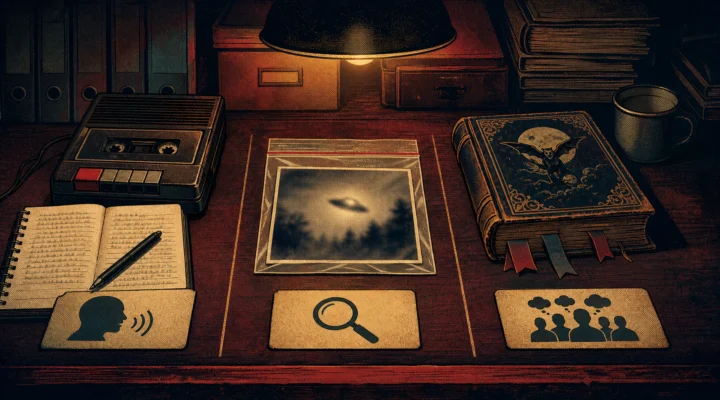
A witness statement is evidence that a person reported an experience. It is not automatically physical evidence of the thing they believed caused it. A repeated local story is evidence of tradition. It is not automatically a second witness statement. Mystery research becomes confused when these different records are placed in one pile and counted as if they carry equal weight.
The remedy is not to dismiss testimony or folklore. Both can preserve information unavailable anywhere else. The task is to label what each source can establish, what it cannot establish and how far it has travelled from the event.
Physical and documentary evidence
Physical evidence includes an object, trace, sample, recording or measurable environmental change. Its value depends on context. A photograph without an original file, date, camera position or chain of custody may be visually impressive but difficult to test. A footprint cast is stronger when the location, substrate, weather and collection method were recorded before the cast was made.
Documents are objects too. A diary entry written the same evening differs from a memoir written forty years later. A police log establishes what was reported at a particular time; it may not verify the report’s interpretation. An official letter can show that authorities discussed a claim without showing that they endorsed it.
Testimony
Testimony is a person’s account of what they perceived, remembered or were told. It carries information about viewpoint, sequence, emotion and meaning that an instrument may miss. It also reflects attention, expectation, later discussion and the questions asked by an interviewer.
Oral-history practice offers a useful discipline: seek direct personal experience, preserve the speaker’s own account, document the recording and treat consent as part of the record. Memory often preserves exceptional events and feelings more readily than exact dates. That is a reason to compare testimony with clocks, maps, weather and other accounts, not a reason to treat witnesses as dishonest.
Rumour, tradition and legend
A rumour is information circulating without secure verification. A tradition is a repeated practice or narrative held by a group. A legend is a story told in relation to belief, often as something that could have happened in the known world. These categories overlap, but none becomes an eyewitness account merely through repetition.
The Cottingley Fairies provide all three layers. There are physical photographs, statements from the people involved, printed endorsement and a wider fairy tradition that made the images legible. Each layer answers a different question. The photographs exist; their interpretation changed; the cultural expectation pre-dated them.
The Piltdown Man case shows why material alone is not enough. Real bone fragments were combined and altered. Their scientific appearance and reported find context gave them authority until chemical tests and anatomical comparison exposed the construction. The chain of custody was part of the evidence, not administrative decoration.
A comparison table
| Record | What it can establish | What must still be checked |
|---|---|---|
| Original photograph | Light reached a sensor in a particular pattern | Date, location, scale, processing, custody and alternative subjects |
| First-hand statement | What a named witness says they perceived | Viewpoint, timing, prompts, later influence and independent records |
| Second-hand account | What was circulating between people | Identity of the original source and changes between versions |
| Newspaper report | What was published by a date | Reporter sources, reprints, corrections and editorial framing |
| Local legend | A narrative associated with a community or place | Earliest documentation, variation and claims of antiquity |
| Museum object | A preserved material item | Excavation context, provenance, restoration and testing history |
The archive test
- Identify the source nearest to the event.
- Record when the source was created, not only when the event supposedly occurred.
- Separate observation from interpretation: “a light moved” is not the same claim as “a craft accelerated.”
- Track custody and copying. Preserve originals where possible.
- Ask whether accounts are independent or derive from one interview, clipping or group discussion.
- State what remains missing instead of filling gaps with the preferred explanation.
Why all three belong
An archive made only of physical traces would lose how events were experienced. One made only of testimony would struggle to test causes. One made only of legend would preserve cultural meaning while blurring individual events. The useful record keeps the layers connected but visibly distinct.
That distinction protects curiosity. It allows a witness to be heard without turning sincerity into proof, and it allows folklore to matter without pretending that a durable story is a laboratory result.
Contextual glossary
Terms used in this entry
Definitions are offered as reading aids, not as conclusions about the case.
- Chain of custody
- The documented sequence showing who collected, stored, copied, tested and transferred an object or recording. Gaps make alteration, contamination or mistaken identity harder to rule out.
- Witness statement
- A recorded account attributed to a particular witness at a particular time. The original wording, questions asked and edits are part of the evidence and should be preserved.
- Oral history
- A recorded interview about remembered experience, usually created with attention to the speaker, context and purpose. It is a source to interpret, not a transcript of the past without mediation.
- Provenance
- The documented history of an object’s origin, ownership, location and handling. A dramatic claim with weak provenance cannot reliably establish where or when an object came from.
- Rumour
- Unverified information circulated between people because it appears relevant or urgent. Repetition can make a rumour familiar without adding an independent source.
Reference trail
Sources
- Oral History Society: Getting Started (opens in a new tab)Practical guidance on first-hand testimony, memory, recording and documentation.
- Oral History Society: Legal and Ethical Advice (opens in a new tab)Consent, trust, preservation and responsible use of recorded testimony.
- Smithsonian National Collections Program: Provenance (opens in a new tab)Why ownership history and gaps in custody matter to authentication and interpretation.
- Library of Congress: Legends and Belief Tales (opens in a new tab)Archive context for distinguishing legend narratives from direct event records.
Case Book
Photographs, Maps and Supporting Images
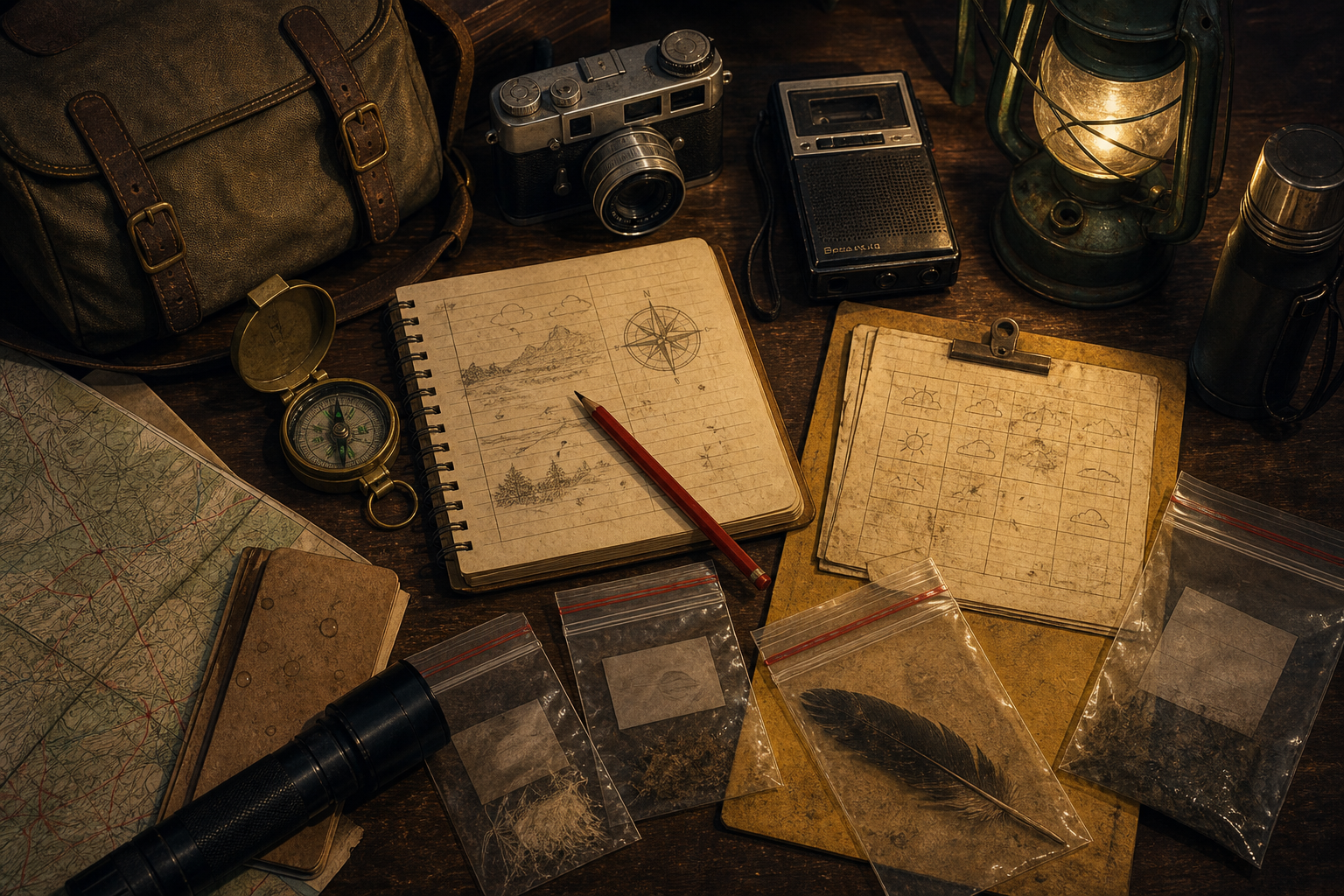
Supporting images provide documentary, geographic or visual context. Read each caption for its date, source and evidential limits.
Continue researching
Follow the evidence, context and comparisons
Curated connections
Selected editorially for this entry.
A practical guide to separating atmosphere, testimony, memory, environment and possible causes in a reported haunting.
Curated connection · Case fileThe Cottingley Fairies: Paper Wings, Cameras and BeliefTwo Yorkshire cousins, a camera and a set of fairy photographs became one of the most instructive image hoaxes of the twentieth century.
Curated connection · Case filePiltdown Man: The Fossil That Flattered an ExpectationPiltdown Man fooled parts of the scientific world for decades because forged evidence appeared to fit a story people were ready to hear.
More through shared context
Additional routes based only on existing topics, themes and metadata.
A calm checklist for writing down unusual events before memory, excitement and online feedback reshape them.
Shared theme: Witness & memory · Same country or region · ArticleHow Ordinary Lights Become Extraordinary UFO ReportsAircraft, satellites, planets, drones and atmospheric effects can become strange when context is missing.