Investigation & Evidence
The Role of Newspapers in Spreading Strange Tales
Old newspapers preserved remarkable local reports, but they also shaped them for appetite, humour and alarm.
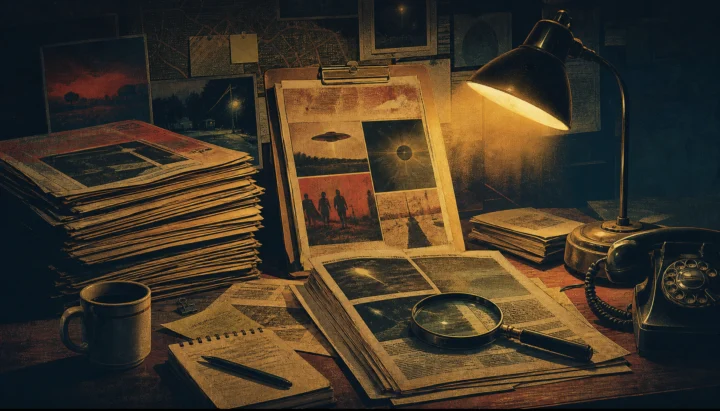
An old newspaper clipping is evidence that a story was printed. It is not, by itself, evidence that the printed event occurred. That distinction sounds obvious until a paragraph with a date, a place and a confident headline begins circulating as a historical fact.
Newspapers are indispensable to strange history because they preserved names, language and public reaction that might otherwise have vanished. They are also participants in the stories they record. Editors selected, shortened, dramatised and reprinted material for readers. A clipping is both a report and a made object.
The reprint machine
Before electronic syndication, papers filled columns by copying items from exchanges. A curious report from one town could travel across a region with its original paper named in the first reprint, shortened in the second and lost by the third. A phrase such as “according to a western journal” gave distance the appearance of corroboration.
This matters because ten clippings may represent one anonymous source rather than ten witnesses. Search by an unusual sentence, not only by the subject. Earlier versions often contain cautions removed later. Changes in names, distances and dates reveal how the story adapted to each paper’s space and audience.
When science became spectacle
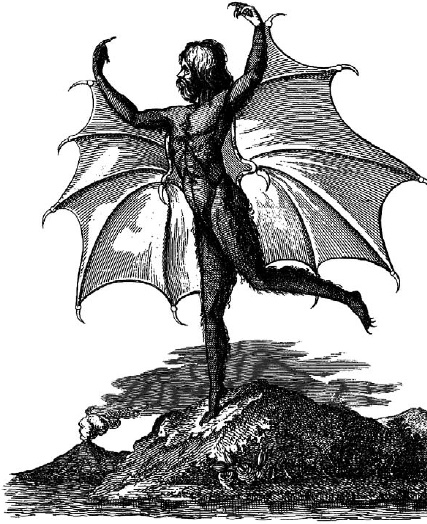
The Great Moon Hoax of 1835 used the authority of astronomer John Herschel and the language of improved telescopes to describe lunar animals and bat-like people. The series did not merely report wonder; it manufactured a credible route into wonder. Technical detail made invention feel observed.
The Library of Congress places the series in the culture of the penny press, where low price, street sales and sensational copy built circulation. Readers did not all respond identically: some believed, some doubted and some enjoyed the performance. “The public believed it” is often a later simplification that erases this range.
Objects, creatures and profitable attention
The Cardiff Giant shows print working beside a physical attraction. Reports brought visitors to a buried gypsum figure; argument over authenticity kept the attraction in the news; exposure created a second story about deception. The object and the press generated value for each other.
Creature panics work similarly. In the Jersey Devil case, scattered folklore and reports acquired a common public form through the newspapers of 1909. Once readers knew the expected outline, later noises, tracks and glimpses could be fitted to it. Printing did not create every experience, but it gave ambiguous experiences a shared name.
Photographs add another layer. The Cottingley Fairies began as private images made by two girls. Reproduction, commentary and endorsement turned them into public evidence. Cropping and captioning determined what readers thought they were seeing before most had access to an original print.
The panic after the panic
Media also report reactions, and reports of reaction can become the larger legend. Coverage after the War of the Worlds broadcast helped fix the idea of a nation thrown into mass panic. Later scholarship has shown real alarm but disputed its supposed scale. Newspapers had commercial reasons to portray radio as an irresponsible rival, so the press account must be read as part of that competition.
A clipping audit
- Record the paper title, edition, date, page and column; do not save only the cropped item.
- Search a distinctive sentence to locate earlier versions and reprints.
- Separate named first-hand witnesses from anonymous attribution and editorial narration.
- Check whether the date describes the event, the report or a later anniversary retelling.
- Look for corrections, denials and follow-up reports in subsequent issues.
- Identify advertisements, exhibitions or local businesses that benefited from attention.
- Note humour, April dates, puns and implausibly neat endings; nineteenth-century readers encountered satire too.
- Compare the clipping with official records, maps, weather observations and independent archives.
What newspapers can prove
A newspaper can establish that particular language was in circulation by a particular date. It can reveal which authorities were quoted, what readers were expected to recognise and how a rumour moved. It may preserve the only surviving first-hand account, but that account still requires evaluation.
The richest use of a clipping is not to treat print as a certificate of truth. It is to follow the story through print: where it began, what changed, who repeated it and when uncertainty hardened into tradition.
Contextual glossary
Terms used in this entry
Definitions are offered as reading aids, not as conclusions about the case.
- Corroboration
- Independent information that supports part of an account, such as a record, trace or separately obtained observation. Repetition from a shared source is not independent corroboration.
- Uncertainty
- The stated limit on what a measurement, reconstruction or body of evidence can establish. Describing uncertainty is not indecision; it prevents a result from appearing more precise than the evidence allows.
- Rumour
- Unverified information circulated between people because it appears relevant or urgent. Repetition can make a rumour familiar without adding an independent source.
- Hoax
- A deliberate attempt to make false evidence or a false story appear genuine. A hoax can still become culturally important, but its later influence should not be confused with the original claim.
Reference trail
Sources
- Library of Congress: Chronicling America collection (opens in a new tab)Collection scope and research context for digitised historic American newspapers.
- Library of Congress: Belief, Legend, and the Great Moon Hoax (opens in a new tab)A case study in scientific authority, newspaper performance and public belief.
- Library of Congress: Original or Reprint? (opens in a new tab)Guidance on identifying notable newspaper issues and later reprints.
- Library of Congress: The Hoax Is On You (opens in a new tab)Archival and legal research around the Cardiff Giant’s afterlife.
Case Book
Photographs, Maps and Supporting Images
Supporting images provide documentary, geographic or visual context. Read each caption for its date, source and evidential limits.
Continue researching
Follow the evidence, context and comparisons
Curated connections
Selected editorially for this entry.
In 1835, newspaper readers met moon forests, lunar animals and winged people in a celebrated lesson about media, science and appetite.
Curated connection · Case fileThe Jersey Devil: From Pine Barrens Legend to Newspaper PanicThe Jersey Devil shows how regional folklore, landscape and newspaper appetite can turn a local creature story into a durable public monster.
Curated connection · Case fileThe War of the Worlds Panic: Radio, Rumour and the Shape of FearA classic media panic case showing how a drama, late tuning and newspaper repetition turned a radio play into a durable legend.
More through shared context
Additional routes based only on existing topics, themes and metadata.
Chain letters, photocopies, local radio and schoolyard retellings show that viral folklore did not need a screen.
Shared theme: Media & rumour · Case fileMothman and the Silver Bridge: When a Creature Story Met a DisasterMothman is interesting not because the creature is easy to prove, but because the legend gathered itself around a town, a bridge and a tragic collapse.