Hoaxes, Misidentifications & Media
The Cardiff Giant: America’s Stone Hoax and the Business of Belief
The Cardiff Giant was a carved gypsum fake sold as a petrified ancient man, and it remains one of the cleanest lessons in spectacle, profit and belief.
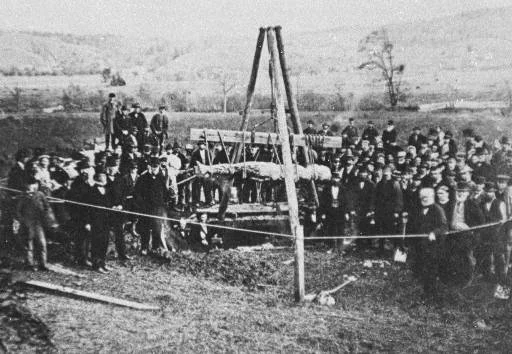
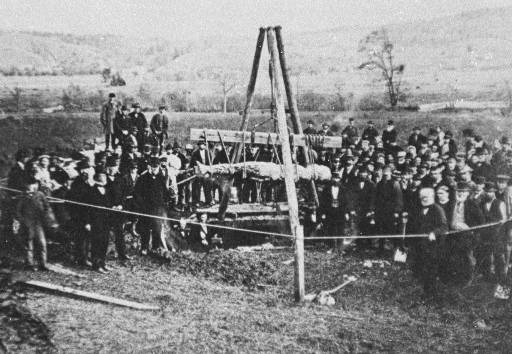
On 16 October 1869, two labourers digging a well on William Newell’s farm near Cardiff, New York, struck a stone foot. The body they uncovered was more than three metres long. Newell placed a tent over it and charged visitors to look. The discovery appeared accidental; almost everything that made it persuasive had been arranged.
Making an ancient giant
George Hull, Newell’s relative and a tobacconist, conceived the figure after arguing about biblical giants. He obtained a large block of gypsum in Iowa, had it shipped to Chicago and hired stonecutters to carve a reclining man. The surface was treated and marked to suggest great age. Hull then transported it to Newell’s farm, where it was buried in 1868 and left for the staged discovery the following year.
The plan exploited provenance in reverse. A statue displayed in a workshop would have invited questions about its maker. A body apparently recovered from undisturbed earth arrived with an origin story already attached. The soil acted as theatre, and the labourers became unwitting witnesses to the reveal.
Belief was not one thing
Visitors did not need to agree on what the object was. Some interpreted it through biblical accounts of giants. Others imagined an ancient statue, a fossilised human or an archaeological wonder. Others came because argument itself was entertaining. Admission money rewarded every interpretation equally.
Scientists objected early. The figure’s material, tool marks and implausible preservation did not support a petrified person. Yale palaeontologist Othniel Charles Marsh called it a decided fraud. Exposure did not stop the show. A syndicate bought the giant and toured it; P. T. Barnum commissioned a copy when the owners refused to sell. The public could then pay to see a fake alongside a fake of the fake.
Confession and afterlife
Hull acknowledged the scheme in December 1869. By then the Cardiff Giant had crossed from alleged discovery into national folklore. Legal disputes, photographs and later exhibitions kept it visible. The original eventually entered The Farmers’ Museum in Cooperstown, where it can be interpreted as an artefact of hoax history rather than ancient history.
What the case teaches
The Cardiff Giant is a compact lesson in chain of custody. Its first public observers did not know that the burial site, timing and discoverer’s relationship to Hull were parts of the production. Testing the object mattered, but testing the story around the object mattered just as much.
It also shows why debunking does not end attention. Once the claim failed, audiences still had a profitable question: how did it work? Deception became the exhibit. Modern anomalous-object claims often follow the same path when a dramatic find is controlled by promoters, independent sampling is restricted and publicity arrives before provenance.
Claim, Context and Cautions
Claim
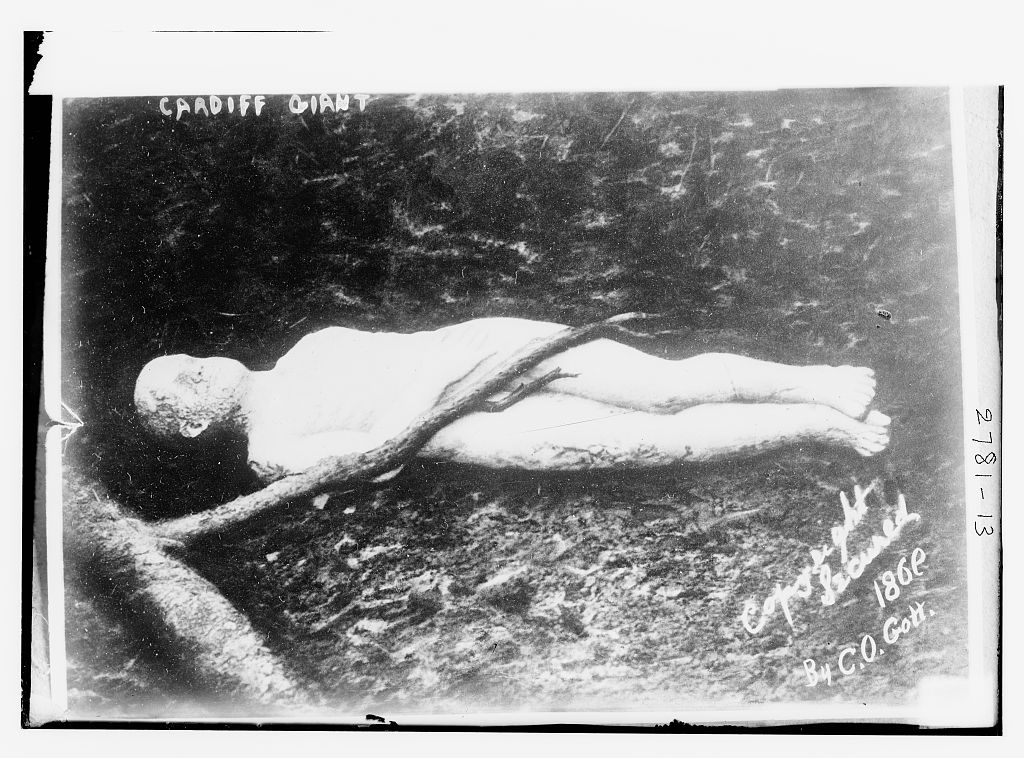
A ten-foot figure unearthed near Cardiff, New York, was promoted as a petrified ancient giant or ancient statue.
What is solid?
George Hull commissioned a gypsum carving, arranged its burial and used the later “discovery” to attract paying visitors. He confessed in 1869.
Reported sequence
The figure was made in Chicago, buried on Newell’s farm in 1868, uncovered in October 1869, toured by a syndicate and copied for P. T. Barnum.
Explanation
This is a documented commercial hoax whose effect depended on staged provenance, public argument and press attention.
Sceptical view
An impressive object without an independent excavation record remains weak evidence. Test the find story as carefully as the material.
Why it still matters
The giant shows how exposure can change a profitable mystery into a profitable story about deception without ending the audience’s interest.
Contextual glossary
Terms used in this entry
Definitions are offered as reading aids, not as conclusions about the case.
- Chain of custody
- The documented sequence showing who collected, stored, copied, tested and transferred an object or recording. Gaps make alteration, contamination or mistaken identity harder to rule out.
- Hoax
- A deliberate attempt to make false evidence or a false story appear genuine. A hoax can still become culturally important, but its later influence should not be confused with the original claim.
- Provenance
- The documented history of an object’s origin, ownership, location and handling. A dramatic claim with weak provenance cannot reliably establish where or when an object came from.
- Excavation
- The controlled removal and recording of archaeological deposits. Because digging destroys the original arrangement, plans, photographs, samples and layer records are as important as the objects recovered.
- Debunking
- Testing a claim against evidence, source quality and ordinary explanations, particularly where a claim has been exaggerated or falsely presented. Good debunking explains the evidence rather than mocking the witness.
Reference trail
Sources
- The Farmers’ Museum: Cardiff Giant (opens in a new tab)Museum context for the surviving original, on display there since 1947.
- Smithsonian Magazine: The Cardiff Giant Was Just a Big Hoax (opens in a new tab)Historical overview of Hull’s construction, the discovery and public response.
- Library of Congress: The Hoax Is On You (opens in a new tab)Archival and legal trail connected with the giant’s exhibition afterlife.
Case Book
Photographs, Maps and Supporting Images
Supporting images provide documentary, geographic or visual context. Read each caption for its date, source and evidential limits.
Continue researching
Follow the evidence, context and comparisons
Curated connections
Selected editorially for this entry.
Piltdown Man fooled parts of the scientific world for decades because forged evidence appeared to fit a story people were ready to hear.
Curated connection · Case fileThe Cottingley Fairies: Paper Wings, Cameras and BeliefTwo Yorkshire cousins, a camera and a set of fairy photographs became one of the most instructive image hoaxes of the twentieth century.
Curated connection · ArticleOut-of-Place Artefacts and the Value of CautionWhy disputed objects need context, chain of custody and patient interpretation before becoming extraordinary evidence.