Cryptids & Animal Reports
The Thylacine After 1936: Survival Reports Without a Specimen
The thylacine is historically real and well documented, but persistence is a separate claim. Habitat, witness error and search limits leave room for uncertainty while the continuing absence of diagnostic evidence weighs against survival.
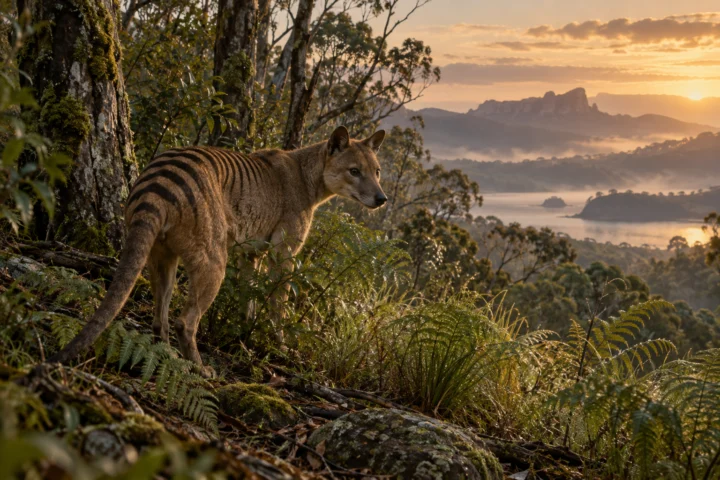
The thylacine was not a mythical animal. Museum skins, skeletons, photographs and film document a marsupial predator once found across mainland Australia and, into historical times, Tasmania. Government bounties and habitat change accelerated its decline. The last known captive died at Hobart’s Beaumaris Zoo in September 1936.
Reports did not stop. Witnesses have described striped, stiff-tailed animals crossing roads or moving through remote bush. Tasmania retains rugged habitat, and the species’ nocturnal behaviour makes occasional encounters plausible in principle. Plausibility is not confirmation of an eighty- or ninety-year breeding population.
Dogs, fox-like views of other animals, lighting and memory can create thylacine-shaped reports. Tasmania has no established fox population comparable with the mainland, but domestic and feral dogs are widespread. A fleeting rear view makes stripes, gait and tail position difficult to judge.
Searches have used track surveys, bait, cameras and public reporting. Images remain indistinct or identify other animals. No recent carcass, scat with verified DNA, clear multi-frame sequence or living capture has entered a documented chain of custody.
The case can be tested against the genuine rediscovery of the coelacanth, contested evidence for the ivory-billed woodpecker, and identification problems in moorland cat reports.
Claim, Context and Cautions
Extinction is a population claim
The death of the last known captive did not prove that no wild individual remained that day. Extinction is inferred as searches fail and time passes without reproduction, bodies or diagnostic traces. A long-lived hidden population would need enough animals to breed, which also increases the expected number of signs.
Official protection in 1936 came too late for the known decline. Later surveys repeatedly failed to verify reports.
How to grade a sighting
A useful report records date, exact place, distance, duration, light, viewing angle and the observer's description before photographs of candidate species are discussed. Stripes across the rump and a rigid tapering tail are diagnostic only if genuinely seen. Confidence falls with a brief road crossing at dusk.
Independent contemporaneous reports may guide cameras, but a total count cannot compensate for missing identification detail.
Searches and their blind spots
Camera traps sample narrow fields and can miss rare animals; access to private or difficult country is incomplete. Negative surveys therefore reduce probability rather than proving absence everywhere. Survey design matters: placement, duration, bait, season and detectability should be published.
On the other hand, cameras, roads and bush activity have expanded enormously since 1936. Continued absence of clear evidence is not neutral when a reproducing terrestrial mammal is proposed.
What would change the assessment
A fresh body or tissue with provenance, independently sequenced DNA, or clear imagery accompanied by location and follow-up would transform the case. Environmental DNA could guide searches, but contamination and reference matching must be controlled. A lone blurred frame or uncast footprint cannot carry the same weight.
For now, historical existence and modern survival require different verdicts. The first is established beyond doubt; the second remains unverified and increasingly difficult to reconcile with decades of failed confirmation. Treating that distinction carefully honours both the animal's documented loss and witnesses who may have honestly misidentified something seen only briefly. Search claims should publish negative results as well as promising detections, preventing repeated rumours from masquerading as independent evidence.
Contextual glossary
Terms used in this entry
Definitions are offered as reading aids, not as conclusions about the case.
- Chain of custody
- The documented sequence showing who collected, stored, copied, tested and transferred an object or recording. Gaps make alteration, contamination or mistaken identity harder to rule out.
- Environmental DNA
- Genetic material collected from water, soil, air or another environment rather than directly from an organism. It can indicate that a species was present, but sampling controls and reference databases determine how specific the result is.
- Independent evidence
- Evidence obtained through a source or method that did not derive from the claim it appears to support. Several retellings of one account are multiple copies, not multiple independent observations.
- Extinction
- The loss of the last living member of a species. Failure to detect a rare animal is not instant proof of extinction, but repeated, well-designed surveys can make continued survival increasingly unlikely.
- Uncertainty
- The stated limit on what a measurement, reconstruction or body of evidence can establish. Describing uncertainty is not indecision; it prevents a result from appearing more precise than the evidence allows.
Reference trail
Sources
- Tasmania Department of Natural Resources and Environment, Tasmanian tiger (opens in a new tab)Official history of bounty records, decline, last captive and unsuccessful later searches.
- Australian Museum, The Thylacine Museum specimen and history (opens in a new tab)Museum overview of anatomy, range, specimens and extinction evidence.
- Natural History Museum, Remembering the Tasmanian tiger (opens in a new tab)Institutional review of historical evidence, last known animal and continuing claimed sightings.
Case Book
Photographs, Maps and Supporting Images
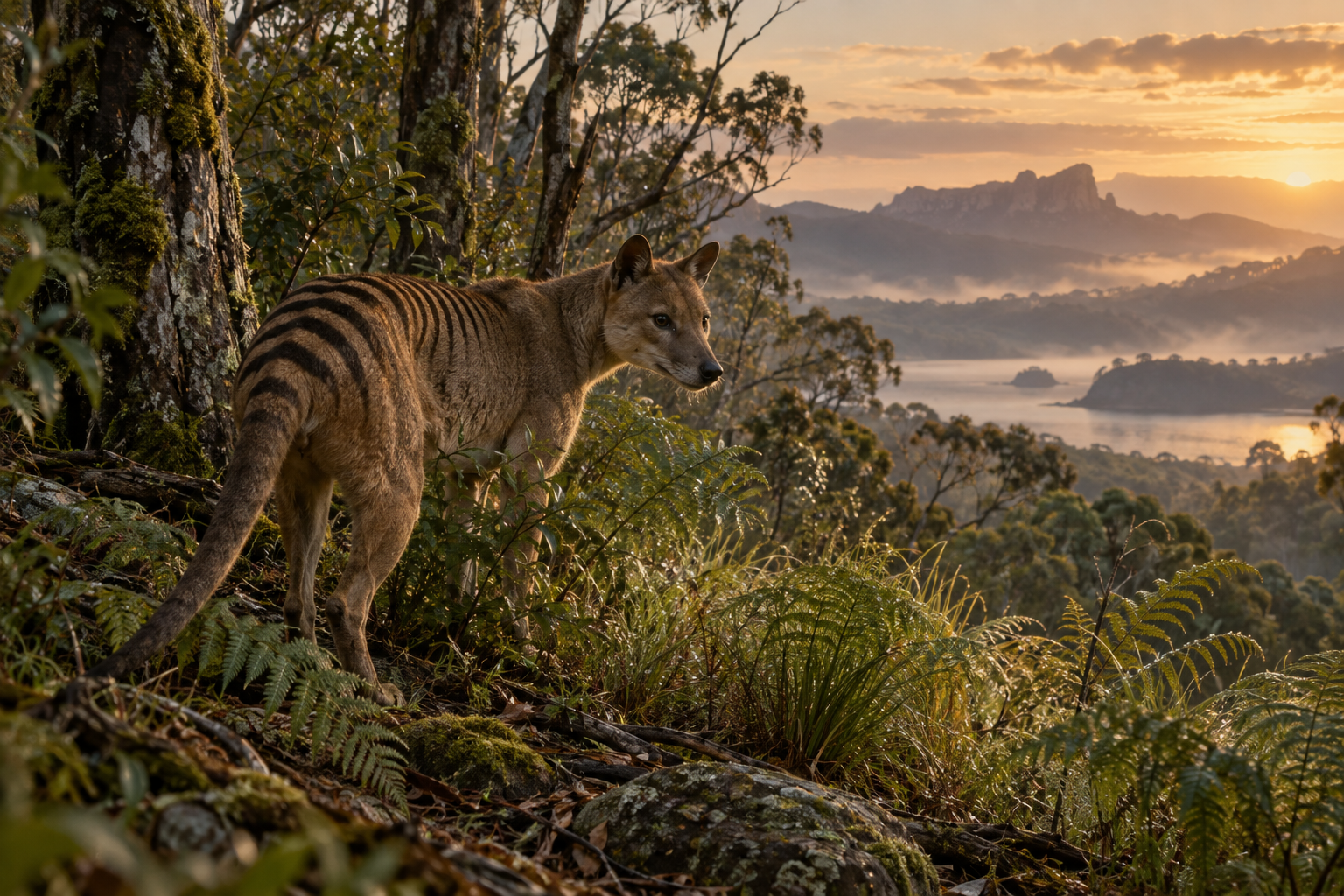
Supporting images provide documentary, geographic or visual context. Read each caption for its date, source and evidential limits.

Continue researching
Follow the evidence, context and comparisons
Curated connections
Selected editorially for this entry.
The 1938 coelacanth was a genuine zoological surprise. Its rediscovery demonstrates gaps in sampling while modern genetics corrects the misleading idea of a species frozen in time.
Curated connection · Case fileThe Ivory-billed Woodpecker: Evidence at the Edge of ExtinctionThe ivory-billed woodpecker controversy tests how conservation science handles suggestive video, acoustic recordings, expert sightings and the irreversible claim of extinction.
Curated connection · Case fileThe Moorland Cat ReportsA careful look at Britain and Ireland large-cat reports, where escaped-animal context, distance errors and local rumour overlap.