Cryptids & Animal Reports
The Okapi: A Known Animal Reintroduced to Western Science
Skin, skull and later living observations established the okapi as a giraffid. The evidence was gathered through Indigenous expertise within a colonial system that long credited outsiders more than local knowledge.
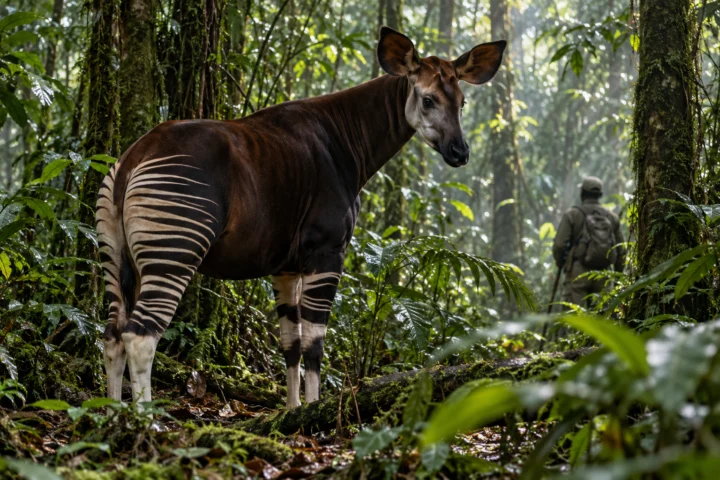
The okapi’s striped hindquarters, long dark body and giraffe-like head can look assembled from several animals. That appearance helped make it a favourite example of a “cryptid proved real.” The phrase is incomplete: people living in the Congo forest already knew the animal before European naturalists classified it.
At the turn of the twentieth century, Harry Johnston pursued reports and obtained strips of hide, then skulls and skins through African knowledge and colonial networks. Philip Sclater first interpreted the striped material as an equid. Ray Lankester’s anatomical study showed that the animal belonged with giraffes, and the genus Okapia was established.
The sequence is instructive. A report guided a search; diagnostic material allowed competing classifications; multiple specimens made the anatomy repeatable. Later observations, captive animals, photographs and genetics strengthened rather than replaced that chain.
Calling this Western “discovery” alone hides who supplied the name, habitat knowledge and routes. It also turns a colonial collection history into a romantic story about explorers finding an unknown beast. Scientific description and human knowledge are not identical milestones.
The okapi’s evidential history complements the coelacanth’s rediscovery, the specimen trail for the giant squid, and the unverified survival claims around the thylacine.
Claim, Context and Cautions
Reports became diagnostic material
Striped hide was striking but ambiguous when separated from the whole animal. Skulls revealed cloven-hoofed giraffid anatomy, while complete skins and skeletons connected the parts. A specimen is powerful because other zoologists can measure the same structures and compare them with known taxa.
The initial horse-like classification shows that physical evidence can still be misread; correction came through better material, not reputation.
Whose knowledge counted
Mbuti and neighbouring communities recognised the animal and its signs. Guides, hunters and intermediaries made specimen collection possible, but published names centred colonial officials and metropolitan institutions. The common name itself derives from regional language, preserving a fragment of that prior knowledge.
A responsible account identifies the asymmetry rather than treating local testimony as a rumour awaiting validation by an outsider.
Real rarity, measurable ecology
Dense rainforest, solitary behaviour and patterned camouflage make okapi difficult to count. Camera traps, dung, genetics and community surveys now estimate distribution without requiring dramatic encounters. Scientific uncertainty concerns abundance, range and trend—not whether the species exists.
Its closest living relatives are giraffes despite superficial zebra-like stripes. Anatomy and molecular data answer that relationship independently of appearance.
The lesson for hidden-animal claims
The okapi does not show that every folkloric creature probably exists. It shows what successful confirmation looks like: local ecological specificity, diagnostic remains, repeatable anatomy, named collection history and later observation. Each step narrowed alternatives.
Today the species is Endangered and endemic to the Democratic Republic of the Congo. Conflict, hunting and habitat pressure make conservation the urgent uncertainty. Repeating the romance of discovery while ignoring contemporary Congolese stewardship mistakes a resolved identity for the animal's unfinished history. Modern range maps remain incomplete, but uncertainty about where surviving populations persist is categorically different from uncertainty about the species' anatomical identity. Conservation evidence must also protect locations when disclosure could aid hunting. Local monitoring partnerships remain essential to both knowledge and protection.
Contextual glossary
Terms used in this entry
Definitions are offered as reading aids, not as conclusions about the case.
- Uncertainty
- The stated limit on what a measurement, reconstruction or body of evidence can establish. Describing uncertainty is not indecision; it prevents a result from appearing more precise than the evidence allows.
- Taxonomy
- The scientific practice of naming, describing and classifying organisms. A proposed species is assessed through diagnostic features, comparison and a published description anchored to type material.
- Cryptid
- An animal or animal-like being reported in testimony or tradition but not established by accepted zoological evidence. The term covers very different claims and should not be treated as a biological category.
- Rumour
- Unverified information circulated between people because it appears relevant or urgent. Repetition can make a rumour familiar without adding an independent source.
Reference trail
Sources
- IUCN, Okapi conservation status and history (opens in a new tab)Specialist-group account of formal description, range, Endangered status and conservation.
- IUCN, Okapi status review and conservation strategy (opens in a new tab)Detailed assessment foregrounding Congolese knowledge, distribution and threats.
- PLOS One, range-wide phylogeography of the okapi (opens in a new tab)Peer-reviewed genetic study of okapi lineages, sampling and Congo Basin history.
Case Book
Photographs, Maps and Supporting Images
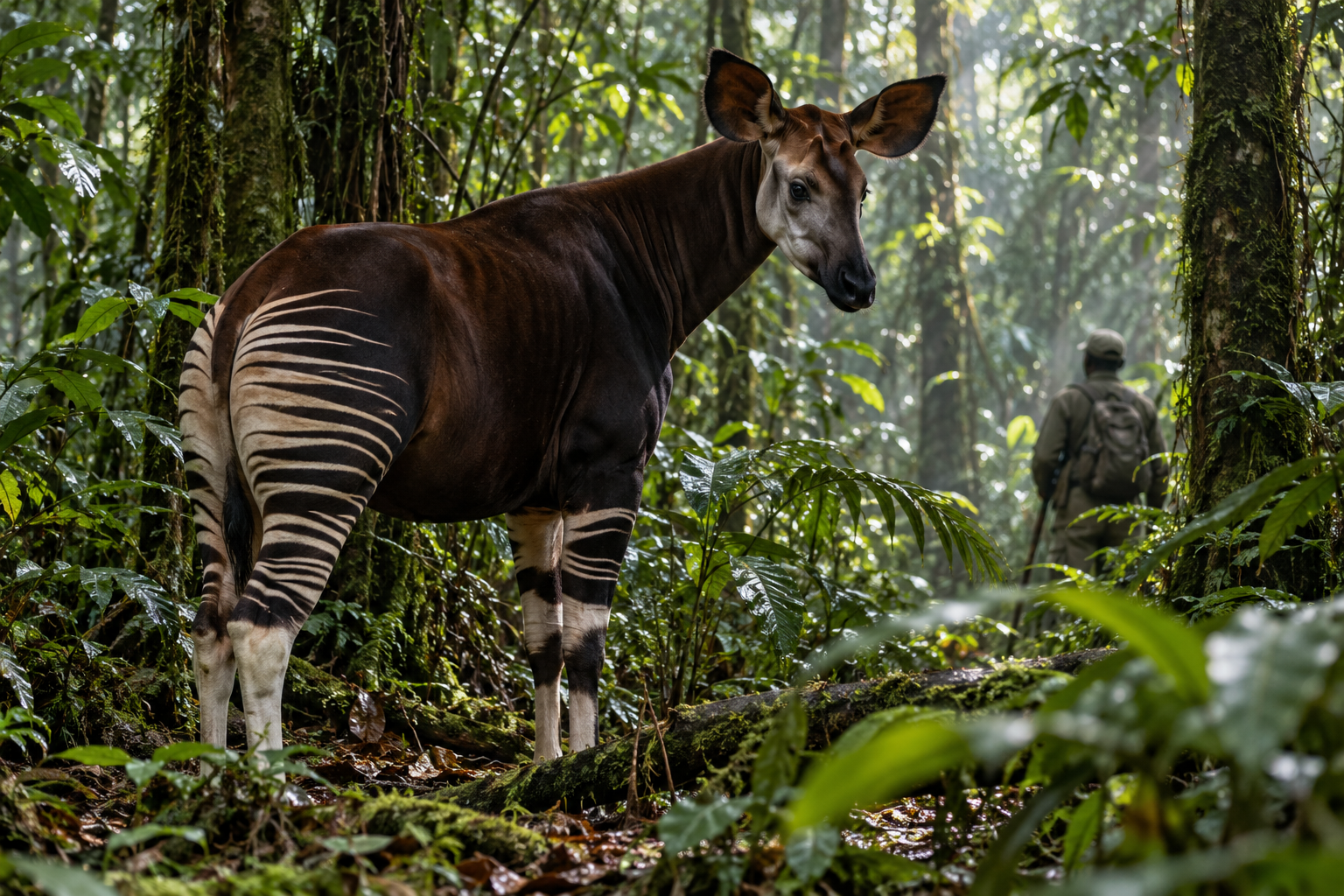
Supporting images provide documentary, geographic or visual context. Read each caption for its date, source and evidential limits.

Continue researching
Follow the evidence, context and comparisons
Curated connections
Selected editorially for this entry.
The 1938 coelacanth was a genuine zoological surprise. Its rediscovery demonstrates gaps in sampling while modern genetics corrects the misleading idea of a species frozen in time.
Curated connection · Case fileThe Giant Squid: How a Sea Monster Became a Measured AnimalGiant squid demonstrate that extraordinary animals can be real while legendary behaviour remains unsupported. Specimens, anatomy, DNA and live imaging establish Architeuthis without validating ship-attacking kraken tales.
Curated connection · Case fileThe Thylacine After 1936: Survival Reports Without a SpecimenThe thylacine is historically real and well documented, but persistence is a separate claim. Habitat, witness error and search limits leave room for uncertainty while the continuing absence of diagnostic evidence weighs against survival.