UFOs & Aerial Phenomena
The Mystery Airships of 1896–97: Invention in the Night Sky
The 1896–97 mystery-airship wave mixed ambiguous lights, invention fever, jokes and newspaper storytelling. No verified machine accounts for the national narrative.
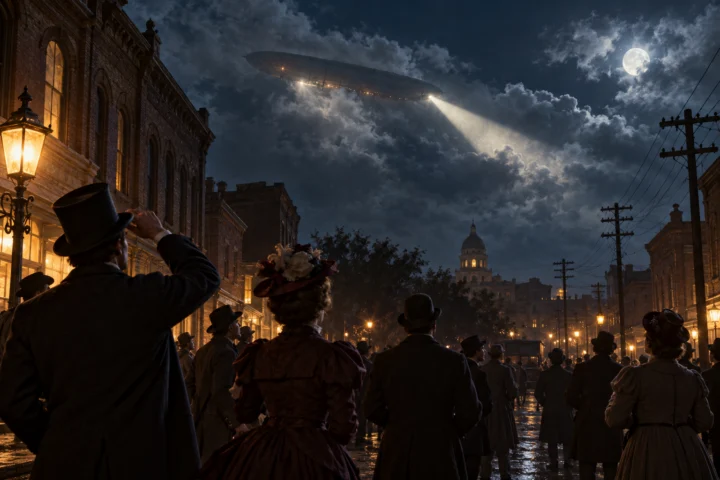
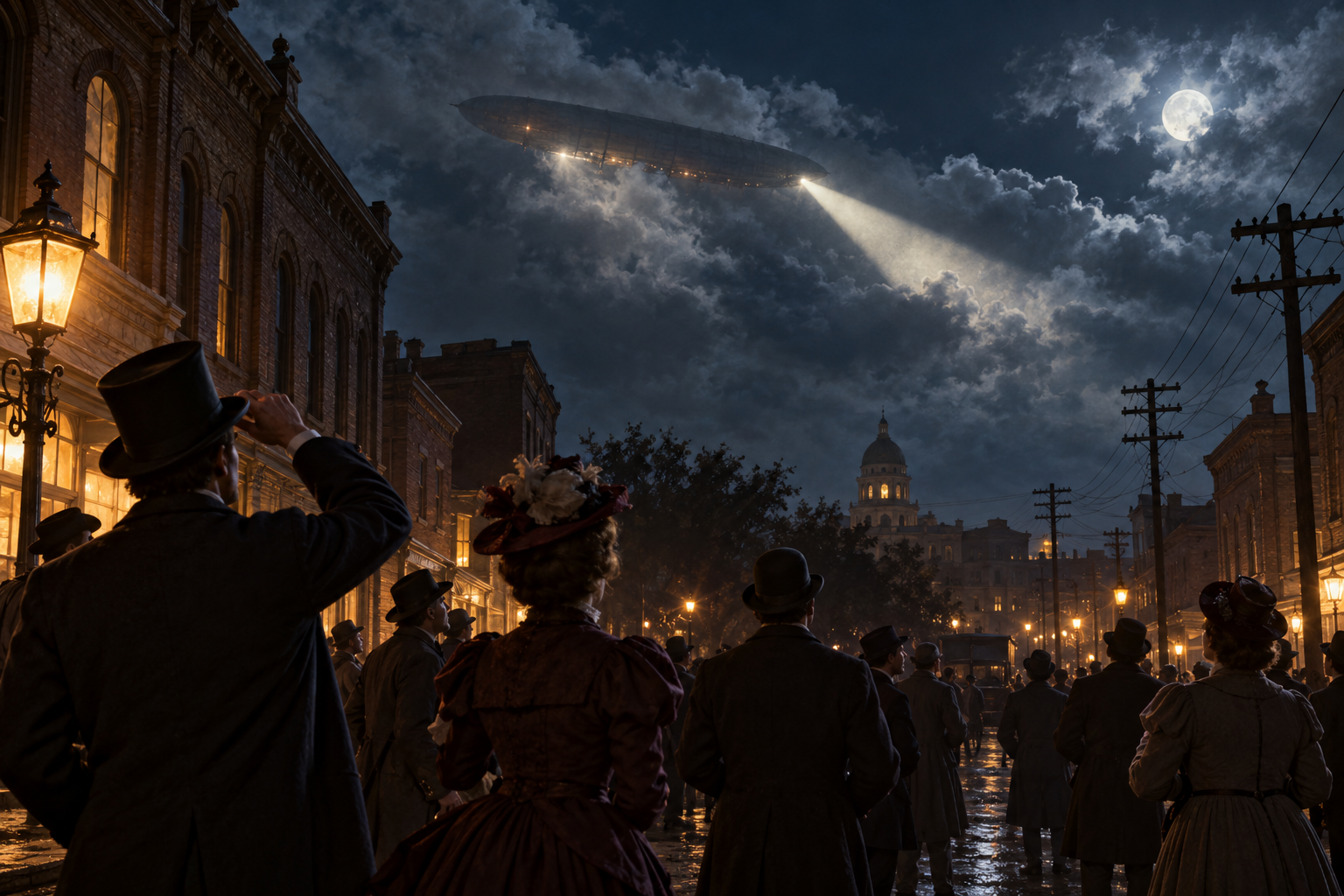
On 17 November 1896, Sacramento residents reported a bright light moving through a clouded sky. Newspapers soon described a secret inventor’s airship, sometimes with a searchlight, propellers, voices or visible occupants. The reports spread across California and returned on a larger scale through the Midwest and South in spring 1897.
This was six years before the Wright brothers’ controlled powered flight. Balloons and experimental gliders existed, and inventors publicly promised heavier-than-air machines. Yet no craft with the range, control and repeated nocturnal itinerary described in the press was produced for inspection.
The wave was not one observation. It was a changing family of lights, jokes, rumours, sincere misidentifications and increasingly elaborate encounter stories. Newspapers copied reports across telegraph networks and rewarded details that made the mystery feel coherent.
The airships anticipate the naming process in the Kenneth Arnold sighting, the media ecology of the Great Moon Hoax, and the archive’s analysis of ordinary lights in extraordinary reports.
Claim, Context and Cautions
A light becomes a machine
The earliest Sacramento reports stressed a brilliant moving light seen through cloud. Some witnesses inferred a dark body or heard voices; newspapers quickly supplied the language of an airship. Later reports described fins, wings, engines and crews.
The progression matters. A distant light and a close mechanical encounter are not interchangeable evidence simply because editors placed them in the same story.
An age expecting invention
The 1890s brought intense public interest in electricity, balloons and mechanical flight. Patents, lectures and publicity claims made a secret breakthrough plausible to readers even when practical machines fell short.
Expectation did not create every light, but it shaped the object observers and journalists believed the light might be.
Telegraphy and newspaper competition
Stories moved rapidly between papers. Anonymous inventors and comic episodes could be republished far from their origin, losing caveats along the way. A report in one town encouraged people in the next to watch the sky and recognise the same mystery.
This feedback can create geographic spread without one vehicle physically following the route.
What survives after the wave
No authenticated wreckage, engineering plan or inventor’s demonstration connects the nationwide reports. Some individual sightings may have involved balloons, astronomical objects, lanterns or unusual atmospheric views; deliberate newspaper fiction explains others.
The wave is best preserved as technological folklore. It shows that unexplained aerial narratives adapted to the most imaginable machine of their time.
Why the reports cannot be counted as one craft
Modern lists can make the wave look like a database of equivalent sightings, but the nineteenth-century material has uneven provenance. A named observer interviewed locally is not the same as an anonymous wire-service anecdote; a light above cloud is not the same as a tale about landing occupants. Dates of publication can also differ from dates of observation, and copied stories can masquerade as corroboration.
Some editors openly treated airship pieces as entertainment. Others defended witnesses in the language of civic respectability, insisting that prominent citizens were not prone to lying. Sincerity, satire and commercial competition therefore sit together in the archive. None supplies the missing machine.
The wave should not be forced into a single debunking answer any more than into a single craft. Its secure history is the rapid public construction of an aerial category, years before practical aviation gave readers a stable object against which to compare it.
Contextual glossary
Terms used in this entry
Definitions are offered as reading aids, not as conclusions about the case.
- Corroboration
- Independent information that supports part of an account, such as a record, trace or separately obtained observation. Repetition from a shared source is not independent corroboration.
- Provenance
- The documented history of an object’s origin, ownership, location and handling. A dramatic claim with weak provenance cannot reliably establish where or when an object came from.
- Debunking
- Testing a claim against evidence, source quality and ordinary explanations, particularly where a claim has been exaggerated or falsely presented. Good debunking explains the evidence rather than mocking the witness.
- Hoax
- A deliberate attempt to make false evidence or a false story appear genuine. A hoax can still become culturally important, but its later influence should not be confused with the original claim.
Reference trail
Sources
- Library of Congress, San Francisco Call, 18 November 1896 (opens in a new tab)Direct digitised newspaper page carrying the early Sacramento “flying airship” report.
- Smithsonian Libraries, Solving the 1897 Airship Mystery (opens in a new tab)Institutional catalogue record for a detailed historical bibliography of the wave and its newspaper record.
- Smithsonian, “In the Cause of Flight” (opens in a new tab)Aviation-history study used to place 1890s airship forms and technical expectations in context.
Case Book
Photographs, Maps and Supporting Images
Supporting images provide documentary, geographic or visual context. Read each caption for its date, source and evidential limits.

Continue researching
Follow the evidence, context and comparisons
Curated connections
Selected editorially for this entry.
Kenneth Arnold’s 1947 report helped launch the modern flying-saucer era. His observation was sincere and carefully timed, but distance and object identity were never independently secured.
Curated connection · Case fileThe Great Moon Hoax and the Machinery of WonderIn 1835, newspaper readers met moon forests, lunar animals and winged people in a celebrated lesson about media, science and appetite.
Curated connection · ArticleHow Ordinary Lights Become Extraordinary UFO ReportsAircraft, satellites, planets, drones and atmospheric effects can become strange when context is missing.
More through shared context
Additional routes based only on existing topics, themes and metadata.
The crew’s visual report was real and professionally documented. Radar returns were intermittent and disputed, while darkness, cloud and uncertain distance made size estimates especially fragile.
Same primary topic · Shared theme: Aviation, Media & rumour · Case fileRoswell: Debris, Balloons and the Story That Grew After 1947Roswell began with recovered debris and a mistaken military press release. Project Mogul explains the material record; later alien-body narratives arose through retrospective testimony.