UFOs & Aerial Phenomena
Roswell: Debris, Balloons and the Story That Grew After 1947
Roswell began with recovered debris and a mistaken military press release. Project Mogul explains the material record; later alien-body narratives arose through retrospective testimony.
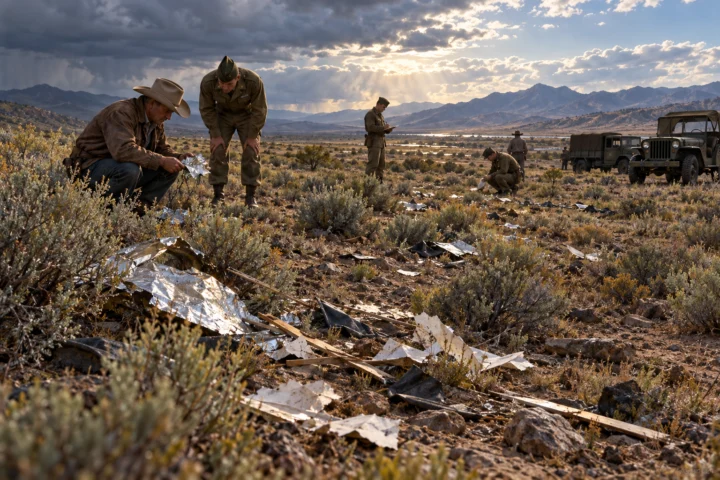
In early July 1947, rancher William Brazel reported scattered material on land northwest of Roswell, New Mexico. Personnel from Roswell Army Air Field collected it. On 8 July the base issued a release saying it had recovered a “flying disc”; the same day senior officers presented material as the remains of a weather balloon.
The contradiction created a durable opening. The 1947 public record concerned lightweight debris, not bodies, an intact craft or a hospital autopsy. Those elements entered the story mainly through interviews and books decades later, when memories had been repeatedly discussed inside an established UFO culture.
United States Air Force investigations linked the debris to Project Mogul, a classified balloon programme designed to detect evidence of Soviet nuclear tests. Secrecy explains why the military did not give a complete account in 1947. It does not validate every later claim made in response to that secrecy.
Roswell is a useful companion to the source-merging behind the Black Knight Satellite, the archive’s caution around objects without secure provenance, and the boundary between evidence and later legend.
Claim, Context and Cautions
The debris and the press release
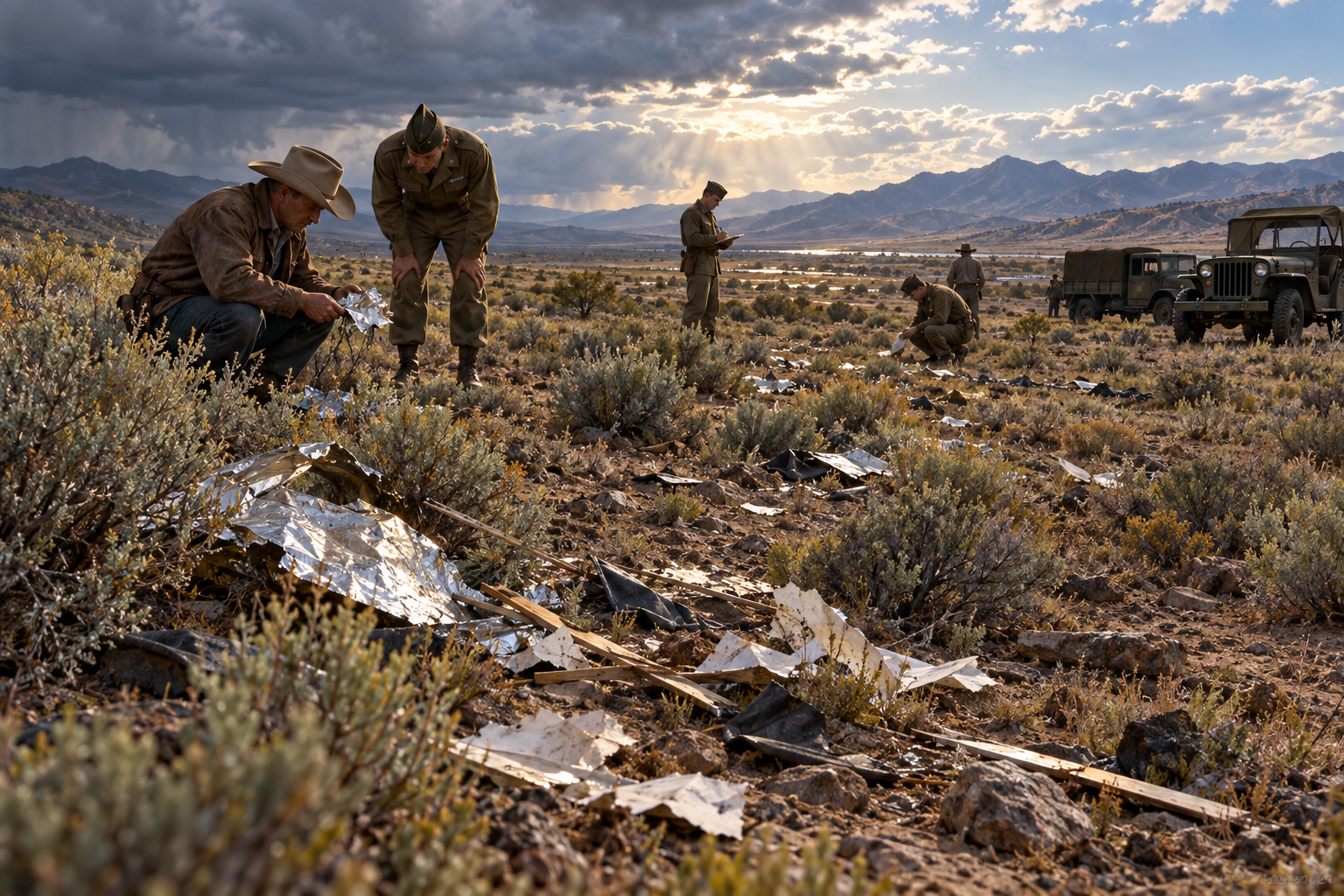
The Army's “flying disc” wording was real and remarkably careless. Contemporary photographs show officers with foil, rubber and structural material; they do not show a vehicle. Brazel's descriptions varied in later retellings, but the early emphasis remained on widely scattered lightweight fragments.
A mistaken announcement is evidence of confusion. It is not independent evidence that officials first held an extraterrestrial craft.
Why Project Mogul matters
Mogul flights used trains of balloons, reflectors and instruments to monitor high-altitude sound associated with nuclear tests. A launch associated with the programme was not described publicly in ordinary detail because the objective was classified.
The materials and timing provide a coherent source for the ranch debris. Debate persists over individual flight records, but no competing physical object with documented custody has displaced the balloon explanation.
Bodies arrive later
Stories of small bodies, unusual coffins and an autopsy became prominent long after 1947. Some witnesses were recalling other military incidents; others reported memories after decades of media exposure. The Air Force later connected certain body accounts with anthropomorphic test dummies used in the 1950s.
That explanation cannot apply to a genuinely dated 1947 observation, but it demonstrates why each account must be dated rather than merged into one night.
Secrecy without aliens
Government secrecy encourages suspicion because it makes early denials incomplete. Project Mogul supplies a documented reason for secrecy that was important in 1947 and no longer extraordinary once declassified.
A cover story can conceal a terrestrial programme. The existence of concealment does not identify whatever explanation a later audience prefers.
A solved object, an enduring legend
The strongest surviving evidence supports balloon-train debris and a mishandled press response. No verified alien material, body record or crash site has entered a public chain of custody.
Roswell still matters because it shows how a genuine contradiction, classified context and retrospective testimony can build an account far larger than the event documented at the time.
Contextual glossary
Terms used in this entry
Definitions are offered as reading aids, not as conclusions about the case.
- Chain of custody
- The documented sequence showing who collected, stored, copied, tested and transferred an object or recording. Gaps make alteration, contamination or mistaken identity harder to rule out.
- Independent evidence
- Evidence obtained through a source or method that did not derive from the claim it appears to support. Several retellings of one account are multiple copies, not multiple independent observations.
- Provenance
- The documented history of an object’s origin, ownership, location and handling. A dramatic claim with weak provenance cannot reliably establish where or when an object came from.
- UFO
- Unidentified flying object, historically used for an aerial observation that remains unidentified at the time of reporting. In popular culture it often implies a spacecraft, which is a separate claim.
Reference trail
Sources
- U.S. Government Accountability Office, Roswell records review (opens in a new tab)Federal review of record searches concerning the 1947 incident and document-retention questions.
- U.S. National Archives, UFO records (opens in a new tab)Official guide to Project Blue Book and related Air Force records, including Roswell research context.
- FBI Vault, Roswell UFO (opens in a new tab)Released federal records often associated with Roswell; useful for distinguishing documents and dates.
- U.S. Air Force, “The Roswell Report: Case Closed” (opens in a new tab)Official synthesis of the Project Mogul explanation and later body-story analysis.
Case Book
Photographs, Maps and Supporting Images
Supporting images provide documentary, geographic or visual context. Read each caption for its date, source and evidential limits.

Continue researching
Follow the evidence, context and comparisons
Curated connections
Selected editorially for this entry.
The Black Knight is a composite legend assembled from unrelated radio experiments, Cold War tracking stories and STS-88 photographs of lost thermal insulation.
Curated connection · ArticleOut-of-Place Artefacts and the Value of CautionWhy disputed objects need context, chain of custody and patient interpretation before becoming extraordinary evidence.
Curated connection · ArticleThe Difference Between Evidence, Testimony and LegendA field guide to three words that often get tangled in mystery research.
More through shared context
Additional routes based only on existing topics, themes and metadata.
The 1896–97 mystery-airship wave mixed ambiguous lights, invention fever, jokes and newspaper storytelling. No verified machine accounts for the national narrative.
Same primary topic · Shared theme: Aviation · Case fileKenneth Arnold: The Sighting That Named the Flying SaucerKenneth Arnold’s 1947 report helped launch the modern flying-saucer era. His observation was sincere and carefully timed, but distance and object identity were never independently secured.