Historical Mysteries
The London Beer Flood: Porter, Pressure and Eight Deaths
A brewery vat rupture released a destructive flood of porter into St Giles on 17 October 1814. Contemporary reports and the inquest document eight deaths and an accidental verdict.
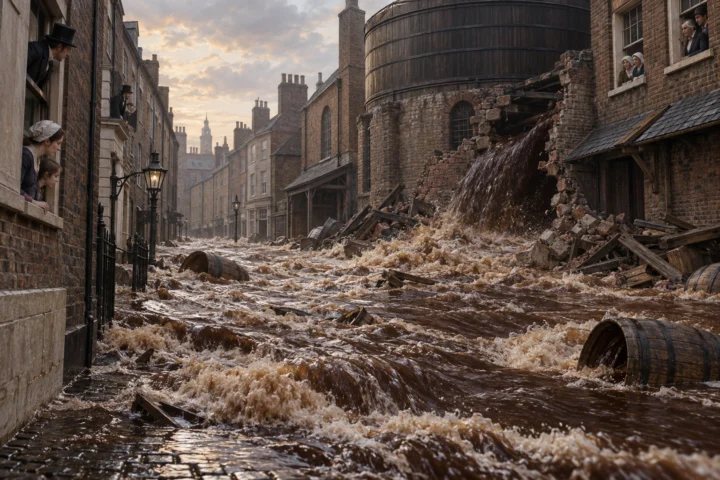
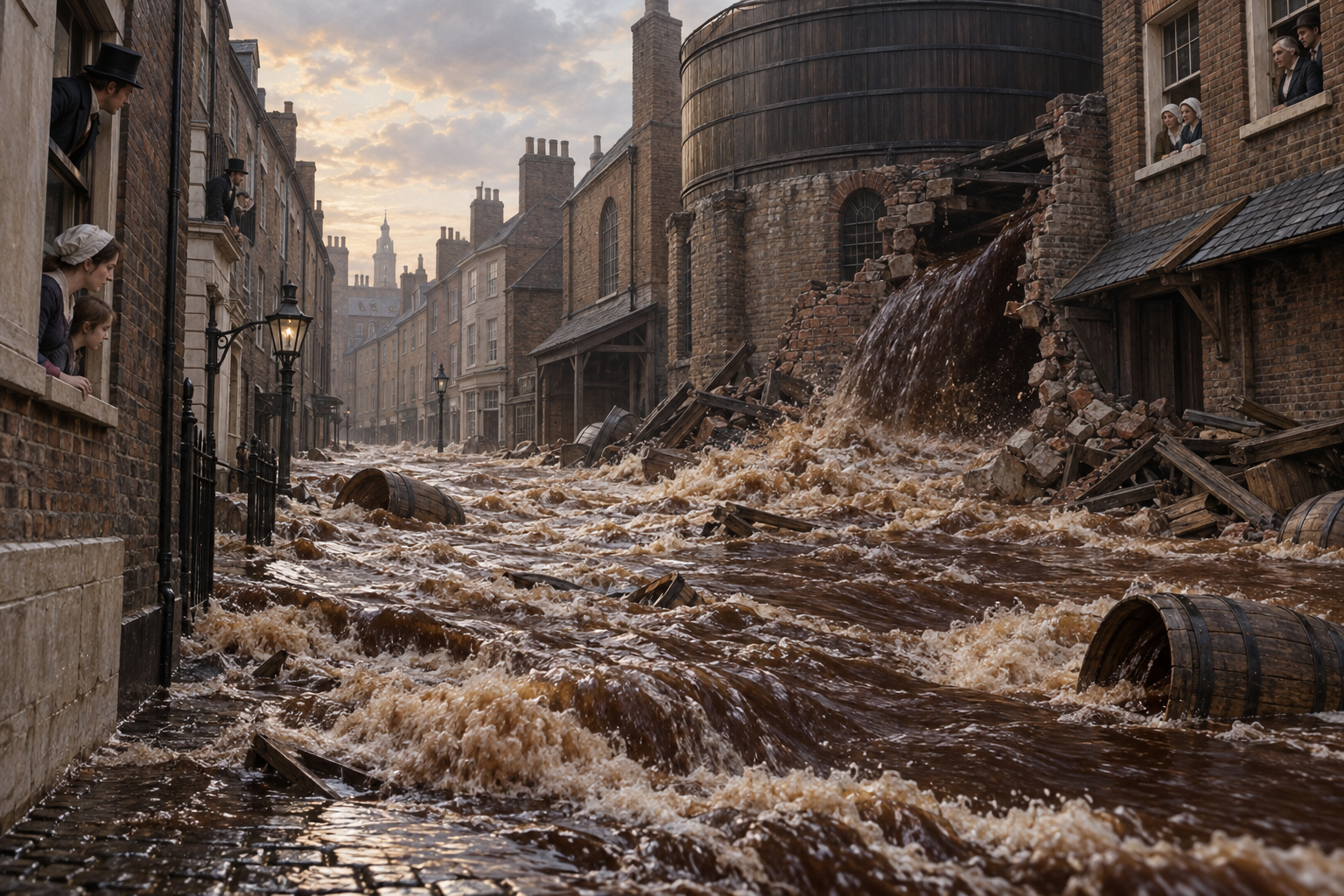
At about half past four on 17 October 1814, a giant vat of porter failed inside Meux and Company’s Horse Shoe Brewery near Tottenham Court Road. A metal hoop had slipped earlier that day, apparently without unusual concern. When the vessel burst, it damaged other vats and sent beer and debris through the brewery wall into nearby St Giles.
Eight people died, most in cramped basement rooms or amid collapsing masonry. The coroner’s jury returned a verdict of accidental death. Parliament later allowed the brewery relief from excise duty already paid on the lost beer, limiting the financial damage to the company.
Later retellings made the event comic: crowds supposedly drank from the street or died of alcohol poisoning. Those additions are poorly supported. Contemporary reporting instead describes neighbours and workers searching wreckage in a densely housed, impoverished district.
The case complements the archive’s account of history simplified into spectacle, the caution around newspaper transmission, and the reconstruction of a sudden disaster in the Tunguska file.
Claim, Context and Cautions
The Horse Shoe Brewery and its scale
London porter brewing depended on enormous storage vats. At the Horse Shoe Brewery, the failed vessel held hundreds of thousands of litres and was bound by heavy iron hoops. Size concentrated both commercial value and stored mechanical energy.
The brewery stood beside the crowded neighbourhood of St Giles. A structural failure inside an industrial site therefore became a residential disaster within seconds.
A hoop slips before the rupture
Clerk George Crick reportedly noticed that one iron hoop had fallen from the vat and informed a superior. Hoops had slipped before without catastrophe, so a repair note was made rather than an evacuation. The vat ruptured soon afterward.
The sequence illustrates normalisation of deviance: a familiar defect can appear harmless until it participates in a rare chain failure.
A cascade through wall and street
The first rupture damaged neighbouring vessels and brewery structures. Porter, timber and brickwork escaped into the adjacent streets and low rooms. Exact volume estimates differ because accounts combine vats of different sizes, but the destructive release and building collapse are well documented.
The event was a pressure and containment failure, not a mysterious tidal phenomenon.
Eight people in the path
The identified victims included women and children in homes and at a wake. Their circumstances matter because later novelty accounts can turn the liquid itself into a joke. Contemporary reports emphasised crushing, drowning and entrapment amid wreckage.
Residents and brewery workers attempted rescue. Claims of a public drinking festival are not supported by the strongest early sources.
The inquest and financial aftermath
The coroner's inquest judged the deaths to have occurred accidentally and by misfortune. That verdict reflected the legal framework of the period, not a modern engineering finding that no preventable weakness existed. The brewery continued operating, aided by remission of duty on the destroyed beer.
No comparable system of regulatory investigation produced a full metallurgical cause report.
How tragedy became eccentric history
The phrase “beer flood” invites comic treatment, and unsupported details accumulated over time. Returning to the inquest and 1814 press shifts attention back to industrial scale, housing vulnerability and eight deaths.
The event is explained in outline: a vat and then associated structures failed. Its value as a case file lies in distinguishing that documented chain from the folklore poured over it later.
Contextual glossary
Terms used in this entry
Definitions are offered as reading aids, not as conclusions about the case.
- Reconstruction
- A later model, image or account made to represent an event from surviving information. It can clarify a hypothesis but should remain visibly separate from contemporary evidence.
Reference trail
Sources
- British Newspaper Archive, “Great flood of London” (opens in a new tab)Archive-led overview drawing on contemporary press coverage and identifying the eight deaths.
- British Newspaper Archive search: Morning Post, 20 October 1814 (opens in a new tab)Contemporary newspaper record of the disaster and inquest context.
- British History Online, “Industries: Brewing” (opens in a new tab)Institutional county history placing the Horse Shoe Brewery within London’s industrial brewing scale.
- Ilan Kelman, Unusual Floods and Drownings (opens in a new tab)Disaster-research compilation used for comparative context and the documented 1814 fatality event.
Case Book
Photographs, Maps and Supporting Images
Supporting images provide documentary, geographic or visual context. Read each caption for its date, source and evidential limits.

Continue researching
Follow the evidence, context and comparisons
Curated connections
Selected editorially for this entry.
In Strasbourg, reports of compulsive dancing became one of history's strangest examples of body, belief, stress and record colliding.
Curated connection · ArticleThe Role of Newspapers in Spreading Strange TalesOld newspapers preserved remarkable local reports, but they also shaped them for appetite, humour and alarm.
Curated connection · Case fileTunguska: The Morning the Forest Fell FlatA 1908 blast over Siberia flattened forest without leaving a classic impact crater, making Tunguska a cornerstone case in anomaly, science and myth.