Disappearances & Unresolved Identities
The Isdal Woman: Names, Labels and an Unfinished Identification
The Isdal Woman case combines a documented unexplained death with coded travel records, uncertain identity and later forensic reconstruction. Espionage remains a possibility, not an established fact.
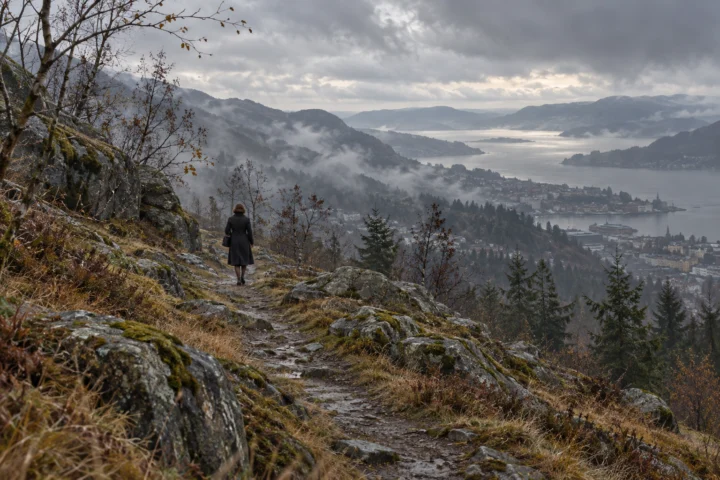
On 29 November 1970, a family walking in Isdalen, a steep valley outside Bergen, found the burned body of an unidentified woman. Police traced two suitcases at Bergen railway station to the dead traveller. They contained clothing with labels removed, wigs, coded notes and items connected with several assumed names used at hotels across Norway and Europe.
The autopsy found sleeping-tablet residues and carbon monoxide exposure alongside burns. Investigators concluded that the woman had died at the scene, but the surviving evidence did not establish whether she took her own life, was killed, or died during an encounter whose context is now lost.
Later reporting and forensic work reconstructed travel routes and used isotope signatures in teeth to explore where she may have grown up. Those methods narrowed possibilities rather than naming her. Claims that she was an intelligence agent draw on secrecy, international travel and the Cold War setting, but no released file proves an employer or mission.
The case belongs beside Hinterkaifeck’s unresolved investigation, the uncertain chronology of the Yuba County Five, and the archive’s distinction between evidence, testimony and legend.
Claim, Context and Cautions
A body and two suitcases
The discovery site yielded bottles, burnt belongings and personal items, but no identity document. The railway-station suitcases supplied fingerprints and a wider material record. Hotel forms then connected the woman with a series of names, dates and travel movements.
These are strong facts about an intentionally obscured identity. They do not explain why the concealment occurred or whether another person directed it.
What the medical record can say
The post-mortem examination recorded burns, carbon monoxide and ingestion of sleeping tablets. Later accounts sometimes compress those findings into a single certain cause or a dramatic poisoning narrative. The combination is more difficult to interpret from public summaries alone.
The official suicide conclusion has been questioned, but uncertainty is not evidence of murder. Scene contamination, missing context and the limits of 1970 toxicology restrict retrospective certainty.
Codes, aliases and Cold War stories
The notebook code was largely understood as a compact record of places and dates. False hotel names and removed labels show concealment, yet such behaviour can arise from intelligence work, crime, personal flight or private circumstances.
Espionage became the dominant cultural frame because Bergen was strategically important and witnesses recalled unusual conduct. No public document securely places the woman in an intelligence service.
What later science added
Researchers used strontium and oxygen isotope patterns from teeth to estimate childhood and later geographic histories. Handwriting and facial reconstructions were also revisited. These techniques generated new leads and corrected assumptions about her likely background.
They remain probabilistic. Isotopes indicate environmental exposure rather than nationality, and a reconstruction is not a portrait verified by a known relative.
An identity problem before a spy story
The most durable mystery is not a secret mission but a missing name. Police established a sophisticated travel trail and many physical details while failing to connect them to a confirmed life history.
The responsible conclusion is narrow: an unidentified woman died in Isdalen under unclear circumstances after concealing her identity. Every larger explanation requires evidence that the public record has not supplied.
Contextual glossary
Terms used in this entry
Definitions are offered as reading aids, not as conclusions about the case.
- Isotope analysis
- Measurement of isotope ratios in material such as bone, teeth, metal or water. Depending on the element and sample, it can inform questions about date, diet, movement or origin within stated limits.
- Reconstruction
- A later model, image or account made to represent an event from surviving information. It can clarify a hypothesis but should remain visibly separate from contemporary evidence.
- Contamination
- The introduction of outside material or information into evidence. It may affect DNA, objects, recordings or witness accounts and must be considered before treating a match as independent.
- Uncertainty
- The stated limit on what a measurement, reconstruction or body of evidence can establish. Describing uncertainty is not indecision; it prevents a result from appearing more precise than the evidence allows.
Reference trail
Sources
- NRK, “The Isdal Woman” investigation (opens in a new tab)Detailed Norwegian public-broadcaster reconstruction based on the police file, witnesses and renewed forensic work.
- BBC World Service, Death in Ice Valley (opens in a new tab)Documentary series made with NRK, used for the case chronology, witness record and the limits of later leads.
- BBC News, “The mystery death haunting Norway for 46 years” (opens in a new tab)Accessible overview of the discovery, aliases, coded itinerary and modern attempts at identification.
Case Book
Photographs, Maps and Supporting Images
Supporting images provide documentary, geographic or visual context. Read each caption for its date, source and evidential limits.


Continue researching
Follow the evidence, context and comparisons
Curated connections
Selected editorially for this entry.
The Hinterkaifeck victims were found on 4 April 1922 and probably killed on 31 March. Official files establish the crime and extensive inquiry, not the identity or movements of the murderer.
Curated connection · Case fileThe Yuba County Five: A Road Into the SnowA disappearance case where winter road, confusion and delayed discovery created a mystery larger than any one clue.
Curated connection · ArticleThe Difference Between Evidence, Testimony and LegendA field guide to three words that often get tangled in mystery research.
More through shared context
Additional routes based only on existing topics, themes and metadata.
Dyatlov Pass remains an archive of frozen conditions, injuries and competing explanations, with the strongest case still grounded in the mountain rather than the supernatural.
Same primary topic · Shared theme: Unsolved deaths · Case fileThe Franklin Expedition: Wrecks, Testimony and a Fatal RetreatThe Franklin expedition was destroyed by a compound Arctic disaster rather than a single mysterious event. Inuit knowledge and archaeology have recovered its ships, while the exact movements and deaths of the crews remain incomplete.