Scientific Anomalies & Natural Phenomena
Fast Radio Bursts: Milliseconds From Distant Galaxies
FRBs are established astrophysical events, not unexplained transmissions in the colloquial sense. Magnetars can produce them, while the population’s diversity and emission physics remain active research questions.
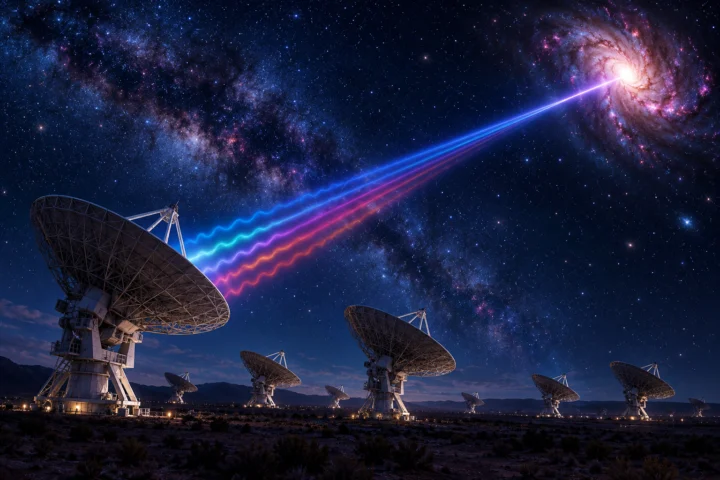
A fast radio burst is an intense pulse of radio energy lasting milliseconds. The first recognised example was found in archived telescope data and published in 2007. Its frequencies arrived at slightly different times, the pattern expected when a pulse crosses ionised material between its source and Earth.
That dispersion was too large to fit a nearby terrestrial source comfortably. Later detections by independent telescopes established a population. Some sources repeat, allowing arrays to localise them to host galaxies; others have produced only one recorded burst despite follow-up.
In April 2020, telescopes detected an FRB-like radio flash from SGR 1935+2154, a magnetar in the Milky Way, accompanied by high-energy activity. This demonstrated that magnetars can generate fast radio bursts. It did not prove that every observed FRB has identical conditions or emission physics.
Search pipelines must reject terrestrial radio-frequency interference and instrumental artefacts. A valid event has a characteristic sweep across frequency, appears in appropriate beams, survives calibration checks and, for localisation, is detected across separated antennas.
FRBs complement the narrowband puzzle of the Wow! signal, the workflow in classifying anomalous signals, and long-term stellar monitoring of Tabby’s Star.
Claim, Context and Cautions
Dispersion provides distance evidence
Cold plasma delays lower radio frequencies more than higher ones. The measured dispersion column combines material in the Milky Way, intergalactic space and the host environment. It is not a direct tape measure, but values and localisations showed that many bursts are extragalactic.
A convincing pipeline fits the sweep and checks whether a local transmitter or receiver behaviour can mimic it.
Repeaters changed the experiment
A one-off pulse is difficult to revisit. Repeating FRB 121102 enabled precise localisation to a dwarf galaxy and revealed bursts with changing spectra and intervals. Other repeaters occupy different environments, warning against turning one well-studied source into a universal template.
Non-repetition during an observing window does not establish a separate class; telescopes sample intermittently and sensitivity varies.
The magnetar connection
Magnetars are neutron stars with extraordinarily strong magnetic fields. The 2020 Galactic event linked a bright radio burst to one such star and simultaneous X-ray activity, supplying direct source-class evidence. Later monitoring probes how crustal or magnetospheric changes trigger bursts.
The Galactic burst was less energetic than many cosmological examples, so scaling and alternative channels remain legitimate research questions.
Unexplained mechanism is not unknown agency
Astronomers debate coherent emission, environments and whether several progenitor pathways contribute. Those gaps concern how compact objects produce radiation, not whether the signals are artificial messages. FRBs are usually broadband, short and dispersed rather than information-rich narrowband beacons.
Their history is a model of productive anomaly work: preserve raw data, reproduce detections, measure propagation, localise sources and seek counterparts at other wavelengths. The category moved from a single archival oddity to a mapped cosmic population, with magnetars demonstrated as at least one engine and meaningful physics still unresolved. Polarisation measurements probe magnetic fields along the path, while burst arrival statistics test source activity. Selection effects remain substantial because telescope frequency, field of view and search algorithms determine which events enter catalogues. Population claims must therefore model what each survey could have missed. That correction is part of the evidence.
Contextual glossary
Terms used in this entry
Definitions are offered as reading aids, not as conclusions about the case.
- Fast radio burst
- A very brief, intense pulse of radio waves arriving from far beyond the Milky Way. Some repeat and some have been traced to host galaxies; the label describes the signal class rather than one single cause.
- Radio-frequency interference
- Unwanted radio energy from transmitters, electronics or equipment that enters a receiver. It can imitate or obscure a target signal and may be intermittent or difficult to reproduce.
- Magnetar
- A neutron star with an exceptionally strong magnetic field. Sudden magnetic activity can produce powerful high-energy flares and, in at least some cases, fast radio bursts.
- Raw data
- Measurements or records in their earliest retained form before substantial selection, correction or presentation. Access to raw data helps others check processing choices, although even raw records reflect how an instrument was configured.
- Wavelength
- The distance between repeating points in a wave. Different wavelengths of light, radio or sound interact differently with matter and determine what a sensor can detect or resolve.
Reference trail
Sources
- NASA JPL, Missions Help Pinpoint a Unique X-ray and Radio Burst (opens in a new tab)NASA account of the 2020 Galactic magnetar association and its evidential limits.
- NASA, New Clues About Mysterious Deep Space Signals (opens in a new tab)Multi-mission observations of magnetar activity before and after a fast radio burst.
- Nature, A Repeating Fast Radio Burst (opens in a new tab)Open manuscript of the peer-reviewed report establishing repetition from FRB 121102.
Case Book
Photographs, Maps and Supporting Images
Supporting images provide documentary, geographic or visual context. Read each caption for its date, source and evidential limits.

Continue researching
Follow the evidence, context and comparisons
Curated connections
Selected editorially for this entry.
The Wow! signal was a one-time narrow-band radio event near the hydrogen line, recorded on 15 August 1977. Its shape was noteworthy; its source remains unconfirmed.
Curated connection · ArticleStrange Signals: How Investigators Classify Sounds and TransmissionsA source-led guide to anomalous signals, from underwater sounds to radio bursts: how calibration, reference libraries and independent repetition separate useful evidence from compelling noise.
Curated connection · Case fileTabby’s Star: Deep Dips, Citizen Science and the Dust QuestionTabby’s Star is a genuine astronomical anomaly discovered through citizen science. Chromatic dimming supports small-particle dust rather than an opaque alien structure, while the dust’s origin remains unsettled.
More through shared context
Additional routes based only on existing topics, themes and metadata.
The Bloop was a real hydrophone recording, but not evidence of a giant animal. NOAA’s later Antarctic observations identified the same sound family in large icequakes.
Same primary topic · Shared theme: Strange signals · Case fileThe Taos Hum: A Sound the Instruments Could Not ShareThe Taos Hum became a public problem in the early 1990s when residents described a distant-engine sound. Researchers documented sincere reports but found no common external source.