Scientific Anomalies & Natural Phenomena
The Bloop: An Ocean Sound Traced to Breaking Ice
The Bloop was a real hydrophone recording, but not evidence of a giant animal. NOAA’s later Antarctic observations identified the same sound family in large icequakes.
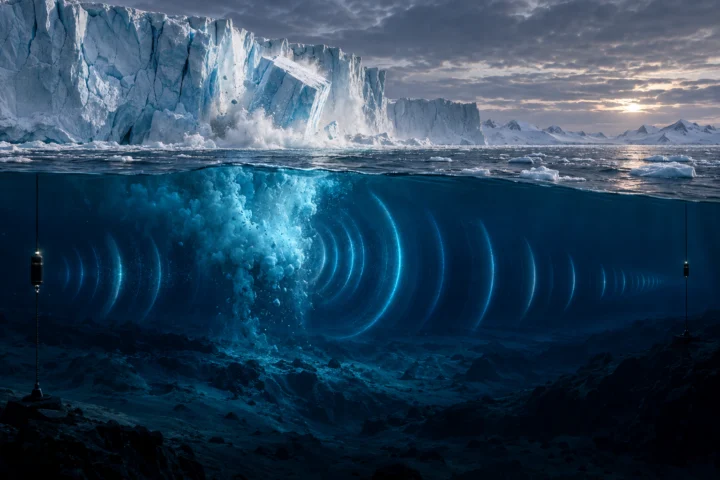
In 1997, hydrophones across the Pacific detected a very loud, low-frequency sound. When played faster, it rose in pitch with a strange organic quality. The recording acquired the nickname “Bloop”, and its scale encouraged stories about an unknown animal larger than any whale.
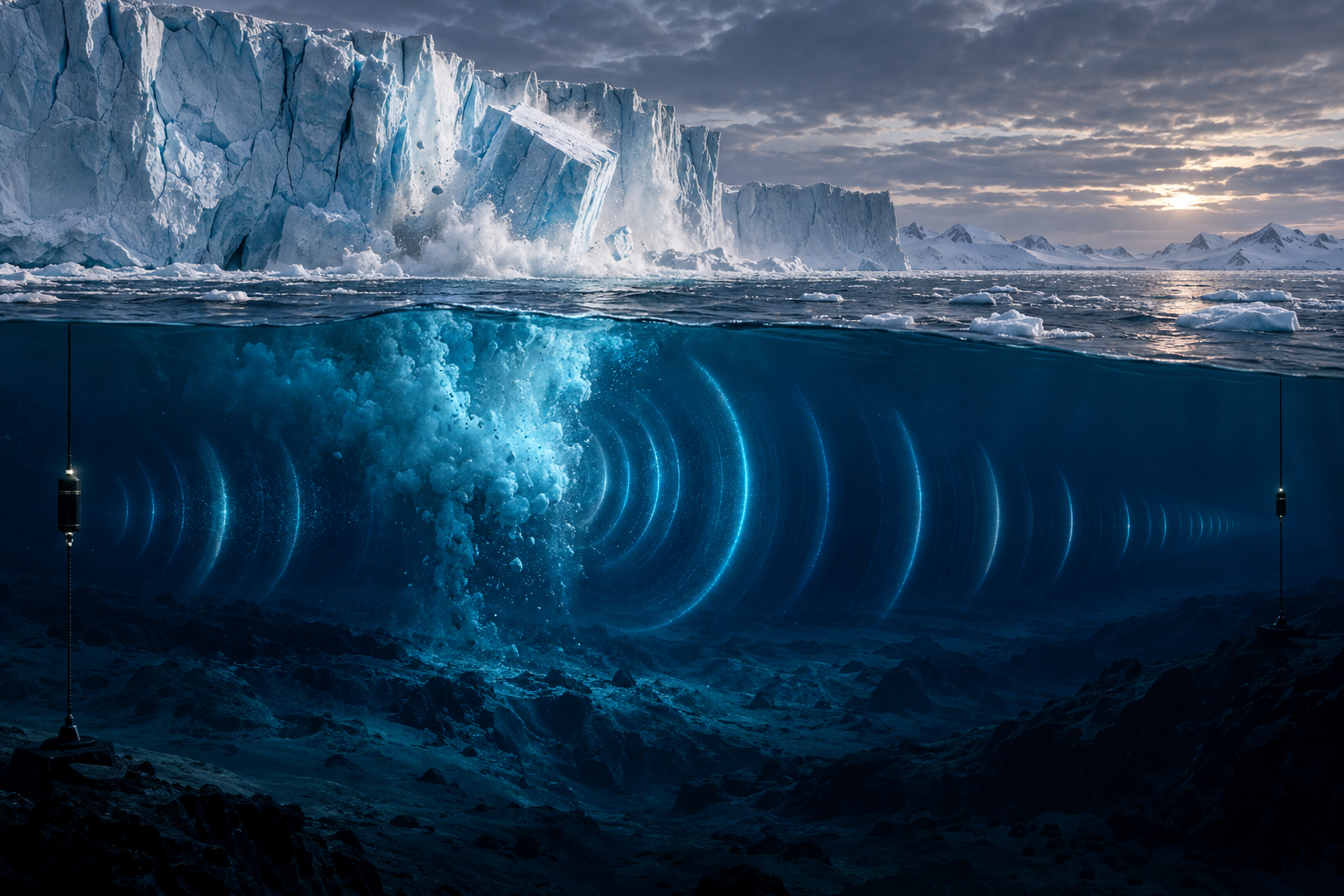
The instruments did not record a creature. They recorded pressure changes arriving through water, and sound alone can rarely identify a source without comparison. NOAA researchers continued deploying hydrophones closer to Antarctica. There they recorded icequakes—large fractures and calving events—with spectrograms closely resembling the Bloop.
By 2005, that comparison supplied the ordinary source class that the original recording lacked. The Bloop was consistent with a major Antarctic ice event transmitting energy across ocean basins. Its range reflected efficient underwater propagation and the scale of breaking ice, not the lungs of an impossible organism.
The case complements the ambiguous signal in the Wow! Signal, the measured uncertainty of the Taos Hum, and the archive’s caution around anomalies without context.
Claim, Context and Cautions
What the instruments captured
The Pacific Marine Environmental Laboratory used widely separated hydrophones to monitor underwater volcanic and seismic activity. Multiple stations receiving the signal allowed researchers to treat it as a distant event rather than local equipment noise.
The public audio is commonly accelerated so that human listeners can hear its structure easily. That processing changes pitch and duration but not the underlying recorded pattern.
Why the animal story spread
The sound was powerful, rose in frequency and was initially unidentified. Those features invited comparison with whale calls and then with fictional deep-sea creatures. Loudness at distant sensors was often translated into body size without a demonstrated biological mechanism.
An unidentified sound is a classification problem. It does not establish that every familiar source has been excluded.
The Antarctic comparison
Hydrophones nearer Antarctica later captured numerous cracking and calving events. Their spectral shapes resembled the Bloop closely enough for NOAA researchers to identify the 1997 signal as an icequake associated with an iceberg breaking from glacial ice.
This conclusion rests on repeated comparison, location and known physics. It is stronger than matching the sound by ear to an imagined animal.
A solved signal with continuing value
Ocean acoustics includes biological calls, ships, earthquakes, volcanoes, weather and ice. Classification improves as networks gain reference recordings and better geometry.
The Bloop remains culturally useful because the mystery was genuine for a time. Its resolution shows how patient monitoring can replace a dramatic unknown with an equally powerful natural process.
How hydrophones turn noise into location
A hydrophone converts changes in water pressure into an electrical record. When the same event reaches separated sensors at different times, researchers can compare arrival patterns and estimate a source region. Frequency, duration and how energy changes through the signal then help distinguish earthquakes, eruptions, ships, animals and ice.
That process is probabilistic rather than magical identification. Ocean temperature and depth bend sound paths, instruments have different coverage, and a distant event may be recorded only in fragments. The Bloop’s initial uncertainty reflected those limits. Later Antarctic monitoring supplied a reference library that did not exist when the nickname was coined.
The case also corrects a common scale error. A signal audible across thousands of kilometres need not come from one vocalising body. Seawater carries low-frequency energy efficiently, while a large ice sheet can fracture across an enormous area. Source physics and propagation must be modelled before apparent loudness becomes a claim about a creature.
Contextual glossary
Terms used in this entry
Definitions are offered as reading aids, not as conclusions about the case.
- Hydrophone
- An underwater microphone used to detect pressure waves in water. Locating a source usually requires several instruments, accurate timing and knowledge of how sound travelled through the ocean.
- Icequake
- A sudden fracture or movement within ice that releases seismic or acoustic energy. Icequakes and breaking ice can produce powerful sounds in polar and glacial environments.
- Uncertainty
- The stated limit on what a measurement, reconstruction or body of evidence can establish. Describing uncertainty is not indecision; it prevents a result from appearing more precise than the evidence allows.
Reference trail
Sources
- NOAA Ocean Service, “What is the Bloop?” (opens in a new tab)Official overview of the 1997 recording and its identification as an Antarctic icequake.
- NOAA PMEL Acoustics Monitoring Program, Icequakes (Bloop) (opens in a new tab)Laboratory page providing the recording and the direct spectrogram comparison with Antarctic icequakes.
- NOAA Fisheries, Environmental and Anthropogenic Ocean Sounds (opens in a new tab)Authoritative context for separating biological, environmental and human sources in ocean soundscapes.
Case Book
Photographs, Maps and Supporting Images
Supporting images provide documentary, geographic or visual context. Read each caption for its date, source and evidential limits.

Continue researching
Follow the evidence, context and comparisons
Curated connections
Selected editorially for this entry.
The Wow! signal was a one-time narrow-band radio event near the hydrogen line, recorded on 15 August 1977. Its shape was noteworthy; its source remains unconfirmed.
Curated connection · Case fileThe Taos Hum: A Sound the Instruments Could Not ShareThe Taos Hum became a public problem in the early 1990s when residents described a distant-engine sound. Researchers documented sincere reports but found no common external source.
Curated connection · ArticleOut-of-Place Artefacts and the Value of CautionWhy disputed objects need context, chain of custody and patient interpretation before becoming extraordinary evidence.
More through shared context
Additional routes based only on existing topics, themes and metadata.
Vela 6911 detected an unexplained double flash on 22 September 1979. Official and scientific assessments disagreed over whether it marked a secret atmospheric nuclear test.
Same primary topic · Shared theme: Strange signals · Case fileFast Radio Bursts: Milliseconds From Distant GalaxiesFRBs are established astrophysical events, not unexplained transmissions in the colloquial sense. Magnetars can produce them, while the population’s diversity and emission physics remain active research questions.