Scientific Anomalies & Natural Phenomena
Tabby’s Star: Deep Dips, Citizen Science and the Dust Question
Tabby’s Star is a genuine astronomical anomaly discovered through citizen science. Chromatic dimming supports small-particle dust rather than an opaque alien structure, while the dust’s origin remains unsettled.
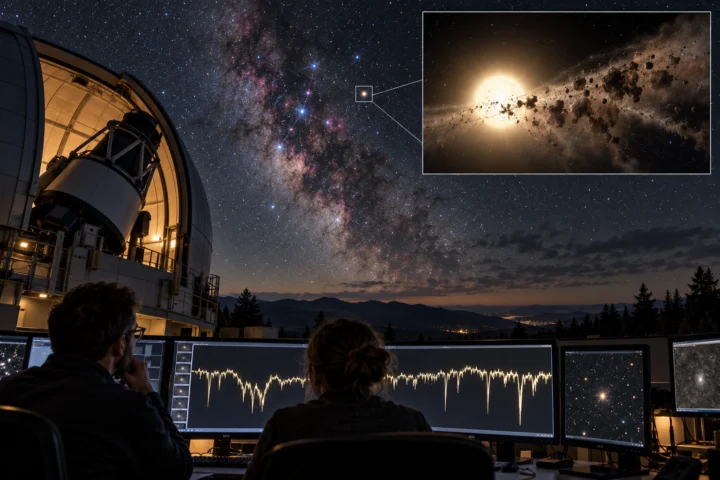
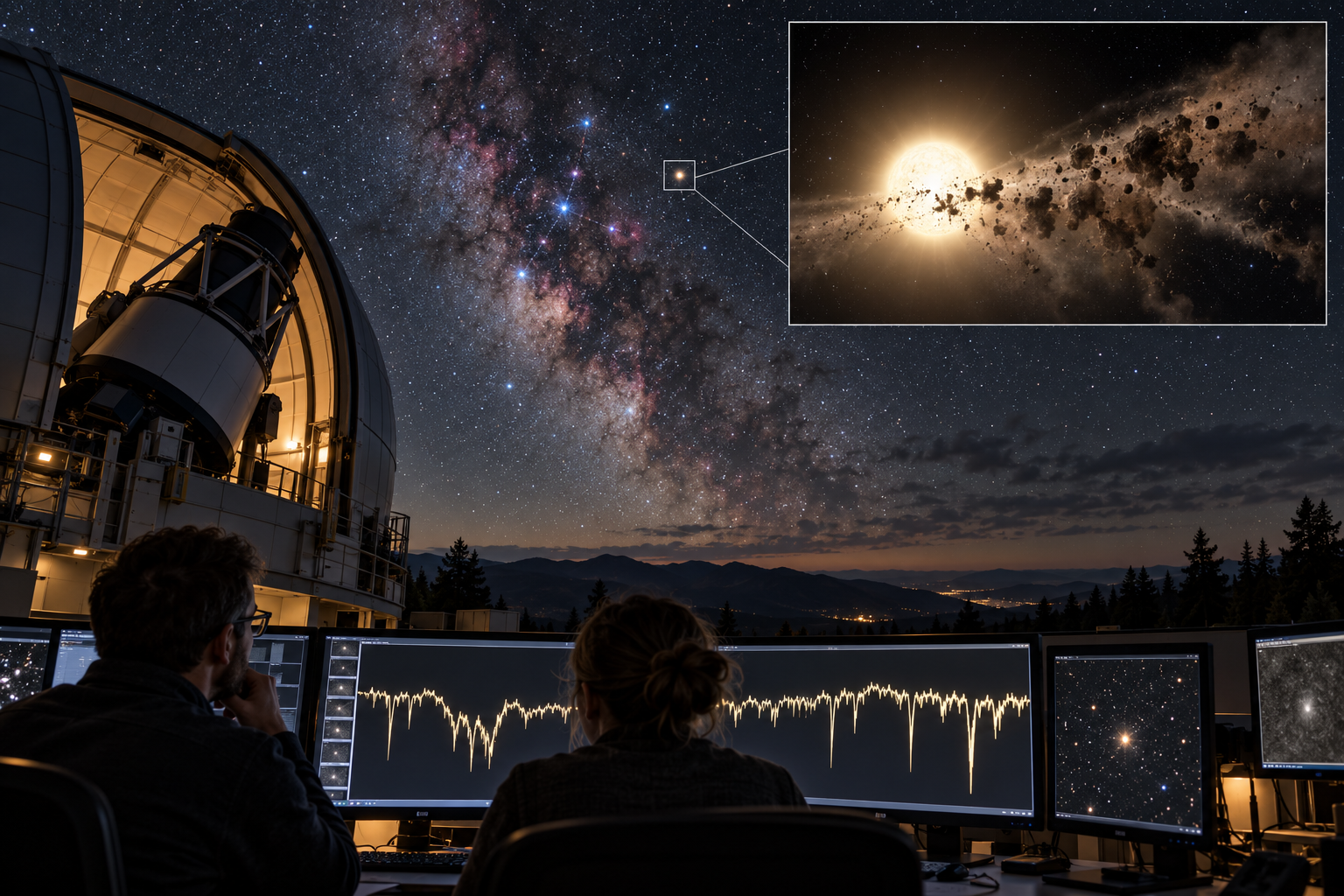
NASA’s Kepler telescope watched more than a hundred thousand stars for the small, regular dips caused by orbiting planets. Citizen scientists in the Planet Hunters project noticed that KIC 8462852 behaved differently. Its brightness fell irregularly, sometimes by roughly twenty per cent, with complex shapes and no simple repeating planetary period.
Tabetha Boyajian and colleagues published the anomaly in 2015. The star appeared broadly ordinary for an F-type main-sequence star, and lacked the strong infrared excess expected from a large warm debris disk. Fragmenting comets or planetesimals were considered, while speculation about an alien “megastructure” brought enormous public attention.
Later dips were observed at several wavelengths. The amount of dimming depended on colour, indicating that small particles preferentially blocked some light. An opaque engineered structure would produce much greyer extinction. Dust therefore explains the immediate dimming better, although researchers still debate whether it is circumstellar, interstellar or produced by disrupted bodies.
Longer-term fading claims added another scale to the problem. Historical photographic plates and modern measurements are difficult to combine because instruments and comparison stars change. Some secular variation is supported, but its magnitude and relationship to the short dips require careful calibration rather than one continuous narrative.
The case complements the archive’s method for classifying anomalous signals, the one-off radio puzzle of the Wow! signal, and the cautionary history of N-rays.
Claim, Context and Cautions
A real light-curve anomaly
Kepler measured brightness with consistent instrumentation over years. The deepest events were far larger and less periodic than ordinary planet transits, and pipeline assumptions initially made the pattern easy to overlook. Volunteers were valuable because they examined shapes rather than only standard candidates.
Instrument checks and observations by other telescopes confirmed that variability belonged to the star’s line of sight, not merely one display or data-processing error.
Why aliens entered the story
Large orbiting collectors could in principle block starlight, so astronomers discussing technosignatures noted the star as an interesting target. That was a hypothesis-generating observation, not a detection. Radio searches found no verified artificial transmission, and a structure able to absorb much light might also produce detectable waste heat depending on its design.
Public retellings often promoted the least likely possibility because it was the most memorable.
The colour of the dips
Dust grains interact with wavelengths according to size. Observed dips being deeper in blue than red support fine particles rather than a solid opaque screen. Infrared and ultraviolet work also constrains the location and amount of material.
This does not identify a single dust-producing event. Small grains near a luminous star are removed quickly, so a viable model must replenish them or place them where survival is longer.
What remains unexplained
Models include exocomet families, collisions, disintegrating planetesimals and material between Earth and the star. Each must account for short deep dips, longer brightness changes, colour dependence and limited infrared emission. No one model yet explains every timescale without difficult assumptions.
Tabby’s Star is therefore unexplained in a productive scientific sense: measurements have eliminated broad classes of cause and narrowed the material involved. Dust is evidence-led, while its origin is an active question. The case demonstrates how an anomaly can remain fascinating after its most sensational interpretation loses support.
Contextual glossary
Terms used in this entry
Definitions are offered as reading aids, not as conclusions about the case.
- Citizen science
- Research in which members of the public contribute observations, classifications, computing or other work to an organised project. Clear protocols and review help turn many individual contributions into usable data.
- Anomaly
- An observation or result that does not fit the current account. An anomaly identifies a question; it is not, by itself, evidence for any particular extraordinary explanation.
- Light curve
- A graph showing how an object’s brightness changes over time. Astronomers use its shape, depth and repetition to investigate eclipses, stellar activity and material passing in front of a star.
- Infrared
- Electromagnetic radiation with wavelengths longer than visible red light. Infrared sensors can record heat-related or reflected signals, but the colours in a displayed image are often assigned during processing.
- Wavelength
- The distance between repeating points in a wave. Different wavelengths of light, radio or sound interact differently with matter and determine what a sensor can detect or resolve.
Reference trail
Sources
- Boyajian et al., Planet Hunters X: KIC 8462852 (opens in a new tab)Open manuscript of the discovery paper documenting the Kepler light curve, stellar properties and early natural hypotheses.
- NASA JPL, Mysterious dimming may be caused by dust (opens in a new tab)Mission-based account of Swift and Spitzer multi-wavelength evidence supporting uneven dust.
- Schaefer et al., KIC 8462852 light curve 2015–2018 (opens in a new tab)Observational study finding chromatic extinction and discussing the continuing requirement for recently formed small dust.
Case Book
Photographs, Maps and Supporting Images
Supporting images provide documentary, geographic or visual context. Read each caption for its date, source and evidential limits.

Continue researching
Follow the evidence, context and comparisons
Curated connections
Selected editorially for this entry.
A source-led guide to anomalous signals, from underwater sounds to radio bursts: how calibration, reference libraries and independent repetition separate useful evidence from compelling noise.
Curated connection · Case fileThe Wow! Signal: Seventy-Two Seconds at Big EarThe Wow! signal was a one-time narrow-band radio event near the hydrogen line, recorded on 15 August 1977. Its shape was noteworthy; its source remains unconfirmed.
Curated connection · Case fileN-Rays: The Scientific Discovery That Wasn’tN-rays were reported by respected physicists using faint visual changes near the threshold of perception. Failed replication and uncontrolled tests showed that the proposed radiation was not established.