Scientific Anomalies & Natural Phenomena
N-Rays: The Scientific Discovery That Wasn’t
N-rays were reported by respected physicists using faint visual changes near the threshold of perception. Failed replication and uncontrolled tests showed that the proposed radiation was not established.
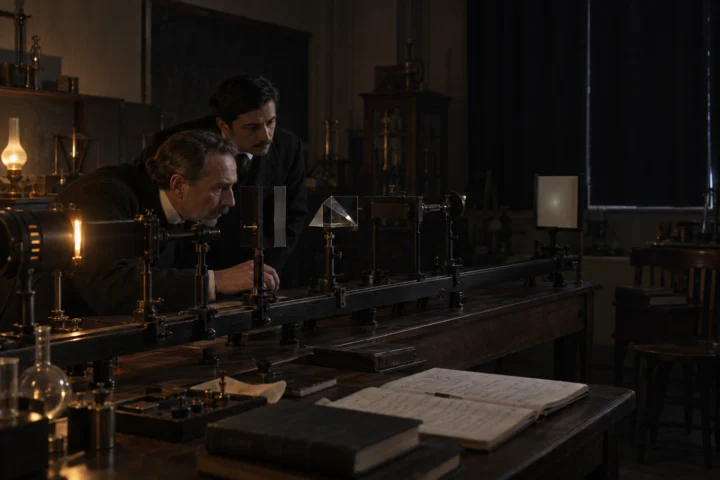
In 1903, the respected French physicist Prosper-René Blondlot announced a new radiation detected in his laboratory at Nancy. N-rays, named for the city, were said to pass through some materials and make a dim electric spark or phosphorescent screen appear slightly brighter. Laboratories published confirmations, especially in France.
The effect sat close to the threshold of vision. Observers had to decide whether one faint patch looked brighter than another in a dark room, often knowing when the apparatus was supposed to produce the ray. Attempts elsewhere failed to reproduce a stable signal.
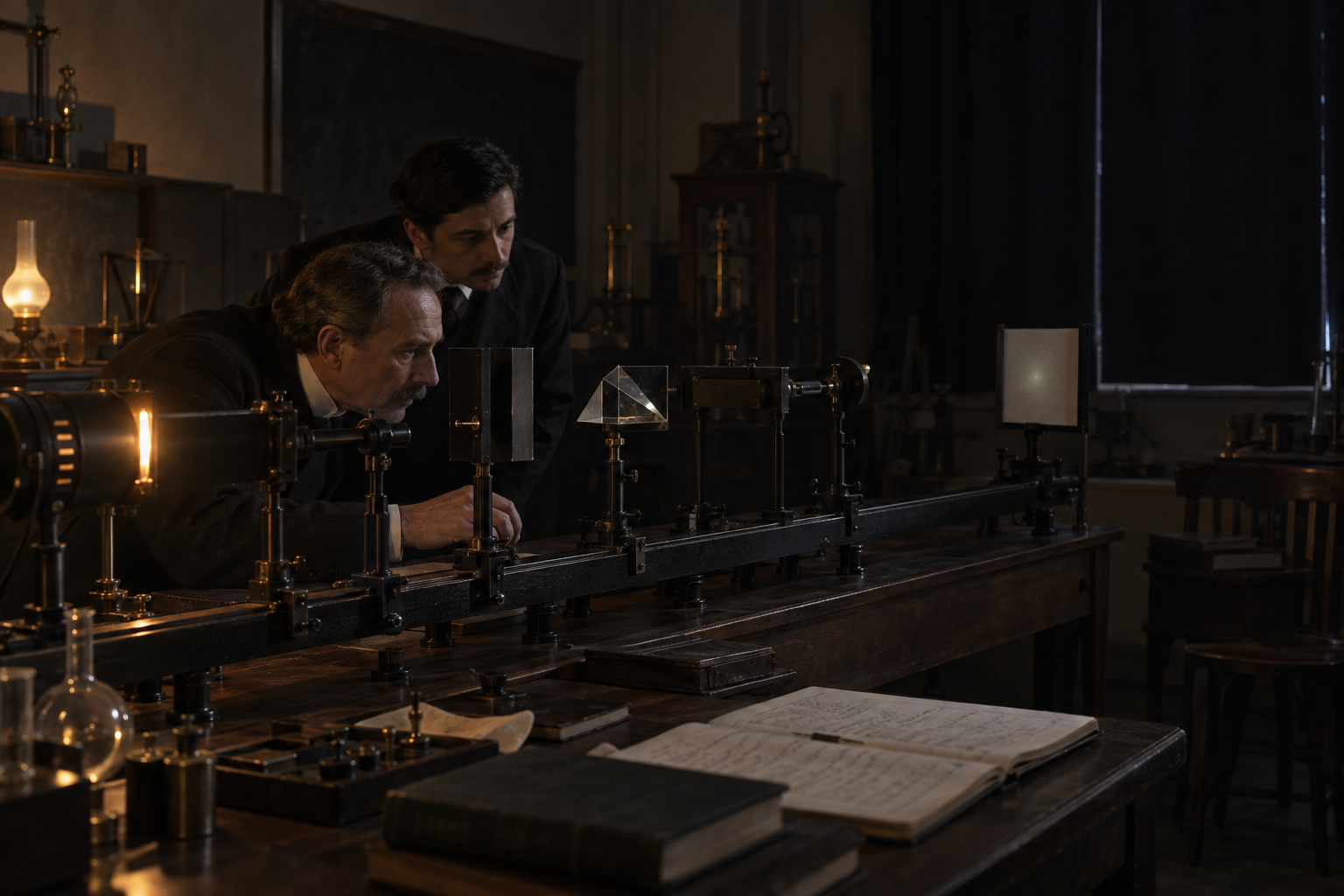
In 1904, American physicist Robert W. Wood visited Blondlot’s laboratory. During a demonstration he secretly removed the crucial aluminium prism; the expected changes were still reported. His account made the failure of blinding controls vivid, though broader replication trouble had already weakened the claim.
N-rays make a useful contrast with the deliberate deception of Piltdown Man, the evidential cautions around out-of-place artefacts, and the wider boundary between evidence, testimony and legend.
Claim, Context and Cautions
A discovery in a respected laboratory
Blondlot was not an outsider to physics. His earlier work on electromagnetic waves was well regarded, and the discovery of X-rays had made new forms of invisible radiation plausible. He reported that N-rays altered the apparent brightness of a small spark and later used a prism to describe a spectrum.
That context explains why colleagues investigated the claim. A surprising result from a competent laboratory deserved testing; it did not deserve exemption from controls.
Confirmation gathers around Nancy
French experimenters reported N-rays from metals, the human body and other sources, while additional varieties and biological effects multiplied. Publications made the field look productive. Outside that circle, many capable physicists could not obtain the visual effect.
National rivalry sometimes coloured the dispute, but geography alone cannot explain it. The decisive difference was whether the subtle judgement survived procedures that concealed the apparatus state from the observer.
The problem of seeing at the threshold
In darkness, tiny fluctuations in vision can make a faint line or spark seem to change. If an observer expects the brighter interval, ordinary variation can become a positive reading. Repetition does not remove this effect when every trial preserves the same expectation.
Objective photography, randomized presentation and blinded observation were therefore crucial. The N-ray programme relied too heavily on trained perception while treating the observer's confidence as an instrument.
Wood removes the prism
Nature asked Robert W. Wood, known for experimental optics, to visit Nancy. In the darkened room he removed the aluminium prism that was supposed to spread N-rays into a spectrum. The demonstrator continued to report the expected brightening at the predicted positions. In another test, changing the apparatus without the observer's knowledge broke the claimed relation.
Wood concluded that he could not report a single observation indicating the rays' existence. Blondlot and supporters did not immediately agree.
Not the same as an admitted hoax
The episode is often told as a prank that instantly destroyed a fraud. The record better supports self-deception amplified by weak experimental design. Blondlot did not confess, and historians have shown that Wood's intervention became a heroic shorthand for a longer dispute involving failed replication and professional judgement.
Calling the discovery false describes the result. Calling every participant dishonest would claim more than the evidence shows.
The control that changes the question
A good control does more than add equipment. It asks whether the observation follows the proposed cause when the observer cannot know the answer in advance. Removing or randomizing the prism converted “Can a trained physicist see N-rays?” into “Does the judgement track whether the apparatus can produce them?” It did not.
N-rays endure as a case study because error occurred inside normal science and was corrected by it. Reputation and repeated reports generated confidence; replication and blinding made the confidence testable.
Contextual glossary
Terms used in this entry
Definitions are offered as reading aids, not as conclusions about the case.
- Replication
- Repeating a study or observation to test whether a result can be obtained again. Independent replication is especially important when an effect is small, surprising or sensitive to procedure.
- Hoax
- A deliberate attempt to make false evidence or a false story appear genuine. A hoax can still become culturally important, but its later influence should not be confused with the original claim.
Reference trail
Sources
- Nature, “M. Blondlot’s n-Ray Experiments” (February 1904) (opens in a new tab)Contemporary description of Blondlot’s apparatus and claimed observations before the controversy was resolved.
- Nature, “The Blondlot or n-Rays” (April 1904) (opens in a new tab)Contemporary report of negative replication and growing concern about subjective visual detection.
- R. W. Wood, “The N-Rays” (Nature, 29 September 1904) (opens in a new tab)Scan of Wood’s original report describing his visit, removal of the prism and unsuccessful controls.
- American Physical Society, “Robert W. Wood Debunks N-Rays” (opens in a new tab)Historical overview of Blondlot’s standing, the detection method, replication failures and Wood’s intervention.
- Malcolm Ashmore, “The Theatre of the Blind” (Social Studies of Science, 1993) (opens in a new tab)Scholarly historiography complicating the simple lone-debunker narrative and examining how the episode was retold.
Case Book
Photographs, Maps and Supporting Images
Supporting images provide documentary, geographic or visual context. Read each caption for its date, source and evidential limits.

Continue researching
Follow the evidence, context and comparisons
Curated connections
Selected editorially for this entry.
Piltdown Man fooled parts of the scientific world for decades because forged evidence appeared to fit a story people were ready to hear.
Curated connection · ArticleOut-of-Place Artefacts and the Value of CautionWhy disputed objects need context, chain of custody and patient interpretation before becoming extraordinary evidence.
Curated connection · ArticleThe Difference Between Evidence, Testimony and LegendA field guide to three words that often get tangled in mystery research.