UFOs & Aerial Phenomena
The Exeter Incident: Five Red Lights Before Dawn
The Exeter incident has named witnesses and a substantial official file, but no photograph or physical trace. “Unidentified” records insufficient resolution, not an extraordinary craft.
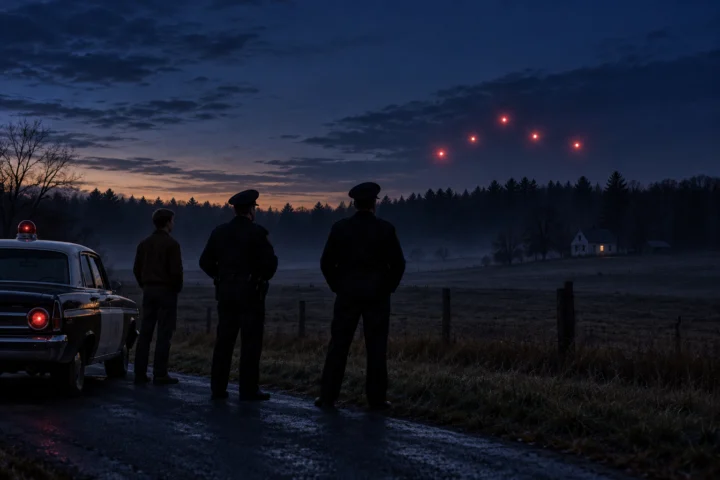
Before dawn on 3 September 1965, eighteen-year-old Norman Muscarello was walking near Exeter, New Hampshire, when he reported five bright red lights approaching over a field. He reached the police station, and patrolman Eugene Bertrand returned with him. Bertrand and later officer David Hunt said they also saw the lights.
The witnesses described a silent pattern that moved near the tree line and cast red light across the surroundings. They did not produce a photograph, radar record or physical trace. Estimates of distance, size and height came from a dark rural scene without a known object for scale.
Project Blue Book first considered aircraft involved in the military exercise Big Blast. The officers objected that the timing and appearance did not fit. Correspondence in the case file shows the hypothesis being checked and weakened; the record card ultimately classified the sighting as unidentified.
Exeter sits well beside the expert-observer issues in pilot reports, the multiple-event problem of the Phoenix Lights, and the archive’s guide to recording strange experiences.
Claim, Context and Cautions
Three witnesses, related observations
Muscarello’s report led Bertrand to the field, and Hunt joined later. That sequence is stronger than one isolated recollection because officers documented what they said soon afterwards. It is not three fully independent discoveries: the witnesses shared the location and knew the expected light pattern.
Their professional roles support careful reporting, but do not supply automatic distance or object identification.
The limits of a dark field
Without a visible body, the five lights could not provide a reliable scale. Apparent movement near trees depends on viewing position, intervening branches and whether the source is nearby and small or distant and large. Silence is also distance-dependent.
The vividness of the experience is secure testimony. Its geometry remains uncertain.
Big Blast and the official file
The Air Force explored whether aircraft from exercise Big Blast accounted for the display. The Exeter officers replied that they saw a probable high-altitude B-47 separately and that the low red lights occurred outside the relevant exercise timing. Subsequent correspondence did not produce a stable aircraft match.
The file therefore documents an explanation tested, challenged and not sustained—not an official finding of extraterrestrial origin.
What unidentified means
Blue Book’s classification says the available information did not support a satisfactory identification under its system. It does not convert witness estimates into measured performance or establish a solid craft.
Exeter remains a comparatively well-documented visual report with unresolved source. Its value lies in the preserved disagreement and the boundary between testimony and instrumented evidence.
The case after Project Blue Book
Writer John G. Fuller’s 1966 book made Exeter a national reference point and fixed a coherent narrative from the statements, interviews and official dispute. That attention preserved details but also meant later recollections developed inside a famous story. Claims about other lights in the region are sometimes added to the core event even when their times, observers and evidential quality differ.
Proposed solutions have included advertising aircraft, military refuelling operations, stars seen through moving cloud and electrical effects. Each must account for the repeated red sequence, reported low altitude, duration and the officers’ objections. None has won broad documentary acceptance. Conversely, no recovered object or independent instrument record supports extraordinary performance.
The responsible status is uncertain. It recognises that an aircraft explanation considered by officials did not close the file, while refusing to turn administrative incompleteness into proof of a vehicle beyond known technology.
Reference trail
Sources
- U.S. National Archives, Project Blue Book reference report (opens in a new tab)Official guide to the declassified Blue Book record series and its evidential scope.
- Project Blue Book, Exeter case file (131 pages) (opens in a new tab)Public-domain scan of the official case packet containing statements, maps and Air Force correspondence.
- Disclosure Files, documentary guide to the Exeter case (opens in a new tab)Page-level guide to the National Archives file, used to locate the record card and competing official explanations.
Case Book
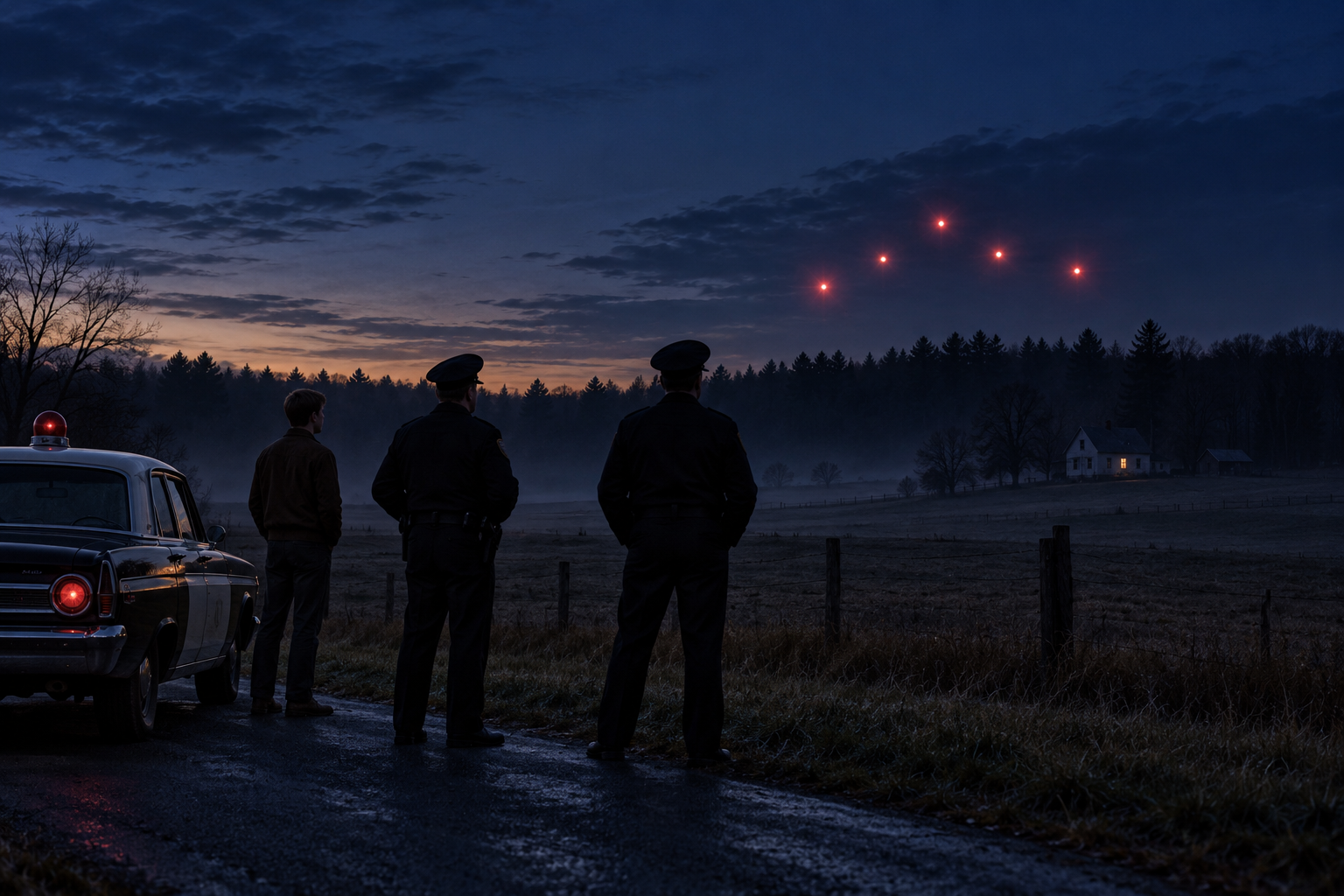
Photographs, Maps and Supporting Images
Supporting images provide documentary, geographic or visual context. Read each caption for its date, source and evidential limits.

Continue researching
Follow the evidence, context and comparisons
Curated connections
Selected editorially for this entry.
Trained observers matter, but expertise does not remove ambiguity from distance, speed, glare and surprise.
Curated connection · Case fileThe Phoenix Lights: Two Events, One NightOn 13 March 1997, reports of a moving light formation crossed Arizona before a separate row of lights appeared near Phoenix. One event has a strong military-flare explanation; the other remains disputed.
Curated connection · ArticleA Field Guide for Recording Strange Experiences ResponsiblyA calm checklist for writing down unusual events before memory, excitement and online feedback reshape them.
More through shared context
Additional routes based only on existing topics, themes and metadata.
The crew’s visual report was real and professionally documented. Radar returns were intermittent and disputed, while darkness, cloud and uncertain distance made size estimates especially fragile.
Same primary topic · Shared theme: Aviation, Witness & memory · Case fileSocorro: Lonnie Zamora and the Object in the ArroyoThe Socorro incident rests on a prompt police report and documented ground traces, yet neither the marks nor later theories securely identify what Lonnie Zamora saw.