Scientific Anomalies & Natural Phenomena
Cold Fusion: The 1989 Claim and the Replication Problem
Cold fusion became a lesson in calorimetry, press-first science and replication. Later reviews left room to investigate materials effects but did not validate the original nuclear-energy claim.
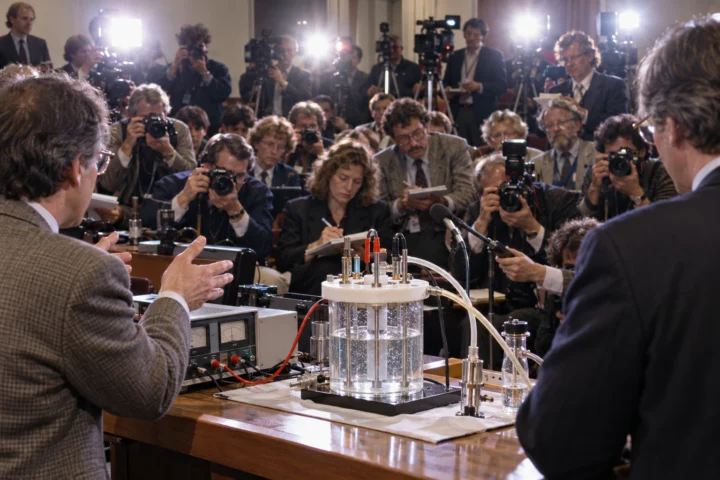
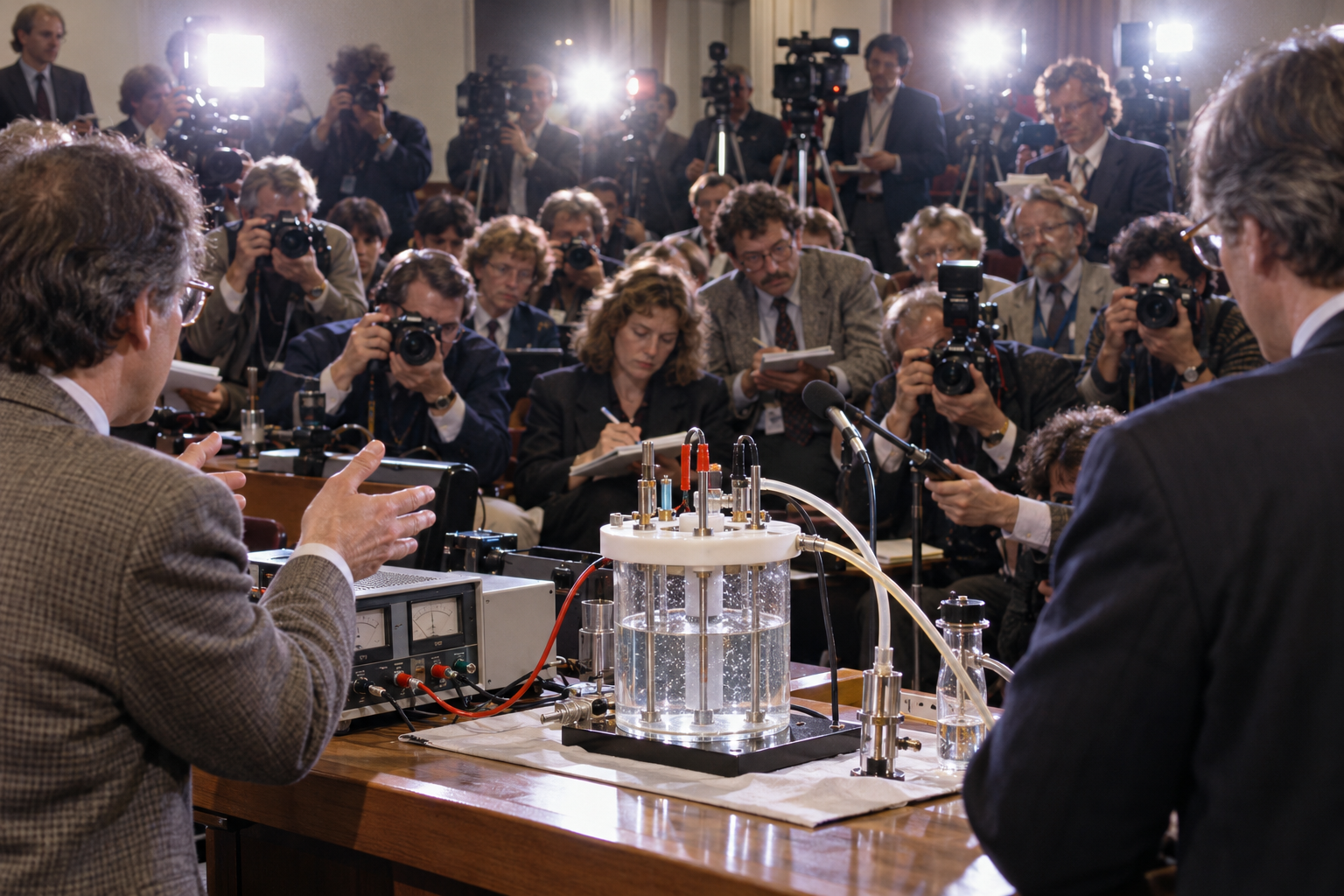
On 23 March 1989, electrochemists Martin Fleischmann and Stanley Pons announced that palladium electrodes loaded with deuterium in heavy water had produced more heat than chemistry could explain. If nuclear reactions occurred near room temperature, the claim promised a compact new energy source. The announcement arrived by press conference before the experimental record had received ordinary peer scrutiny.
Laboratories rushed to reproduce the effect. Most failed to obtain convincing excess heat or the neutron, gamma-ray and tritium products expected from known deuterium fusion. Calorimetry proved sensitive to cell conditions, recombination, calibration and data selection. Positive reports continued, often under the broader label low-energy nuclear reactions, but results did not become reliably reproducible.
A 1989 United States Department of Energy panel found the evidence unpersuasive and advised against a special programme. A 2004 review heard new submissions; reviewers differed over some claimed anomalies, yet the department again found no basis for a dedicated federal effort. A later multi-institution investigation reported no evidence for the claimed effect while identifying useful materials questions.
Cold fusion resembles the archive’s history of N-rays, where expectation met difficult measurement, and the methodological cautions in out-of-place artefacts and the Hessdalen lights.
Claim, Context and Cautions
What was claimed
Fleischmann and Pons argued that deuterium concentrated inside palladium could undergo nuclear reactions, with anomalous heat as the central observation. They also reported nuclear products, although the measured quantities did not consistently match the heat expected from standard fusion pathways.
That mismatch mattered. A large nuclear energy release should leave corresponding particles, radiation or reaction products. Proposing an unknown pathway is possible, but it increases rather than removes the need for repeatable, quantitatively linked evidence.
Why calorimetry became the battleground
Electrochemical cells exchange heat, gas and electrical energy with their surroundings. Small errors in input power, evaporation, gas recombination or thermal modelling can appear as excess output. Some claims involved larger bursts, but these too required independent repetition with controls and complete records.
A failed replication does not prove that an intermittent effect never occurred. Repeated failure across capable laboratories does lower confidence, especially when experimenters cannot state conditions that reliably switch the effect on.
What the official reviews concluded
The 1989 Energy Research Advisory Board reviewed experimental evidence and concluded that it did not convincingly demonstrate a new nuclear process. It supported ordinary peer-reviewed proposals on relevant science but rejected a specially funded programme.
In 2004, the Department of Energy revisited material submitted by advocates. Some reviewers found portions suggestive; the panel as a whole did not reach confirmation, and agency funding practice did not change. Describing that review as government validation removes its central conclusion.
Research after the controversy
Researchers have continued to study hydrogen in metals, unusual nuclear claims and improved calorimetry. A 2019 Nature collaboration, formed with substantial resources and an explicit willingness to test the field, reported no evidence supporting cold fusion in the examined conditions. It also described unexplored materials regimes worth studying for conventional scientific reasons.
The distinction is important: a field can generate useful techniques and unanswered questions without vindicating its founding claim. Cold fusion was not shown to be a deliberate hoax, nor was it established as a power source suppressed by orthodoxy. The case remains a historical example of premature announcement and a scientific claim that has not crossed the threshold of reliable replication.
Contextual glossary
Terms used in this entry
Definitions are offered as reading aids, not as conclusions about the case.
- Cold fusion
- A proposed form of nuclear fusion occurring near room temperature, most famously claimed in electrochemical experiments announced in 1989. The central claims were not reliably reproduced under controlled conditions.
- Replication
- Repeating a study or observation to test whether a result can be obtained again. Independent replication is especially important when an effect is small, surprising or sensitive to procedure.
- Hoax
- A deliberate attempt to make false evidence or a false story appear genuine. A hoax can still become culturally important, but its later influence should not be confused with the original claim.
Reference trail
Sources
- Nature, Search for neutron, gamma and X-ray emission from palladium-deuterium systems (opens in a new tab)Contemporary peer-reviewed replication study reporting no detectable fusion products or excess heat under its tested conditions.
- U.S. Department of Energy, Review of Low Energy Nuclear Reactions (2004) (opens in a new tab)Official account of the later review process and the mixed reviewer assessments that did not establish the claimed phenomenon.
- Nature, Revisiting the cold case of cold fusion (opens in a new tab)Peer-reviewed multi-institution re-evaluation reporting no evidence of cold fusion while identifying materials-science opportunities.
Case Book
Photographs, Maps and Supporting Images
Supporting images provide documentary, geographic or visual context. Read each caption for its date, source and evidential limits.

Continue researching
Follow the evidence, context and comparisons
Curated connections
Selected editorially for this entry.
N-rays were reported by respected physicists using faint visual changes near the threshold of perception. Failed replication and uncontrolled tests showed that the proposed radiation was not established.
Curated connection · ArticleOut-of-Place Artefacts and the Value of CautionWhy disputed objects need context, chain of custody and patient interpretation before becoming extraordinary evidence.
Curated connection · Case fileThe Hessdalen Lights: A Valley Under ObservationHessdalen’s recurring lights prompted field campaigns and automatic monitoring after a wave in the early 1980s. The label covers mixed observations, not one proven phenomenon.