Scientific Anomalies & Natural Phenomena
Blood Falls: The Iron-Rich Brine Beneath Taylor Glacier
Blood Falls is visually uncanny but scientifically explained. Its colour comes from iron oxidation, while its isolated salty ecosystem remains valuable for studying life beneath ice.
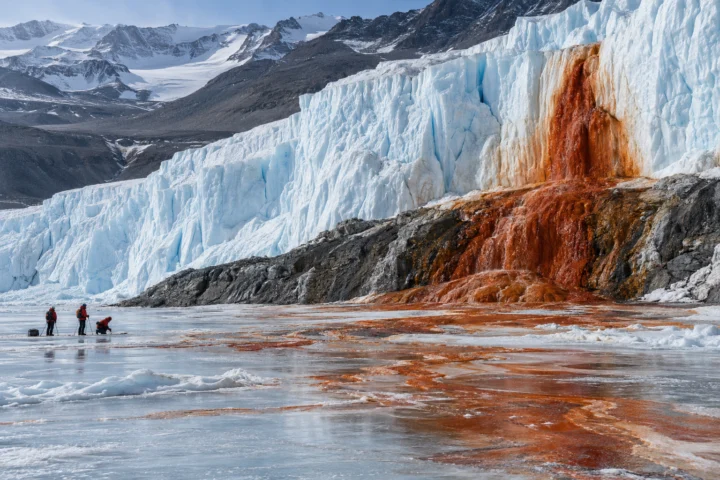
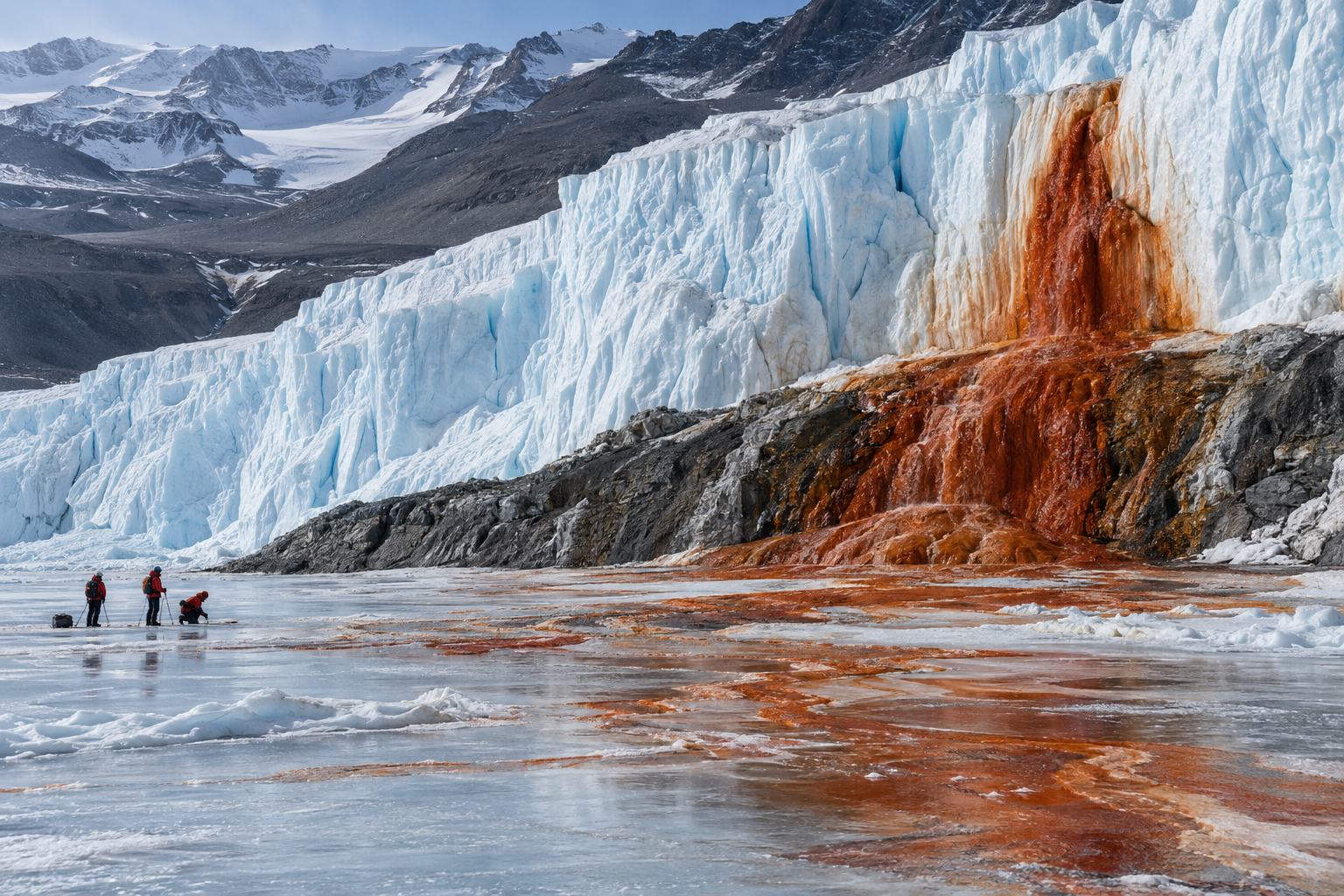
At the terminus of Taylor Glacier in Antarctica’s McMurdo Dry Valleys, red-orange material spills intermittently from fractures and stains the ice. Early observers compared the colour to blood. It is not blood, algae spread across the surface, or volcanic lava.
The discharge is hypersaline brine carrying dissolved iron from beneath the glacier. When iron-rich fluid reaches oxygen at the surface, the iron oxidises and precipitates into rust-coloured minerals. Salt lowers the freezing point, allowing liquid pathways in conditions where fresh water would freeze.
Geophysical work indicates a network of brine within and beneath the glacier rather than a simple open underground river. Pressure, fracture opening and glacier movement influence episodic release. Chemistry points to ancient seawater contributions modified during long isolation and water-rock interaction.
Microorganisms survive without sunlight in the cold, salty, low-oxygen environment by using available chemical energy. Blood Falls therefore remains scientifically unusual even after the colour is explained. It is an analogue—not a duplicate—for questions about subsurface habitats on Mars or icy moons.
The case demonstrates the measurement discipline used for the Pioneer anomaly, rare natural observations such as ball lightning, and the broader signal framework in anomalous investigations.
Claim, Context and Cautions
Why the flow stays liquid
Salts depress water's freezing temperature, and concentrated brine can persist in small channels or reservoirs within ice. Radar and electromagnetic surveys map conductive zones consistent with salty water. The exact plumbing changes as the glacier deforms, so one cross-section is a working model rather than a permanent pipe diagram.
Intermittent surface flow does not mean the hidden source appears and disappears; access fractures and pressure can change.
Iron makes the colour
Below the glacier, limited oxygen helps keep iron dissolved in the brine. At the surface it encounters air and forms iron oxides or related particles, producing the red-orange stain. Modern microscopy and spectroscopy distinguish these mineral phases from pigments made by a surface algal bloom.
The comparison to bleeding is visual language, not a chemical clue. Sampling provides the decisive test.
A microbial ecosystem under ice
Recovered brine contains microbial communities adapted to salinity, darkness and cold. Metabolic pathways recycle sulphur and iron while drawing on chemical rather than photosynthetic energy. Contamination controls are essential because sampling crosses the surface into a low-biomass environment.
Life at Blood Falls does not prove life exists elsewhere, but it expands experimentally supported limits for habitable environments.
Solved spectacle, active science
The central mystery of the red colour has a conventional geochemical answer. Open questions remain about the brine's full geometry, residence time, marine inheritance, flow triggers and ecological history. Calling the site “explained” should not flatten those research programmes.
Blood Falls shows why appearance is a starting point. Investigators moved from analogy to measurements of salt, iron, microbes and subsurface conductivity. The result is more remarkable than a supernatural label: a persistent liquid and living chemical system sealed within one of Earth’s coldest deserts. Repeated sampling must also distinguish long-term reservoir chemistry from changes that occur as brine freezes, mixes and oxidises during collection. That is why field notes and temperature-controlled sample handling matter alongside dramatic photographs. Replication across field seasons matters too.
Contextual glossary
Terms used in this entry
Definitions are offered as reading aids, not as conclusions about the case.
- Brine
- Water containing a high concentration of dissolved salts. Dense brines can remain liquid below the usual freezing point and can move beneath ice or through sediments.
- Ball lightning
- A rare report of a luminous, usually short-lived sphere associated with storm conditions. The label is sometimes applied too broadly to any unexplained light near the ground.
- Oxidation
- A chemical process involving loss of electrons, commonly seen when iron-bearing material reacts to form rust-coloured compounds. It can change the colour of water, rock, metal and biological deposits.
- Contamination
- The introduction of outside material or information into evidence. It may affect DNA, objects, recordings or witness accounts and must be considered before treating a match as independent.
- Replication
- Repeating a study or observation to test whether a result can be obtained again. Independent replication is especially important when an effect is small, surprising or sensitive to procedure.
Reference trail
Sources
- NASA Earth Observatory, Blood Falls, Antarctica’s Dry Valleys (opens in a new tab)NASA overview of the iron-rich brine, ancient lake context and colour mechanism.
- National Science Foundation, Science on the Ice (opens in a new tab)Official Antarctic programme account of subglacial microbial communities and iron-rich discharge.
- Mikucki et al., geochemical evidence from Blood Falls (opens in a new tab)Peer-reviewed research on hypersaline brine chemistry, iron and ancient seawater solutes.
Case Book
Photographs, Maps and Supporting Images
Supporting images provide documentary, geographic or visual context. Read each caption for its date, source and evidential limits.

Continue researching
Follow the evidence, context and comparisons
Curated connections
Selected editorially for this entry.
The anomaly was a real navigation residual, not an invented effect. Uneven radiation of onboard heat matched its magnitude and evolution, leaving no statistically significant anomalous acceleration.
Curated connection · Case fileBall Lightning: Rare Observation, Unsettled MechanismBall lightning is a label for rare luminous events reported near thunderstorms. Instrumental observations constrain some cases, while varied testimony and competing physical models leave its full scope unresolved.
Curated connection · ArticleStrange Signals: How Investigators Classify Sounds and TransmissionsA source-led guide to anomalous signals, from underwater sounds to radio bursts: how calibration, reference libraries and independent repetition separate useful evidence from compelling noise.