Scientific Anomalies & Natural Phenomena
The Pioneer Anomaly: When Spacecraft Heat Looked Like New Physics
The anomaly was a real navigation residual, not an invented effect. Uneven radiation of onboard heat matched its magnitude and evolution, leaving no statistically significant anomalous acceleration.
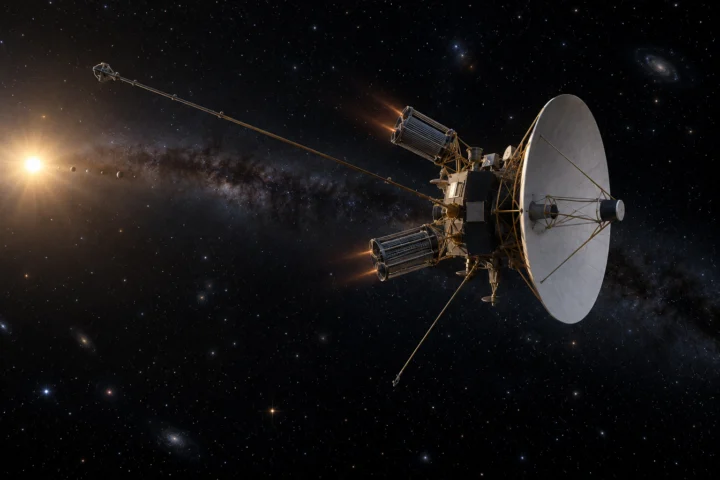
Navigation teams track a spacecraft by measuring the Doppler shift of its radio signal. For Pioneer 10 and 11, residuals accumulated after known gravitational and operational effects were modelled. They could be expressed as a tiny acceleration roughly toward the inner Solar System.
The effect was about 0.9 nanometres per second squared—minuscule, but persistent enough to attract attention. Proposed explanations ranged from gas leaks and tracking errors to modified gravity. A real mismatch in a model does not imply that its most revolutionary interpretation is real.
The spacecraft carried radioisotope thermoelectric generators and electrical equipment that produced heat. Photons carry momentum. If more thermal radiation leaves in one direction, the recoil gently pushes the craft the other way, much as a fantastically weak thruster would.
Researchers recovered decades-old telemetry and engineering records, built detailed thermal models, and independently fitted recoil parameters to navigation data. The predicted magnitude, direction and decline tracked the observed anomaly. Once thermal recoil was included, no statistically significant residual remained.
This resolution parallels instrumental work on the Wow! signal, data discipline in anomalous signals, and the image-processing lesson of the Face on Mars.
Claim, Context and Cautions
A residual is a question
Orbit determination subtracts expected gravity, solar pressure, manoeuvres and signal effects from observations. The remainder may reveal omitted physics, but it may also reveal imperfect knowledge of the vehicle. Pioneer was unusually sensitive because its spin stabilisation required fewer masking thruster firings than three-axis-controlled craft.
The acceleration language describes how the Doppler drift can be modelled; it was not a direct accelerometer reading.
Recovering an ageing dataset
Much of the evidence lived on obsolete tapes and in engineering documentation scattered among institutions. Researchers preserved tape drives, translated formats and reconstructed telemetry that recorded temperatures and electrical power. Data rescue expanded the question from a simple constant acceleration to an effect evolving with the spacecraft.
That history makes archive preservation part of experimental physics, not administrative housekeeping.
Heat produces momentum
Radioactive decay and electronics warmed the craft. The large high-gain antenna reflected or blocked some radiation, while equipment geometry directed other heat unevenly. A finite-element model used actual design and telemetry to calculate recoil. Independently fitting coefficients from Doppler data produced compatible values.
The decay in power helped distinguish this explanation from a new universal force expected to remain constant.
Why the resolution matters
The result did not declare the original measurement an error. It explained a genuine residual by improving the physical model. Earlier researchers were justified in publishing the anomaly because they quantified known forces and uncertainty; later researchers were justified in closing it when recovered evidence supported a conventional cause.
That sequence is how anomaly investigation should work. Competing ideas remain visible, predictions sharpen, neglected engineering is tested, and the least exotic explanation wins only after matching the data. Pioneer did not overthrow gravity, but its tiny thermal push produced a valuable demonstration of archival science and measurement humility. Multiple modelling groups reached compatible thermal conclusions using different computational approaches, strengthening the result beyond a single preferred fit. The anomaly remains historically important even though its physical cause is no longer mysterious. Its resolution is evidence of success, not failure.
Contextual glossary
Terms used in this entry
Definitions are offered as reading aids, not as conclusions about the case.
- Anomaly
- An observation or result that does not fit the current account. An anomaly identifies a question; it is not, by itself, evidence for any particular extraordinary explanation.
- Thermal recoil
- A small force produced when heat is radiated unevenly from an object. Over long periods it can measurably alter a spacecraft’s motion and imitate an unexplained acceleration.
- Doppler shift
- A change in observed frequency caused by relative motion between a source and an observer. Radar and radio analysis can use it to estimate motion along the line of sight.
- Uncertainty
- The stated limit on what a measurement, reconstruction or body of evidence can establish. Describing uncertainty is not indecision; it prevents a result from appearing more precise than the evidence allows.
Reference trail
Sources
- NASA JPL, Study Finds Heat is Source of Pioneer Anomaly (opens in a new tab)Official mission summary of the recovered records, thermal model and conclusion.
- Physical Review Letters via PubMed, Support for the Thermal Origin (opens in a new tab)Peer-reviewed abstract reporting agreement between thermal estimates and Doppler fits.
- Physical Review D, Thermal recoil force, telemetry, and the Pioneer anomaly (opens in a new tab)Peer-reviewed development of the telemetry-based thermal-recoil method.
Case Book
Photographs, Maps and Supporting Images
Supporting images provide documentary, geographic or visual context. Read each caption for its date, source and evidential limits.

Continue researching
Follow the evidence, context and comparisons
Curated connections
Selected editorially for this entry.
The Wow! signal was a one-time narrow-band radio event near the hydrogen line, recorded on 15 August 1977. Its shape was noteworthy; its source remains unconfirmed.
Curated connection · ArticleStrange Signals: How Investigators Classify Sounds and TransmissionsA source-led guide to anomalous signals, from underwater sounds to radio bursts: how calibration, reference libraries and independent repetition separate useful evidence from compelling noise.
Curated connection · Case fileThe Face on Mars: Pareidolia in a Planetary ArchiveThe Face on Mars became a classic anomaly because one low-resolution Viking image looked uncannily human until better imaging restored it to geology.