Disappearances & Unresolved Identities
Percy Fawcett: The Last Letter From the Search for Z
The expedition disappeared after leaving Dead Horse Camp, most plausibly through accident, illness, starvation or violence. Archaeology validates complex pre-Columbian Amazon settlements, not Fawcett’s particular Z or any theory of his fate.
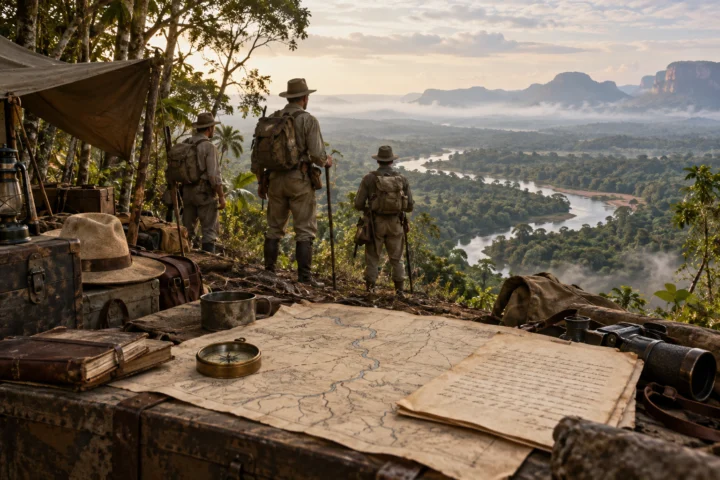
In 1925, British surveyor Percy Harrison Fawcett entered Brazil’s Mato Grosso with his son Jack and Jack’s friend Raleigh Rimell. They sought an ancient settlement Fawcett called “Z,” a hypothesis assembled from travel accounts, documents and his conviction that the Amazon had supported complex societies.
Fawcett deliberately kept the party small and withheld his intended route to discourage poorly prepared rescuers. From a camp remembered as Dead Horse Camp, he sent a final letter dated 29 May. It reported that the three were ready to proceed and expressed confidence. No authenticated later message from them survives.
The lack of a precise route widened every later search. Illness, injury, hunger, drowning and interpersonal violence are plausible in a difficult environment. Accounts that an Indigenous group killed or hosted the men vary by teller and date; treating any community as the default culprit repeats colonial assumptions rather than closing the evidence gap.
Claimed survivors, messages, objects and skeletons repeatedly attracted attention. Human remains examined in 1951 did not match Fawcett. No verified personal artefact or biological sample has established where the three died.
The case belongs with the failed search geometry of Amelia Earhart, documentary survival in the Franklin expedition, and the framework in search theory.
Claim, Context and Cautions
The last secure point
The final letter is a terminus for documentation, not a death certificate. Its attributed date, handwriting and expedition context constrain when the party was alive and where messages could still leave the interior. From there, route branches and elapsed time expand the possible area rapidly.
Fawcett's secrecy protected his project from imitators but made responsible rescue harder. Later maps often turn a broad intention into a falsely exact trail.
Claims after the disappearance
Search parties collected stories, objects and remains, often through translation and under intense publicity. A claimed sighting must be dated to when it was first recorded, separated from newspaper circulation and tested against travel time. A skull or tool needs biological or documentary association, not mere proximity.
The 1951 examination of alleged remains illustrates useful falsification: anatomical comparison failed to identify Fawcett, so the claim was rejected.
Z and real Amazonian archaeology
Research in the Upper Xingu has documented large settled landscapes with plazas, roads, ditches, managed soils and regional organisation. These findings overturn older ideas that tropical forest permitted only small, transient populations. They also depend on Kuikuro knowledge and continuing Indigenous landscapes.
They do not locate Fawcett's imagined city or prove he reached any archaeological complex. A broad premise can gain support while a specific expedition claim remains unverified.
A disappearance without a recoverable scene
Environmental hazards and the absence of later contact make death during the journey the simplest class of explanation. Whether disease, accident, starvation, conflict or several causes combined cannot be chosen from the surviving record. A sensational captivity story predicts later witnesses or objects that never formed a secure chain.
The ethical conclusion also matters. The Upper Xingu was not an empty wilderness waiting for discovery, and Indigenous people should not appear only as suspects in a European disappearance. Fawcett’s archive documents his ambition and final passage; archaeology documents deep local histories; neither supplies the missing final scene. The three men remain lost beyond the last reliable letter.
Contextual glossary
Terms used in this entry
Definitions are offered as reading aids, not as conclusions about the case.
- Search theory
- The use of probability, detection performance and resource planning to decide where and how to search. The search plan is revised as new evidence changes likely locations or detectability.
- Artefact
- An object made, modified or used by people. Its material, manufacture, wear and archaeological context are evidence; an unusual appearance alone does not establish an unusual age or origin.
Reference trail
Sources
- Royal Anthropological Institute, Fawcett Papers A69 (opens in a new tab)Archival catalogue documenting the disappearance, later investigations and examination of alleged remains.
- LaborHistórico, palaeographic analysis of a 1925 Fawcett note (opens in a new tab)Scholarly analysis of a document attributed to Fawcett’s final expedition.
- Museu Paraense Emílio Goeldi repository, Pre-Columbian Urbanism in the Upper Xingu (opens in a new tab)Research record for regional settlement and anthropogenic-landscape archaeology.
Case Book
Photographs, Maps and Supporting Images
Supporting images provide documentary, geographic or visual context. Read each caption for its date, source and evidential limits.

Continue researching
Follow the evidence, context and comparisons
Curated connections
Selected editorially for this entry.
The surviving radio and search record most directly supports fuel exhaustion and a sea crash near Howland. Castaway and capture theories remain possible narratives but lack confirmed physical evidence linking Earhart to another location.
Curated connection · Case fileThe Franklin Expedition: Wrecks, Testimony and a Fatal RetreatThe Franklin expedition was destroyed by a compound Arctic disaster rather than a single mysterious event. Inuit knowledge and archaeology have recovered its ships, while the exact movements and deaths of the crews remain incomplete.
Curated connection · ArticleSearch Without a Story: How Missing-Person Investigations Manage UncertaintyA practical guide to search theory: how planners separate likely location from detectability, update search areas and avoid turning an unsuccessful search into proof of an extraordinary disappearance.